virtio-win: what you build is unsigned by default, and the three signing tiers are not the same support promise
Windows paravirtualized drivers for QEMU\KVM
At a glance
- What is it?
- The C sources behind the Windows guest drivers for QEMU and KVM, shipped in the Fedora and RHEL RPMs and as ISO and VFD images. The page is mostly about signing: what you compile yourself will not load, what a cross-sign buys you, and what Microsoft asks you to change before you can submit.
- Who is it for?
- Take it as the source of record when you are building the drivers yourself, or when you want to know what signing tier a given RPM carries before deploying it. Skip it if you wanted a guest tools installer or a one line install, because the page sends you to the Fedora documentation for binaries and names no installer of its own.
- Can I use it commercially?
- Yes. BSD-3-Clause is a permissive licence: you can use, modify and sell software built on it, as long as you keep its copyright and licence notices.
- Is it still maintained?
- Yes. The repository last received commits 2 days ago.
- What is it written in?
- Mainly C, according to GitHub's language statistics.
Answers come from the project's GitHub data, last synced on November 15, 2026, and from our analysis. They are not legal advice.
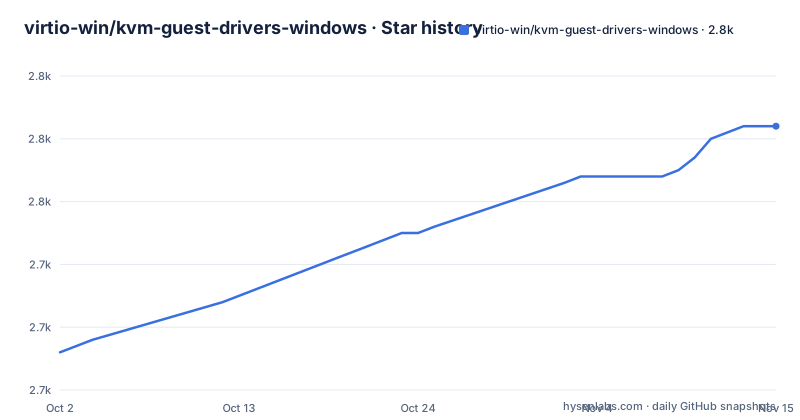
Star history
- virtio-win/kvm-guest-drivers-windows2,762 ★ · +36
| Repository | 2026-10-02 | 2026-11-15 |
|---|---|---|
| virtio-win/kvm-guest-drivers-windows | 2.7k | 2.8k |
36 Stars in the last 44 days, measured from the daily GitHub snapshot. Compare with other projects
Editorial analysis
What you compile will not load, and there are three ways out
The page is organized around signing, and the first case is the one every contributor hits. Build from source and the drivers come out either unsigned or test-signed with Tools/VirtIOTestCert.cer, and Windows will not load them by default. That leaves two documented exits. Cross-signed binaries, the kind that ship in the Fedora RPM, need your own code-signing certificate, work on all versions of Windows except the latest Windows 10 with secure boot enabled, and carry an explicit cost: systems with cross-signed drivers will not receive Microsoft support. Microsoft-signed binaries, described as fully supported and compared to the ones in the Red Hat Enterprise Linux RPM, require submitting the drivers to Microsoft with a set of test results. So the two RPMs named in the same paragraph are not the same thing, and which one you get decides your support position.
Microsoft asks you to change your Hardware IDs before submitting
The WHQL paragraph carries a request that is easy to skim past. Alongside the test results, the project asks that you make a change to the Hardware IDs so your drivers will not match devices exposed by the upstream versions of KVM and QEMU. The stated reason is that it matters especially if you plan to distribute the drivers with Windows Update, and the page links to Microsoft's publishing restrictions for the detail. Read as a mechanism, this is a separation measure: two driver sets claiming the same device IDs, differing only in who signed them, is exactly the situation that produces mismatched binaries and confused hardware identification, and renaming the IDs keeps the signed set distinguishable from the upstream one. It also means the change is in your source tree and has to be carried forward on every rebase, not applied once at submission time.
WHQL submissions have a licensing floor at commit eb2996de
If you decide to pursue the Microsoft-signed route, the page sets a specific commit as the base: make sure to base the drivers on commit eb2996de or newer, since the GPL license used prior to that commit is not compatible with WHQL. That sentence is the only record of a licence change on the page, and it lines up with two other facts. The license recorded for the project is BSD-3-Clause, and the root of the tree holds a LICENSE file rather than a copy of the GPL text. So the history implied by the page is a relicensing from GPL to the current terms, and the boundary is drawn at a commit hash that anyone submitting for signing has to respect. That constraint is also why the Fedora and Red Hat RPMs differ: the Fedora one carries cross-signed binaries without Microsoft support, and the Red Hat one carries the fully signed set.
Five build scripts at the root and six driver package definitions
The build surface is a set of batch files and a Visual Studio solution, all at the top level. There are five build entry points: buildAll.bat, build_AllNoSdv.bat, build_all_drivers.bat, build_cab.bat and build_sdv.bat, plus clean.bat for teardown and two more batch files tied to the signed path, RunSdv.bat and SDVTOOL.bat. The names alone separate two workflows: one build that includes the SDV stage and one that skips it, with the no-SDV variant spelled out in build_AllNoSdv.bat. Package definitions come in six files, win10_x86.ddf, win10_x64.ddf, win10_arm64.ddf and the matching three for win11, which is two operating system versions times three architectures including arm64. virtio-win.sln sits beside them as the solution the IDE opens, and the build page it points to is hosted externally and written against a specific Windows 11 24H2 EWDK.
Nineteen device directories, two of which are not devices
The source is one directory per device family: Balloon, NetKVM, Q35, VirtIO, fwcfg, fwcfg64, ivshmem, pciserial, pvpanic, stdvga, and ten prefixed with vio, which are viocrypt, viofs, viogpu, vioinput, viomem, viorng, vioscsi, vioserial, viosock and viostor. Two entries are not drivers in the ordinary sense. Q35 names a machine type rather than a device, and fwcfg and fwcfg64 are the firmware configuration interface in two word widths. Two more pairs are parallel implementations of the same job rather than separate hardware: pciserial beside vioserial for serial ports, and the virtio prefix naming against Linux side names where Balloon and NetKVM carry their upstream names unchanged. stdvga is the emulated display path rather than a paravirtual one, and pvpanic and viorng cover the panic and entropy interfaces. The page states that the drivers cover both paravirtual and emulated hardware, which is what that list is.
Three external sites, no install command, and no guest tools
Nothing on the page tells you how to install anything. If all you want is virtio-win in a Windows virtual machine, the instruction is to go to the Fedora virtIO-win documentation for information on obtaining the binaries, and building from source means following a hosted wiki page. The other two external destinations are Microsoft's pages on installing test-signed driver packages and on driver publishing restrictions. The formats named are the virtio-win RPM on Fedora and Red Hat Enterprise Linux, plus distribution-neutral ISO and VFD images. No guest tools package is mentioned, and the top-level entries have no directory for one, which matters because guest tools are a separate MSI that people search for alongside these drivers. The repository does carry its own Documentation directory, but the page routes all four topics outward rather than into it.
Tags moved from b302 to mm322, and the release title records the jump
The three most recent releases show a naming change rather than a steady series. The newest is mm324 on 2026-09-14, the one before is mm323 on 2026-09-10, and the third is titled b302 <--> mm322 on 2026-07-22, which records the mapping between the old b-prefixed scheme and the new mm-prefixed one. The gap before mm323 is seven weeks, and the gap after it is four days, so the cadence is irregular in both directions. The most recent commit recorded for the repository is dated 2026-09-27, two weeks after the mm324 tag, which means the tagged tree and the branch tip are not the same thing. For anyone tracking a specific build, the useful identifiers are the mm number and the date, since the release titles are not uniform: two of the three are plain mm numbers while the third carries the old-to-new mapping.
Editorial conclusion
Take it as the source of record when you are building the drivers yourself, or when you want to know what signing tier a given RPM carries before deploying it. Skip it if you wanted a guest tools installer or a one line install, because the page sends you to the Fedora documentation for binaries and names no installer of its own. Three checks before you build. Decide your tier first: unsigned or test-signed drivers do not load under default Windows settings, and the project says cross-signed builds do not receive Microsoft support. Base any WHQL submission on commit eb2996de or newer, because the licence before it was GPL and not compatible with the process. The project asks redistributors to change hardware IDs, especially when distributing through Windows Update; consult the linked Microsoft publishing restrictions.
Frequently asked questions
What are the latest virtio drivers for Windows?
In this repository the most recent release listed is mm324, dated 2026-09-14, following mm323 on 2026-09-10 and mm322 on 2026-07-22, whose title reads b302 <--> mm322. The last recorded commit is dated 2026-09-27, and the page sends readers to the Fedora virtIO-win documentation for obtaining the binaries.
Are the virtio-win drivers I build from source signed?
No. Drivers you build will be either unsigned or test-signed with Tools/VirtIOTestCert.cer, and the page states that Windows will not load them by default. Cross-signed drivers need your own code-signing certificate, and Microsoft-signed drivers require submitting to Microsoft with test results through the WHQL process.
Do cross-signed virtio-win drivers work on current Windows?
The page states that cross-signed drivers can be used on all versions of Windows except for the latest Windows 10 with secure boot enabled, and that systems with cross-signed drivers will not receive Microsoft support. The fully supported tier is the Microsoft-signed set that ships in the Red Hat Enterprise Linux RPM.
Why must a WHQL submission be based on commit eb2996de?
Because the GPL license used prior to that commit is not compatible with WHQL. The license recorded for the project is BSD-3-Clause and the tree holds a LICENSE file, so the page's note marks where the terms changed and where a signing submission has to start.
Where do I get virtio-win binaries without building them?
The page points to the Fedora virtIO-win documentation for obtaining them. They ship as part of the virtio-win RPM on Fedora and Red Hat Enterprise Linux, and are also available as distribution-neutral ISO and VFD images.
Does this repository contain the virtio guest tools?
Nothing on the page mentions a guest tools package. The top-level entries are driver directories such as NetKVM, viostor and viogpu, batch build scripts, solution and driver definition files, and the delivery formats named are the RPM, a distribution-neutral ISO and a VFD image.
Official sources
Add this badge to your README
If you maintain this project, the badge below links readers to this analysis and shows its maintenance status from the daily GitHub snapshot. Paste the markdown into your README; add ?metric=license or ?metric=stars to the image URL for a different field.

[](https://hysenlabs.com/projects/virtio-win-kvm-guest-drivers-windows)Star history chart for your README
[](https://hysenlabs.com/projects/virtio-win-kvm-guest-drivers-windows)Was this useful?