Machine Learning for Algorithmic Trading: Notebook Workflow and Limits
Machine Learning for Algorithmic Trading, Second Edition - published by Packt
At a glance
- What is it?
- PacktPublishing's Machine Learning for Algorithmic Trading, Second Edition is a large Jupyter Notebook companion for learning and prototyping an ML-driven trading workflow. Its educational breadth is clear, while the README does not document a production execution stack.
- Who is it for?
- Adopt this repository as a study and prototyping resource if you want the book's ML4T workflow represented in executable notebooks. Do not treat it as a ready-to-deploy trading system without verifying data licensing, notebook dependencies, data availability, backtest assumptions, and execution costs.
- Can I use it commercially?
- Yes. MIT is a permissive licence: you can use, modify and sell software built on it, as long as you keep its copyright and licence notices.
- Is it still maintained?
- Activity is slowing. The repository last received commits 6 months ago.
- What is it written in?
- Mainly Jupyter Notebook, according to GitHub's language statistics.
Answers come from the project's GitHub data, last synced on November 6, 2026, and from our analysis. They are not legal advice.
Star history
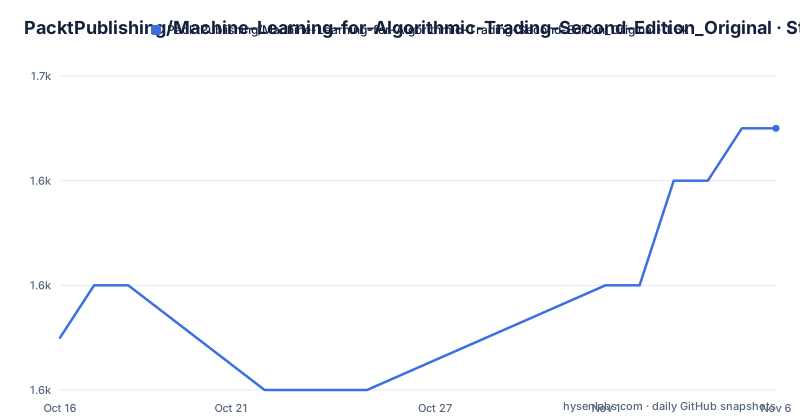
- PacktPublishing/Machine-Learning-for-Algorithmic-Trading-Second-Edition_Original1,649 ★ · +4
| Repository | 2026-10-16 | 2026-11-06 |
|---|---|---|
| PacktPublishing/Machine-Learning-for-Algorithmic-Trading-Second-Edition_Original | 1.6k | 1.6k |
4 Stars in the last 21 days, measured from the daily GitHub snapshot. Compare with other projects
Editorial analysis
What the ML4T Notebook Companion Is For
This repository is the notebook companion to Packt's Machine Learning for Algorithmic Trading, Second Edition. It is aimed at readers who want to connect machine learning methods with an algorithmic trading process rather than use a model as an isolated predictor. The README describes four parts spanning 23 chapters and an appendix, with coverage of market and fundamental data, financial feature engineering, long-short strategies, text signals, deep learning, generative models, and deep reinforcement learning.
The audience is narrower than a general machine learning course. A reader needs to understand the difference between a prediction and a trading decision, because the repository treats strategy design and backtesting as part of the workflow. The examples also cover different asset classes, international stocks, ETFs, and minute-frequency equity data. That breadth makes the material useful for comparing several kinds of financial data and modeling approaches, but it also means the repository is a large learning collection rather than one focused application.
The repository description identifies Jupyter Notebook as its primary language. The README says it contains more than 150 notebooks, usually in an executed state, and recommends reviewing them alongside the book. The notebooks therefore function as worked examples and extensions of the text. They are not presented as a packaged library, command-line application, broker integration, or managed service.
The ML4T Pipeline From Data to Backtest
The central design is an end-to-end workflow. It begins with a well-defined investment universe and an investment idea, then moves through data collection and feature extraction. A model is selected, trained, tuned, and evaluated for the predictive task. Its outputs are then treated as signals inside a trading strategy, and the strategy is simulated against historical data.
This ordering matters. A model that predicts returns does not automatically define position size, entry and exit rules, turnover, transaction costs, or portfolio construction. The README explicitly presents model optimization and strategy evaluation as connected stages. The `08_ml4t_workflow` directory reflects that emphasis, while `05_strategy_evaluation` gives strategy evaluation a separate place in the repository structure.
The data path is broader than a simple price table. The README names market data, fundamental data, SEC filings, earnings call transcripts, financial news, and image data. Other directories cover alternative data, alpha factors, text processing, topic modeling, and word embeddings. Deep learning examples include CNNs, RNNs, autoencoders for conditional risk factors, GANs for synthetic time series, and deep reinforcement learning. The intended data flow is data acquisition, feature representation, prediction or representation learning, signal extraction, strategy construction, and historical evaluation.
What the Repository Contains and How It Differs
The top-level directories make the repository easy to navigate by workflow stage. `01_machine_learning_for_trading/` contains introductory material, while `02_market_and_fundamental_data/` and `03_alternative_data/` separate conventional and alternative data. `04_alpha_factor_research/` focuses on factors, and `06_machine_learning_process/` covers the modeling process. Later directories move through linear models, time series models, Bayesian methods, decision trees, random forests, gradient boosting machines, unsupervised learning, text, topic modeling, word embeddings, and deep networks.
This organization differs from a general-purpose machine learning repository. The models are selected in the context of financial prediction and portfolio decisions. For example, time series and risk-factor material is organized around financial data rather than generic tabular datasets. The `24_alpha_factor_library/` directory is also significant because the README describes an appendix containing more than 100 alpha factors, although the cleaned README does not enumerate their definitions or usage instructions.
Compared with a conventional course based mainly on textbook exercises, this repository emphasizes reproducibility and research translation. It claims to show how to replicate recently published research and how to design and evaluate strategies. Compared with a production trading platform, however, the repository lacks the documented components required for continuous operation, such as a service interface, execution adapter, production monitoring, or deployment configuration.
Reading and Running the Notebook Examples
The README points readers to the notebooks and says they are usually in an executed state. It does not provide a complete installation guide, dependency list, Python version, environment file, or command for launching Jupyter. Although the repository contains an `installation/` directory, the README does not state which commands or files a new user should run from it.
The first real use is to obtain the repository or the associated book materials, locate the relevant chapter directory, and inspect the notebook before executing it. The README gives the book link, while the repository structure identifies the chapter folders. A reader should first confirm that any external data files referenced by a notebook are present, because the repository includes a `data/` directory but the README does not explain its contents or whether every example can run without separately obtained data.
A practical first pass is to open the workflow-oriented notebooks in `08_ml4t_workflow`, compare their inputs and outputs with the surrounding chapter, and then follow the related strategy evaluation material. The repository is primarily Jupyter Notebook content, so the execution environment is the notebook environment selected by the reader. The missing setup documentation is a real constraint, especially for a collection with more than 150 notebooks that may use different libraries and data sources.
Backtesting Boundaries and Evaluation Risks
Backtesting is a central benefit of the collection, not an incidental feature. The README says the notebooks demonstrate how to build, backtest, and evaluate a trading strategy driven by model predictions, and it describes a backtesting engine as part of the ML4T workflow. It also mentions minute-frequency equity data and long-short strategies, which implies that the examples consider more than a simple daily prediction task.
That scope does not eliminate the usual gap between historical simulation and live execution. The README does not document transaction-cost assumptions, slippage treatment, liquidity constraints, market-impact modeling, data survivorship controls, corporate-action handling, or brokerage integration. Those omissions matter because a strategy evaluation notebook can look complete while still depending on assumptions that are not visible in the top-level documentation.
The repository also includes synthetic time series generation and deep reinforcement learning. Those subjects can support research and experimentation, but the README does not claim that a learned trading agent is ready for autonomous deployment. The correct interpretation is narrower: the notebooks provide examples and methods for studying such strategies, not evidence that every example has been validated for real capital.
Maintenance, Licensing, and Upgrade Cost
The repository is not marked archived, and the last push was on 2026-04-22. There are no GitHub releases listed. That means the repository can receive repository changes without providing a release-based upgrade path in the repository description. Users should therefore inspect the commit history and notebook dependencies when updating their local copy, especially because the collection spans many libraries and data workflows.
The repository declares the MIT license. That declaration permits use and modification under the terms of the license, but it does not grant rights to the underlying financial data, book text, model outputs, or third-party assets. SEC filings and other market or alternative data may have separate terms. This is a licensing boundary rather than legal advice. A user who adapts the notebooks for a commercial system must check the permissions of every dataset and asset involved, not only the repository license.
Upgrade cost is likely to be uneven across the collection. A notebook that uses only local files may be straightforward to run, while an example involving external financial data can require separate access and may fail because a provider, path, or data format is unavailable. The README does not document a supported dependency matrix or a reproducible environment.
Editorial conclusion
Adopt this repository as a study and prototyping resource if you want the book's ML4T workflow represented in executable notebooks. Do not treat it as a ready-to-deploy trading system without verifying data licensing, notebook dependencies, data availability, backtest assumptions, and execution costs. The repository's last push was on 2026-04-22, and it is not archived, but the absence of GitHub releases means versioned upgrades are not documented there.
Frequently asked questions
What does Machine Learning for Algorithmic Trading, Second Edition contain?
The repository contains more than 150 Jupyter Notebooks accompanying the book. It covers market and fundamental data, feature engineering, alpha factors, text, deep learning, synthetic time series, reinforcement learning, strategy design, backtesting, and evaluation.
Does the README provide installation instructions for the notebooks?
No. The README does not provide a Python version, dependency list, environment setup, or Jupyter launch command. It does show that the repository has an `installation/` directory, but the README does not explain the files or steps in that directory.
Can I use these notebooks as a production algorithmic trading system?
The README describes notebooks for developing, backtesting, and evaluating strategies, but it does not document brokerage connectivity, deployment, monitoring, or live execution. The examples should be treated as educational and research material unless a separate implementation supplies those missing pieces.
Official sources
Add this badge to your README
If you maintain this project, the badge below links readers to this analysis and shows its maintenance status from the daily GitHub snapshot. Paste the markdown into your README; add ?metric=license or ?metric=stars to the image URL for a different field.

[](https://hysenlabs.com/projects/packtpublishing-machine-learning-for-algorithmic-trading-second-edition-original)Star history chart for your README
[](https://hysenlabs.com/projects/packtpublishing-machine-learning-for-algorithmic-trading-second-edition-original)Was this useful?