LIT's README carries a freshness marker dated sixteen months before the last push, and the pip install does not include the application
The Learning Interpretability Tool: Interactively analyze ML models to understand their behavior in an extensible and framework agnostic interface.
At a glance
- What is it?
- The Learning Interpretability Tool is a Google project for inspecting model behaviour across text, image and tabular data. Its README opens with a machine-readable review date from mid-2024, the package metadata declares production stability, the package index calls the tool by a different name than the project, the container builds on a third Python version than the manifest requires, and the two files that are supposed to be generated from each other disagree on one dependency.
- Who is it for?
- Use LIT if you need to look at why a model behaved the way it did rather than only at what it scored, and if you are prepared to build the application yourself rather than install a finished artefact. The questions it is built around are the right ones, and the extension points, a data loader, a model wrapper, a component, are small enough to wrap an existing model in an afternoon.
- Can I use it commercially?
- Yes. Apache-2.0 is a permissive licence: you can use, modify and sell software built on it, as long as you keep its copyright and licence notices.
- Is it still maintained?
- Yes. The repository last received commits 6 days ago.
- What is it written in?
- Mainly TypeScript, according to GitHub's language statistics.
Answers come from the project's GitHub data, last synced on November 23, 2026, and from our analysis. They are not legal advice.
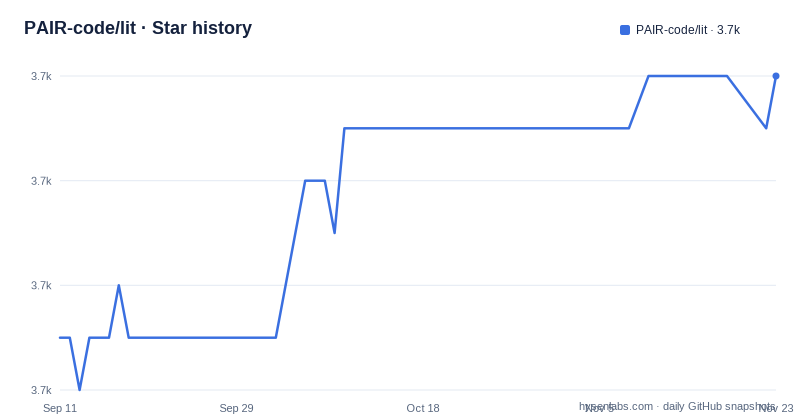
Star history
- PAIR-code/lit3,672 ★ · +5
| Repository | 2026-09-11 | 2026-11-23 |
|---|---|---|
| PAIR-code/lit | 3.7k | 3.7k |
5 Stars in the last 73 days, measured from the daily GitHub snapshot. Compare with other projects
Editorial analysis
The README opens with a freshness marker sixteen months before the last push
The second line of this README is a comment, and it is machine-readable.
It names an owning team and a review date, in a structured form that a tool could read. The date is the middle of 2024.
The last push to the default branch is dated September 2026, sixteen months later, and this repository is not archived. The newest release tag is from December 2024, ten months after the review date.
So the file declares its own staleness, precisely and in a format something could act on, and nobody has updated it. That is worth more than a maintenance badge in one respect: a machine could find this. It is worth less than a badge in another: a reader looking at the rendered page sees nothing at all.
The marker also tells you where to look for an answer. It names a team rather than a person, which for a project hosted under a research-organisation account and authored by a company means the review happened in one company's process rather than in the repository's own.
The pip install gives you the Python side, and the application still has to be built
The installation section has two halves, and they are not the same thing.
One command installs the package from the index. The README says that default install brings in everything needed for the Python API, the built-in interpretability components and the web application. Three more commands add extras for the demos and the test suite.
Then a note that changes the picture: the repository does not include a distributable version of the application, and you must build it from source.
The build is one line, and it is a JavaScript toolchain command run inside the package's own directory.
(cd lit_nlp; yarn && yarn build)So the claim that the default install gives you the web application is at odds with the claim that the application must be built. The most likely reading is that the pip package ships a prebuilt copy of the compiled application while the repository only ships its source, which is a common arrangement and a confusing thing to write down.
Either way, a contributor cannot clone, install and run. They clone, install, install a JavaScript package manager's dependencies, and build. The README even warns about a known package-manager bug on two Linux distributions, which is the kind of note you only write after hitting it twice.
Three Python versions, in three different files
Count the interpreter versions in this project and you get three answers.
The manifest requires a recent third version or newer. The README says the same in its install notes and offers a different environment manager for anyone who does not have it.
The package metadata's classifiers list one version-specific classifier, and it is a later minor than the floor. There is no classifier for the floor itself, which means a user on exactly the minimum version sees a package index page with no classifier claiming support.
And the container image is built on a third minor, newer than both.
So the declared floor, the declared support and the shipped runtime are three different versions, and the most likely practical outcome is that the floor works, because the tool is not trying to use anything new, and that the container is the only combination anybody has actually run.
The development-status classifier is worth reading alongside that: it declares the project to be at production or stable stage, which is a claim about the API rather than about the interpreter matrix.
The two files that are supposed to be generated from each other disagree
The dependency list exists twice, and the project has built a mechanism to keep them in step.
The manifest's dependency array is wrapped in a conditional-change pair that names the requirements file as the thing to edit when it changes. The requirements file wraps its own copy in the mirror pair, naming the manifest.
So a lint rule enforces the correspondence. Now compare the two lists.
Twenty-five of the twenty-six entries match exactly. One does not: the plotting library has a floor and a ceiling in the requirements file, and a different floor and no ceiling in the manifest.
That is the whole story of the mechanism. A file that exists to prevent this class of mistake has the mistake in it, which means either the rule is not running on every change, or it ran and was overridden, or one file was hand-edited.
Two other details make the arrangement clearer. Every entry has a floor and only two have ceilings, one being the numeric library pinned below its next breaking major release. For a tool whose job is loading arbitrary models into a process, refusing to work with the newest major of the array library is a considered choice rather than an oversight.
The production container installs the package from the index, not from the checkout
The container file has three stages and the middle one is the one that runs.
The base stage sets a home directory, installs build tools, and copies a single file from the examples directory: a configuration file for a WSGI server.
The production stage then installs the package from the package index with one of the extras, and sets the entry point to that WSGI server with that configuration file.
So the production image contains one file from the checkout, a server configuration, and a published package installed fresh. The source in the repository is not what runs in production.
That is a defensible decision. It makes the image reproducible against a published artefact, and it means the image does not silently change when a branch moves. It also means the image cannot be used to test a local change to the package, which is presumably why there is a third stage.
The development stage is the one that installs a JavaScript package manager by fetching its key over https and adding it to the machine's key store with a command that has been deprecated in Debian for years. It is also the stage that copies the requirements files, so the path from a source change to a running container goes through the stage with the deprecated step in it.
Production stability is declared for a tool whose last release is two years old
The package metadata makes a maturity claim, and the repository's own record argues against it.
The classifier says development status five, which is production or stable. That is the highest of the five levels and it is what a package index renders as a badge.
The newest release tag is from December 2024. The README's review marker is from June 2024. The last push is from September 2026, so the code is moving and the releases are not.
A stability classifier is a promise about breaking changes, not about activity, and a research tool can keep that promise while going a year without a release. So the two facts are not contradictory.
They are, however, in tension in the way a package index presents them. A user reading a badge that says stable, with a release date eighteen months old, has no way to tell whether the project is quiet or finished.
One more detail in the same metadata block: the project declares itself a JavaScript package as well as a Python one, which is accurate, and lists typing support, which given the classification is about the tool's own annotations rather than about the data it analyses.
Two keywords misspell a word, and one link in the README is missing a letter
Small things, all in the same file, all in the metadata rather than the prose.
The keyword list contains two misspellings of the word for artificial intelligence, in two separate phrases, one of which is the phrase most people would search for.
A keyword list is how a package is found. Two of this project's four keywords are misspelled, so they match nothing.
The README also carries a mailing-list link whose path is misspelled, missing a letter from announcements. That link is how readers are told to stay current with the project, and it goes nowhere.
Neither is fatal. Both are in the part of the file a machine reads rather than a person, which is exactly why they survive.
The same pattern appears in the naming. The project is called LIT, the repository is named after the organisation, the package on the index has a different name again, and the README notes in a parenthetical that the tool was formerly known by an earlier expanded name. Four names for one tool, and the one a user types into a package manager is the one that matches none of the others.
The quick start tells you to open the same address twice
The quick-start section is four paragraphs and one of them is a duplicate.
You run a demo module with a port and a quickstart flag, then navigate to a local address to reach the interface. That is the first instruction.
The section then describes what you will see: a small classifier fine-tuned on a sentiment dataset, and the ability to switch to a semantic-similarity benchmark or an inference benchmark using the toolbar or a settings icon in the upper right.
And then, after all of that, the same instruction again: navigate to the same address for the interface.
So the navigation step is given once before the reader knows what to expect and once after. It reads like a merge from two drafts of the section, where one draft ended with the instruction and the other added the description above it.
The rest of the quick start is careful. It names the exact module and flags, and the general example template repeats the same shape with a placeholder name, so a reader can copy any of the demos. It also offers hosted demos and notebook usage for people who would rather not start a server at all.
Editorial conclusion
Use LIT if you need to look at why a model behaved the way it did rather than only at what it scored, and if you are prepared to build the application yourself rather than install a finished artefact. The questions it is built around are the right ones, and the extension points, a data loader, a model wrapper, a component, are small enough to wrap an existing model in an afternoon. Three things to know before you plan around it. That there are two installs, because the package gives you the Python side and the web application has to be built separately from the same checkout. How current it is, because the README's own freshness marker names a review date from June 2024 while the last commit is from September 2026. And what its dependency floor means for you, because the package pins a numeric library below a breaking major release and an explanation library below a narrow ceiling, so an environment that already has newer versions will need work.
Frequently asked questions
What is the Learning Interpretability Tool?
It is a visual, interactive tool for understanding how a machine learning model behaves, supporting text, image and tabular data, and runnable either as a standalone server or inside notebook environments. It is built to answer what kinds of examples a model performs poorly on, whether a prediction can be attributed to adversarial behaviour or to undesirable priors in the training set, and whether behaviour stays consistent when textual style, verb tense or pronoun gender change. It is licensed under Apache 2.0 and authored by Google.
How do I install the Learning Interpretability Tool?
One package manager command installs the published package with its Python API, the built-in interpretability components and the web application, and three extras add the demo and test dependencies. However, the README also states that the repository does not include a distributable version of the application and that you must build it from source, which requires a JavaScript package manager and a build command run inside the package directory. A source install needs a recent third version of Python and an editable install with the test extra.
Which Python versions does the Learning Interpretability Tool support?
Three different answers across three files. The manifest requires a recent third version or newer, and the README repeats that floor. The package metadata lists only one version-specific classifier, a later minor than the floor, with no classifier for the floor itself. The container image is built on a third, newer, minor. The development-status classifier in the same block declares the project production or stable.
Does the Learning Interpretability Tool send data to a hosted service?
The base dependency set includes a cloud translation client, which is the one dependency in the list that reaches a hosted service. The documentation describes running the tool locally as a server or inside a notebook, and offers pre-built container images with accelerator support for generative and language-model use cases. The README does not discuss data residency, and the cloud client is installed by default rather than behind an extra.
How current is the Learning Interpretability Tool?
The README opens with a machine-readable comment naming an owning team and a review date of 2024-06-25. The newest release is from December 2024, and the last push to the default branch is dated 2026-09-29. The package metadata simultaneously declares a production or stable development status, so the rendered package page and the repository's own marker tell different stories about how much attention the project is getting.
Is this the same as the Lit JavaScript library?
No. The search terms around those names point at a web-components library, whereas this repository is a Python and TypeScript tool for model interpretability. Four names are in play here: the tool, its former expanded name noted in the README's parenthetical, the repository, and the published package, which matches none of the others. Two of the package's four keywords also misspell the word for artificial intelligence, so they match no search.
Official sources
Add this badge to your README
If you maintain this project, the badge below links readers to this analysis and shows its maintenance status from the daily GitHub snapshot. Paste the markdown into your README; add ?metric=license or ?metric=stars to the image URL for a different field.

[](https://hysenlabs.com/projects/pair-code-lit)Star history chart for your README
[](https://hysenlabs.com/projects/pair-code-lit)Was this useful?