Pathoschild's StardewMods: a monorepo of SMAPI mods
Mods for Stardew Valley using SMAPI.
At a glance
- What is it?
- The StardewMods repository holds a dozen or so SMAPI mods for Stardew Valley in one place, from the everyday quality of life ones to Content Patcher, which changed how mods replace game assets, with shared helper libraries and a shared test suite underneath them. It is the work of one author, MIT licensed, and each mod is released separately on ModDrop and Nexus.
- Who is it for?
- Adopt this repository if you play Stardew Valley with SMAPI, since the mods are individually published, widely used and cover the quality of life gaps that the game leaves open. It is not a library for developers, though the Common and Common.Patching projects and the shared test projects are the parts worth reading if you write mods of your own.
- Can I use it commercially?
- Yes. MIT is a permissive licence: you can use, modify and sell software built on it, as long as you keep its copyright and licence notices.
- Is it still maintained?
- Activity is slowing. The repository last received commits 6 months ago.
- What is it written in?
- Mainly C#, according to GitHub's language statistics.
Answers come from the project's GitHub data, last synced on November 7, 2026, and from our analysis. They are not legal advice.
Star history
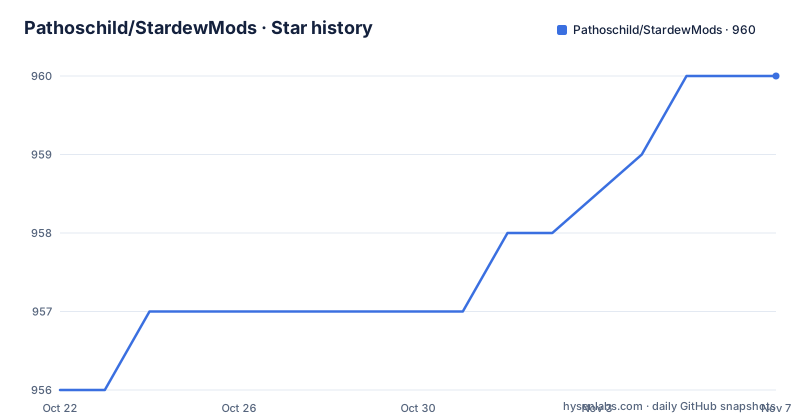
- Pathoschild/StardewMods960 ★ · +4
| Repository | 2026-10-22 | 2026-11-07 |
|---|---|---|
| Pathoschild/StardewMods | 956 | 960 |
4 Stars in the last 16 days, measured from the daily GitHub snapshot. Compare with other projects
Editorial analysis
What this repository is
The repository contains the author's SMAPI mods for Stardew Valley, and the README says to see the individual mods for documentation and release notes. That single sentence explains the structure. This is a monorepo of separate products rather than one application, and the top level listing shows one directory per mod, with Automate, CentralStation, ChestsAnywhere, Common.Patching, Common, ContentPatcher, CropsAnytimeAnywhere, DataLayers, DebugMode, FastAnimations, HorseFluteAnywhere, LookupAnything, NoclipMode, SkipIntro, SmallBeachFarm and TractorMod as the mod directories, and an _archived directory for the retired ones.
The build is a single Visual Studio solution, Pathoschild.Stardew.slnx, with a DotSettings file beside it, and the shared MSBuild configuration lives in Directory.Build.props and Directory.Packages.props, which is how a set of independent projects keeps one package version list and one set of compiler settings without each project repeating them.
The code is C#, and the licence is MIT with a LICENSE file at the root. The default branch is develop, which is the normal convention for a repository with a public release branch per mod, and the last push was on 2026-05-10. There are no GitHub releases attached, because the releases happen elsewhere, on ModDrop and on Nexus, and each mod's page is the place its version and its notes live.
The mod list itself is organised as active and inactive, and every entry links to its download page and to its source directory. That structure is the most useful thing in the README for anyone who wants to know what this project is, because it is a catalogue rather than a narrative.
The mods that change how other mods work
One entry is different in kind from the rest, and it is the one that has the largest effect on the modding community.
Content Patcher loads content packs that change the game's images and data without replacing XNB files. The README contrasts this with XNB mods directly: these content packs get automatic update checks and compatibility checks, they are easy to install and uninstall, and they are less likely to break due to game updates.
That last clause is the important one. The XNB format is the compiled asset format the game itself uses, so a traditional mod ships a replacement file that was built against a specific game version, and when the game updates, the replacement can stop matching. A content pack instead describes a change, in terms the game can apply to its own assets, so the description survives an update where the compiled file does not.
The second consequence is installation. A content pack is data rather than a binary replacement, so it can be installed and removed without touching the game's own files, and the update and compatibility checks are the kind of thing a framework can do and a loose file cannot.
So the practical shape of this repository is a set of small, single-purpose mods on top of a platform mod. The two directories that support that are Common, which holds shared code used across the author's own mods, and Common.Patching, which is the shared library for the content patching work. A third shared project, Common.Patching's sibling in the tree, supports the patch format used by the framework and by the mods built on it.
The mods that depend on the framework, such as Data Layers, which can include data from other mods, or the crops mod, sit on top of that shared layer, which is why the monorepo arrangement pays for itself.
The everyday quality of life mods
Most of the active mods are small changes to the game's friction points, and reading them together says something about what players actually want.
Chests Anywhere lets you access your chests from anywhere and organise them your way, transferring items without running around, from the comfort of your bed to the deepest mine level. It is a convenience mod in the classic sense, and it is the kind of thing that, once installed, is never removed.
Automate is the one that changes how the game plays rather than how it feels. You place a chest next to a machine, such as a furnace or a crystalarium, and the machine automatically pulls raw items from the chest and pushes processed items into it. Connect multiple machines with a chest to create factories. The wording is careful, machines and chests rather than a generic conveyor, and the factory metaphor is the point.
Tractor Mod lets you buy a tractor to till, fertilise, seed, water and harvest crops more efficiently, and to clear rocks.
Small Beach Farm replaces the riverlands farm with a fertile pocket beach, suitable for slower or challenge runs. It is a save-scoped content change, and it shows the platform doing work that would otherwise be a separate XNB mod.
Crops Anytime Anywhere grows crops in any season and location, including on grass and dirt tiles you normally could not till. That last clause is the interesting one, because the restriction is not a seasonal rule but a property of the tile, and the mod changes tile behaviour rather than the calendar.
Central Station is the mod that pulls in the others. It lets you travel to other mods' destinations by boat, bus or train, and you can get a ticket to the Central Station to change line, visit the gift shop and more. It is a hub for the wider mod scene, which tells you the ecosystem around this repository is bigger than the fourteen entries in the list.
The diagnostic and convenience mods
A second group of mods is about seeing and controlling the game rather than changing what it contains, and it is arguably the more interesting group for anyone learning what modding can do.
Lookup Anything shows live info about whatever is under your cursor when you press F1. The README lists what it will tell you, a villager's favourite gifts, when a crop will be ready to harvest, how long a fence will last, why your farm animals are unhappy. That is a debugger for game state, and the animal unhappiness example is the kind of thing that normally takes a wiki page and a lot of guessing.
Data Layers overlays the world with visual data such as accessibility information and bee, Junimo, scarecrow and sprinkler coverage, and it automatically includes data from other mods if applicable. The last clause is what makes it a platform feature rather than a tool: it reads from other mods' data and draws it in the same overlay, so a user of Data Layers gets a combined picture without configuring anything.
Debug Mode is a button that shows debug information and unlocks the game's built-in debug commands, including teleportation and time manipulation. The description of what an inactive sibling mod did is the point of comparison here, since No Debug Mode disabled SMAPI's F2 debug mode because it could cause unintended effects like skipping an entire season or teleporting into walls.
Noclip Mode toggles noclip at the press of a button, letting you walk through anything, even map boundaries. Skip Intro jumps straight to the title screen or load screen, and also skips the screen transitions, so starting the game is much faster. Fast Animations speeds up a list of specific animations, currently eating, drinking, milking, shearing and breaking geodes, with the speed configurable per animation.
Horse Flute Anywhere lets you use the horse flute to summon your horse anywhere, even indoors or in caves and dungeons.
Together these describe a modder's relationship with the game: not just new content, but instrumentation, and the removal of friction the developer left in for their own debugging convenience.
The inactive mods and what they teach about maintenance
Three entries are listed as inactive, and their descriptions are more interesting than they first appear.
No Debug Mode was deleted, because it disabled SMAPI's F2 debug mode, which can cause unintended effects like skipping an entire season or teleporting into walls, and it was no longer needed after SMAPI 1.0. So a mod was retired because the platform grew the feature and the mod's behaviour became a hazard.
The Long Night disabled collapsing, so you stayed awake forever and the night never ended until you went to bed. The README says it broke permanently in Stardew Valley 1.3.20. That is a game update changing something the mod depended on, and the mod is kept in the archive with a note rather than deleted.
Rotate Toolbar rotated the top inventory row for the toolbar by pressing Tab, and the note says it was added to the game in Stardew Valley 1.4.0. So the feature was upstreamed, and the mod has nothing left to do.
Those three cases cover the three reasons a mod ends: the platform absorbed it, the platform made it redundant, or a game update broke it. And the handling is consistent. The source stays in the _archived directory, the download link is struck through, and the reason is written in one line. Nothing is deleted, which is what makes the archive useful to anyone wondering why a familiar mod stopped working.
The source links point into _archived for these two, while No Debug Mode has no source link at all, because it was deleted rather than archived. So even the inactive list is not perfectly uniform, which is a small reminder that this repository is a working collection rather than a curated catalogue.
Translations, releases and the shape of the project
The translation section is a good example of a workflow being documented properly.
The mods can be translated into any language supported by the game, and SMAPI automatically uses the right translations, so a player gets their own language without the mod author maintaining a translation per language. Contributions are welcome, with a link to the modding wiki page for translation help.
The table that follows lists every mod against a set of languages, with a legend of a box for untranslated, a circular arrow for partly translated and a tick for fully translated. And there is a comment above the section saying it is auto-generated using a script, that there is no need to edit it manually, with a link to the create-translation-summary script in a separate repository, Pathoschild/StardewScripts. That is a small piece of engineering that saves an hour of manual table editing per release, and the comment tells contributors not to touch it.
The distribution model is the other thing to understand. Each mod is published on ModDrop and Nexus with its own page, its own version and its own release notes, and the README's instruction to see the individual mods for documentation and release notes is the whole story. There are no GitHub releases, so the repository is a source of truth rather than a channel.
The judgement is about what this is. It is not a framework for building mods, it is a collection of finished mods that share libraries and a test suite, written by one author over years, and the quality of the collection is the point. The shared test projects, Tests.Common, Tests.Mods, TestMod and TestDataLayersMod, are the sign of a codebase maintained like software rather than like a folder of scripts, and the fact that the author also wrote the platform mod that other people's mods build on is what makes the whole thing more than a list of downloads.
For a user, the practical advice is to install from the mod pages rather than from the repository, to check the inactive list if a mod you remember has stopped working, and to read the Content Patcher entry first, because several of the others assume it.
Editorial conclusion
Adopt this repository if you play Stardew Valley with SMAPI, since the mods are individually published, widely used and cover the quality of life gaps that the game leaves open. It is not a library for developers, though the Common and Common.Patching projects and the shared test projects are the parts worth reading if you write mods of your own. Before installing any of them, check which ones are active and which are archived, since the inactive ones are kept for history and one of them broke permanently with Stardew Valley 1.3.20, and note that the mods are published per mod rather than from this repository, so each one has its own version and its own release notes.
Frequently asked questions
What does the Pathoschild StardewMods repository contain?
It contains the author's SMAPI mods for Stardew Valley, one directory per mod, with shared helper libraries in Common and Common.Patching, shared test projects and a single Visual Studio solution. Each mod is documented and released separately, and the README directs readers to the individual mods for documentation and release notes.
What does Content Patcher do for Stardew Valley modding?
It loads content packs that change the game's images and data without replacing XNB files. Compared with XNB mods, those content packs get automatic update and compatibility checks, are easy to install and uninstall, and are less likely to break when the game updates.
Which mods in the repository are no longer active?
Three. No Debug Mode was deleted because it was no longer needed after SMAPI 1.0 and could cause unintended effects. The Long Night broke permanently in Stardew Valley 1.3.20. Rotate Toolbar was added to the game itself in version 1.4.0. Their sources are kept in the _archived directory.
How are translations handled for these mods?
The mods can be translated into any language the game supports and SMAPI automatically picks the right translation. The summary table in the README is generated by a script from the Pathoschild/StardewScripts repository, and the README says not to edit it by hand.
How do I install these Stardew Valley mods?
Each mod has its own download page on ModDrop and on Nexus, linked from the README, and each mod is released independently with its own version and release notes. The repository itself is the source code rather than the distribution channel.
Official sources
Add this badge to your README
If you maintain this project, the badge below links readers to this analysis and shows its maintenance status from the daily GitHub snapshot. Paste the markdown into your README; add ?metric=license or ?metric=stars to the image URL for a different field.

[](https://hysenlabs.com/projects/pathoschild-stardewmods)Star history chart for your README
[](https://hysenlabs.com/projects/pathoschild-stardewmods)Was this useful?