NotyKT architecture, Android builds, and adoption limits
📒 NotyKT is a complete 💎Kotlin-stack (Backend + Android) 📱 application built to demonstrate the use of Modern development tools with best practices implementation🦸.
At a glance
- What is it?
- NotyKT is a Kotlin reference application that pairs a Ktor REST API with Android clients built using both Navigation Architecture and Jetpack Compose. Its value is primarily as a worked example of a full-stack Kotlin project, not as a documented production-ready note service.
- Who is it for?
- Android developers should use NotyKT when they need a concrete Kotlin reference spanning a REST backend, two Android UI approaches, dependency injection, MVVM, coroutines, and tests. Teams needing a supported production note platform should not adopt it as their system of record.
- Can I use it commercially?
- Yes. Apache-2.0 is a permissive licence: you can use, modify and sell software built on it, as long as you keep its copyright and licence notices.
- Is it still maintained?
- Activity is slowing. The repository last received commits 6 months ago.
- What is it written in?
- Mainly Kotlin, according to GitHub's language statistics.
Answers come from the project's GitHub data, last synced on October 23, 2026, and from our analysis. They are not legal advice.
Star history
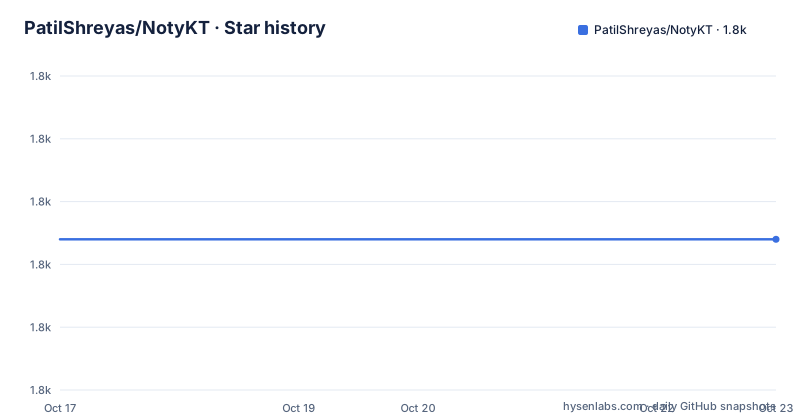
- PatilShreyas/NotyKT1,774 ★ · +0
| Repository | 2026-10-17 | 2026-10-23 |
|---|---|---|
| PatilShreyas/NotyKT | 1.8k | 1.8k |
0 Stars in the last 6 days, measured from the daily GitHub snapshot. Compare with other projects
Editorial analysis
What NotyKT demonstrates across Noty API and Noty Android
NotyKT addresses a narrow but useful problem for Android developers: showing how one Kotlin language can support both a server-side application and an Android client. The repository contains two named subprojects, `noty-api` and `noty-android`, rather than presenting a mobile app with an unrelated sample backend. That split makes the repository suitable for examining how a client and a REST service can live in one project without collapsing into one deployable component.
The intended audience is explicit in the README, which describes the project as a demonstration for Kotlin server-side development and modern Android tools. It is therefore closer to an architectural reference implementation than a finished commercial product. The repository description calls it a "complete Kotlin-stack" application, but the README does not define service levels, account administration, deployment procedures, data retention rules, or compatibility guarantees. Those omissions matter when judging whether it can serve as a production foundation.
The client also has a distinguishing scope. It implements UI through traditional Android Navigation Architecture and through Jetpack Compose. That makes it more useful for comparing two UI paths within one sample, but the top-level README does not explain whether both clients support identical feature sets or are intended for different demonstrations. Engineers adopting either path still need to inspect its own directory and current build configuration rather than infer parity from the repository overview.
The Ktor and Android data path behind NotyKT
Based on the repository layout, the architecture is split along a network boundary. `noty-api` is the REST API, built with Ktor and described as deployed on Heroku. `noty-android` consumes that API. The client directory represents the presentation and device-side application, while the API directory represents the separately deployable server.
The repository topics provide more detail about the client stack than the top-level README does. They include coroutines and Flow, Hilt for dependency injection, MVVM Android, Retrofit2 for REST access, View Binding, Testing, and the Navigation Architecture Component. Jetpack Compose appears as a separate topic. Together, these labels describe an Android architecture built around data transfer over REST, presentation state exposed through Kotlin abstractions, and dependency injection at application boundaries.
The top-level README does not include endpoint paths, request models, response models, database configuration, authentication rules, or synchronization behavior. It also does not state whether notes are stored locally on the device, in the Ktor service, or in both places. As a result, the confirmed architecture stops at the REST boundary. The README supports a claim that the Android application uses Noty REST API, but it does not support a more detailed sequence such as offline creation, background upload, conflict resolution, or account isolation. Those behaviors require direct inspection of the subproject source.
Two Android UI paths make comparison the main adoption reason
NotyKT offers two client UI implementations within `noty-android`: one using Android's Navigation Architecture and another using Jetpack Compose. This is the project's clearest technical differentiator for readers deciding which Android UI approach to study. A conventional View Binding client can help someone examine screen navigation and the older XML-oriented route, while a Compose client can serve as a reference for declarative UI code.
That comparison comes with a maintenance question. Two Android implementations can duplicate concepts, build logic, and state handling even when they target the same REST API. The repository topics list both View Binding and Jetpack Compose, but the top-level documentation does not say which is preferred for new work or whether both receive equal attention. An organization should avoid copying both clients into production merely because both are present.
The MVVM label adds another design layer. It suggests that presentation code is intended to sit between Android UI components and data sources, but the README does not provide a diagram explaining who owns state, how failures are surfaced, or where coroutines are canceled. The linked project documentation may contain more detail, yet no additional claims should be added beyond what the repository confirms. NotyKT is most useful for comparative code reading, not for making an architectural decision without opening both Android subprojects.
Installing the published Android builds
The documented installation route is a prebuilt APK from GitHub releases. The README publishes separate download URLs for the `Simple App` and the `Compose App`. They are identifiers rather than shell commands, so they should be used as download links in a browser or through the GitHub releases page. The project does not document APK signing details, minimum Android versions, supported device architectures, or emulator settings in the top-level README.
The first download URL is:
https://github.com/PatilShreyas/notykt/releases/latest/download/noty-android-simple.apkThis selects the latest release asset named `noty-android-simple.apk`. A reader who chooses the Simple App should expect the traditional Android UI described by the README.
The Compose build is available separately:
https://github.com/PatilShreyas/notykt/releases/latest/download/noty-android-compose.apkThis selects `noty-android-compose.apk`. The reader should see two different release assets rather than one APK being silently replaced by a variant.
Android device installation policy determines whether either APK can be opened directly after download. The README does not document an `adb` installation command, so none is included here. It also provides no verified sequence for creating, editing, or deleting a note. Start with one published APK, then consult the linked documentation at `https://patilshreyas.github.io/NotyKT/` for the client and API setup. If either app depends on a hosted Noty API, service availability becomes an immediate acceptance concern.
Kotlin stack breadth versus production operating evidence
NotyKT covers many parts of a Kotlin application, but breadth is not the same as operational maturity. The API and Android components are both present, and the repository metadata names specific technologies such as Ktor, Hilt, coroutines, Flow, MVVM, Retrofit2, View Binding, Compose, and Testing. That makes it a useful index of where to look for common Android implementation patterns.
The evidence is weaker for production operation. The README says the API is deployed on Heroku, yet it does not publish an uptime target, deployment process, observability configuration, backup policy, recovery plan, or rollback instructions. It also does not document database selection, secret management, request throttling, authentication, authorization, or data migration. For a note application, those omissions affect trust in note availability and isolation between users.
Testing is listed as a repository topic, but no test count or coverage claim is supplied. The build badges show CI workflows named for the API, Android build, and release, but badges alone do not establish which cases run on every change or whether release artifacts are reproducible. The repository was not archived, and the last push was on 2026-04-23. Its most recent listed release is `v3.0.0` from 2025-06-22. That indicates recent repository activity, but the README still provides no compatibility policy between releases.
Upgrade and licensing implications for engineering teams
NotyKT's upgrade surface includes at least two Android UI implementations, an Android data and presentation stack, and a separate Ktor API. A dependency update can therefore affect several layers, while changes to Retrofit models or API contracts can require coordinated work in both client and server. The repository's release history shows versions `v2.1.2`, `v2.2.0`, and `v3.0.0`, but the top-level README includes no migration guide or upgrade policy.
Teams must also account for the cost of replacing demo assumptions with their own infrastructure. The README does not specify persistent storage, secret configuration, deployment automation, or environment setup. It offers prebuilt Android downloads rather than a documented server installation procedure. As a learning project, that is manageable. As a service foundation, it requires additional design and operational work that cannot be estimated from the README alone.
The repository is licensed under Apache-2.0. The license grants use of the project under its terms and includes a copyright notice for Shreyas Patil. This review does not interpret the legal effect of that license. Teams still need to review `LICENSE`, preserve required notices where applicable, and check the licenses of separately obtained dependencies before distribution or commercial use.
Where NotyKT is preferable to a conventional notes stack
A conventional notes stack might pair a mobile application with a separately managed backend, a dedicated note database, and product-specific infrastructure. That approach can provide clearer ownership for deployment, authentication, backups, migrations, and monitoring. It is the better fit when the note service is an operational product rather than an educational sample.
NotyKT takes a different approach by placing a Ktor REST API and an Android application inside one repository, then presenting both traditional Navigation Architecture and Compose UI paths. This is preferable for learning how the pieces relate and for reading a reference implementation across Kotlin server and Android code. It also gives engineers a concrete project to compare dependency injection, MVVM, coroutine use, REST access, and UI implementation choices.
It is the wrong tool when the main requirement is offline-first editing, cross-device synchronization, encrypted storage, granular access control, auditability, proven export formats, or a maintained hosting service. None of those guarantees appears in the README. It is also a poor choice for teams unwilling to own the gap between demonstration code and production requirements. The project can serve as a starting codebase, but the README does not establish that those capabilities already exist.
Editorial conclusion
Android developers should use NotyKT when they need a concrete Kotlin reference spanning a REST backend, two Android UI approaches, dependency injection, MVVM, coroutines, and tests. Teams needing a supported production note platform should not adopt it as their system of record. Evaluate it first by checking whether the latest APK works with the referenced API, whether the subprojects remain aligned, and whether its demo structure matches the Android architecture you intend to maintain.
Frequently asked questions
What does NotyKT demonstrate?
NotyKT demonstrates a Kotlin stack spanning a Ktor REST API and Android clients. The Android side covers traditional Navigation Architecture and Jetpack Compose, along with topics such as coroutines, Hilt, MVVM, Retrofit2, and View Binding.
How do I install the NotyKT Android app?
The README links to prebuilt APKs in GitHub releases, with separate downloads for the Simple App and Compose App. It does not document APK signing requirements, minimum Android versions, or supported device architectures.
Does NotyKT include both a backend and an Android application?
Yes. The `noty-api` directory contains a Ktor REST API, while `noty-android` contains the Android application that uses it. The README describes the API as deployed on Heroku.
Official sources
Add this badge to your README
If you maintain this project, the badge below links readers to this analysis and shows its maintenance status from the daily GitHub snapshot. Paste the markdown into your README; add ?metric=license or ?metric=stars to the image URL for a different field.

[](https://hysenlabs.com/projects/patilshreyas-notykt)Star history chart for your README
[](https://hysenlabs.com/projects/patilshreyas-notykt)Was this useful?