Voxtype ships nine engines and twelve build Dockerfiles
Voice-to-text with push-to-talk for Wayland compositors
At a glance
- What is it?
- A Rust push-to-talk dictation daemon for Wayland compositors whose Cargo version and release tags disagree, whose KDE path cannot do hold-to-talk at all, and whose configure TUI can swap GPU binaries through pkexec.
- Who is it for?
- Voxtype is worth a look for anyone dictating on Linux all day, especially on Hyprland, Sway or River, where native key-release bindings exist and wtype does the typing. Three things should be settled first.
- Can I use it commercially?
- Yes. MIT is a permissive licence: you can use, modify and sell software built on it, as long as you keep its copyright and licence notices.
- Is it still maintained?
- Yes. The repository last received commits 1 day ago.
- What is it written in?
- Mainly Rust, according to GitHub's language statistics.
Answers come from the project's GitHub data, last synced on November 15, 2026, and from our analysis. They are not legal advice.
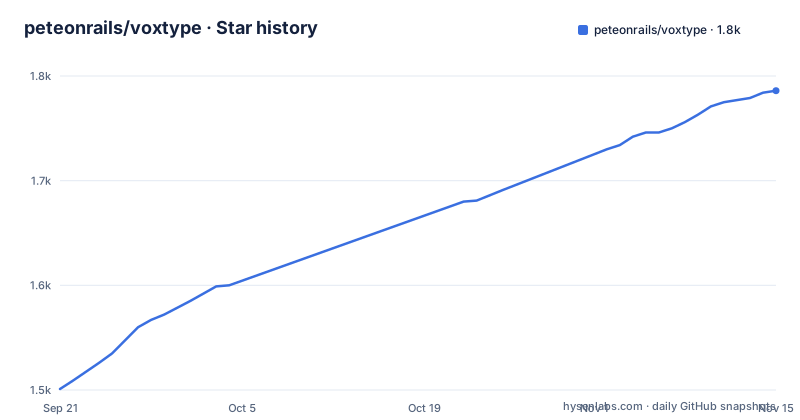
Star history
- peteonrails/voxtype1,786 ★ · +285
| Repository | 2026-09-21 | 2026-11-15 |
|---|---|---|
| peteonrails/voxtype | 1.5k | 1.8k |
285 Stars in the last 55 days, measured from the daily GitHub snapshot. Compare with other projects
Editorial analysis
Cargo.toml says 1.1.0, the newest tags say v1.1.1-rc5
Cargo.toml pins the crate at version 1.1.0, while the three newest tags are v1.1.1-rc3, v1.1.1-rc4 and v1.1.1-rc5, dated 2026-09-27, 2026-09-28 and 2026-09-30. The manifest has not moved onto the 1.1.1 line even though three candidates on it have shipped, and the default branch is dev rather than a release branch. The release titles carry more information than the numbers do. rc3 is named File Output on Timeout, transcribe --model, Config Reach. rc4 is Settings the TUI Lost, Early Cancel, One Meeting at a Time. rc5 is Instant Clipboard Output, From Transcripts Paste Again. Read those three lines as the changelog for the current cycle rather than looking for version numbers to tell you what changed.
Typing falls through four layers and ends at the clipboard
Output is a fallback chain rather than a single mechanism. Wayland typing goes through wtype first, with full CJK support, and when that layer is unavailable the chain continues to dotool, then ydotool, and finally the clipboard. A compositor with none of the three typing backends still produces text, but the user pastes it by hand instead of seeing it land at the cursor. The usage notes say exactly that, text appears at the cursor or in the clipboard if typing is not available. X11 takes a different route through an evdev fallback for the built-in hotkey, which defaults to ScrollLock. That fallback reads raw input devices, so it asks for membership of the `input` group with `sudo usermod -aG input $USER`, then a logout and a login.
KDE is the compositor that cannot do hold to talk
The README states plainly that KDE does not support key-release events, so push-to-talk is unavailable there and toggle mode is the only option, pressed once to start and once to stop. The binding then has to be created in System Settings under Custom Shortcuts with the command `voxtype record toggle`, and because the window manager now owns the binding, the built-in hotkey has to be switched off in `~/.config/voxtype/config.toml` with `[hotkey] enabled = false`. Compositors that do report release events bind the two halves directly. River, for example:
riverctl map normal Super V spawn 'voxtype record start'
riverctl map -release normal Super V spawn 'voxtype record stop'
A second trap sits with multi-modifier bindings such as SUPER+CTRL+X, where releasing the keys slowly can let typed text trigger a window manager shortcut instead of inserting. The troubleshooting guide points at output hooks and Hyprland submaps for that case.
Twelve Dockerfiles stand in for a hardware matrix
The build matrix is encoded as files rather than as flags. Twelve Dockerfiles sit at the root: Dockerfile.baseline, Dockerfile.build, Dockerfile.aarch64-cpu, Dockerfile.aarch64-onnx, Dockerfile.avx512, Dockerfile.onnx, Dockerfile.onnx-avx512, Dockerfile.onnx-cuda-12, Dockerfile.onnx-cuda-13, Dockerfile.onnx-export, Dockerfile.onnx-migraphx and Dockerfile.vulkan, alongside docker-compose.build.yml. That split lines up with the hardware claims: separate CUDA 12 and CUDA 13 binaries per NVIDIA driver generation, MIGraphX 7.2 for Radeon, Vulkan for Whisper across vendors, and OpenVINO IR for Intel NPU acceleration on Lunar Lake. Release binaries are signed, and the trust note attributes them to a reproducible Docker pipeline. There is no single portable image, so choosing the wrong one of twelve is the first mistake available here. The source path is a separate route with its own cost: build dependencies installed per distro first, then `cargo build --release`, then `./target/release/voxtype setup --download` to fetch a model. Most users are pointed away from that and toward a pre-built package, with AUR packages named voxtype, voxtype-bin and voxtype-bin-rc for people who want pre-release builds, alongside .deb, .rpm and Homebrew on macOS.
The configure TUI can escalate through pkexec
`voxtype configure` is an interactive TUI that edits `~/.config/voxtype/config.toml` so nobody has to hand-edit TOML. Alongside the file edits it downloads missing models, swaps GPU binaries, and restarts the daemon when needed. The swap goes through pkexec, which means the settings screen can raise a polkit authentication prompt and replace a binary on disk while you are working through a menu. The same screen surfaces inside Walker, fuzzel and rofi, so that privileged path can be entered from a launcher instead of a terminal. Config reach was itself a release candidate item in rc3. Worth knowing before binding a global hotkey to a command that can escalate, because the escalation sits inside a settings screen rather than behind a flag you opt into.
Nine engines, two of which are Whisper
Nine engines are offered: Whisper, Parakeet, Moonshine, SenseVoice, Paraformer, Dolphin, Omnilingual, Cohere and OpenVINO Whisper, so Whisper appears twice, once standalone and once through the OpenVINO runtime. The headline number belongs to Cohere Transcribe, at 9 to 11 times realtime quantized to 1.5 GB under q4f16 on a plain Zen 4 CPU, with punctuation, capitalization and inverse text normalization included, sitting at number one on the Open ASR Leaderboard. Memory is not the sum of all nine, because models load on first use and unload when idle. Switching is a config line or the TUI, and that stays cheap for a mechanical reason: Cargo.toml pulls in strum with serialize_all, so a new engine variant takes its lowercase config name automatically instead of a hand-written match block. Text handling sits alongside the engines rather than behind a flag. Spoken punctuation turns the word comma into a comma mark, per-user replacement tables fix common mistranscriptions, and an optional post-processing pipe hands the result to any LLM or shell script. The examples directory ships cleanup scripts named examples/gemini-cleanup.sh, examples/openai-cleanup.sh, examples/ollama-cleanup.sh and examples/swedish-chef.sh, which is the shape that pipe takes in practice. The crate itself declares twenty-six authors and two categories, multimedia::audio and accessibility.
Meeting mode, and a daemon that holds your terminal
Meeting mode handles long recordings with continuous transcription, automatic chunking, speaker attribution, and export to Markdown, JSON, SRT or VTT:
# Start a meeting
voxtype meeting start --title "Weekly standup"

# Check status
voxtype meeting status

# Stop and export
voxtype meeting stop
voxtype meeting export latest --format markdown --speakers -
Outside meeting mode the lifecycle is simpler. `voxtype` runs as a foreground daemon, you hold the hotkey, speak, and release, and Ctrl+C stops it. Nothing in the running instructions installs a service entry or an autostart rule, so the daemon occupies a terminal unless your compositor starts it for you. Toggle mode and optional audio cues cover the other preference. Voxtype also talks to MPRIS clients while dictating, auto-pausing Spotify and Plasma media players when recording starts and resuming on release, and it draws its level meter into the same band as swayosd so the feedback lands where volume and brightness already do.
One dependency outside the nine engines
The engine list and the dependency list do not fully agree. Alongside cpal for audio capture, hound for WAV reading and writing, and ureq with its json feature as the HTTP client for remote transcription, the manifest annotates a WebSocket client as the client for a Soniox streaming backend. No Soniox engine appears in the list of nine, and nothing in the overview says how a streaming backend differs from the file-based engines around it. The trust note does allow optional remote Whisper servers when you want them, so reaching outside the machine is a supported direction, just not one the engine list enumerates. Read the manifest before assuming those nine names are the whole set of back ends.
Editorial conclusion
Voxtype is worth a look for anyone dictating on Linux all day, especially on Hyprland, Sway or River, where native key-release bindings exist and wtype does the typing. Three things should be settled first. It is a foreground daemon you stop with Ctrl+C, not something that installs a service. Its nine engines are spread across twelve Dockerfiles, so you pick the image that matches your GPU rather than a portable one. And the configuration TUI can escalate through pkexec to swap a binary, which is worth knowing before you bind it to a global hotkey. KDE users should read the key-release limitation before expecting push-to-talk to work there.
Frequently asked questions
how to use voxtype
Run `voxtype` as a foreground daemon, hold the hotkey, which defaults to ScrollLock, speak, and release so the text is typed at your cursor. Press Ctrl+C to stop the daemon. On KDE, where key-release events are not supported, use toggle mode with `voxtype record toggle` instead.
what is voxtype
A push-to-talk voice-to-text daemon for Linux and Wayland compositors, written in Rust and MIT licensed. It runs nine transcription engines locally, including Whisper, Parakeet, Cohere and OpenVINO Whisper, and states no cloud, no subscription and no telemetry by default.
vox type alternative
The README does not name substitutes for voxtype. It positions voxtype against hosted dictation instead: local by default, no cloud, no subscription, no telemetry, with optional remote Whisper servers available when you want them.
Official sources
Add this badge to your README
If you maintain this project, the badge below links readers to this analysis and shows its maintenance status from the daily GitHub snapshot. Paste the markdown into your README; add ?metric=license or ?metric=stars to the image URL for a different field.

[](https://hysenlabs.com/projects/peteonrails-voxtype)Star history chart for your README
[](https://hysenlabs.com/projects/peteonrails-voxtype)Was this useful?