PINTO_model_zoo: pre-quantized models with a LICENSE inside every folder
A repository for storing models that have been inter-converted between various frameworks. Supported frameworks are TensorFlow, PyTorch, ONNX, OpenVINO, TFJS, TFTRT, TensorFlowLite (Float32/16/INT8), EdgeTPU, CoreML.
At a glance
- What is it?
- PINTO_model_zoo stores neural network models converted between TensorFlow, PyTorch, ONNX, OpenVINO, TFJS, TFTRT, TensorFlow Lite, EdgeTPU, and CoreML, one numbered folder per model. It ships weights rather than verification code, each folder carries its own LICENSE because the weights keep their upstream terms, and the README still flags two model families as returning incorrect results.
- Who is it for?
- PINTO_model_zoo suits someone who already knows which model and which target runtime they need, and who reads a folder's LICENSE before shipping the file. It does not suit someone shopping for a model by format alone: the table records which conversions exist but not whether they still work, two families are called out as returning incorrect results, and no verification code comes with the weights.
- Can I use it commercially?
- Yes. MIT is a permissive licence: you can use, modify and sell software built on it, as long as you keep its copyright and licence notices.
- Is it still maintained?
- Yes. The repository last received commits 30 days ago.
- What is it written in?
- Mainly Python, according to GitHub's language statistics.
Answers come from the project's GitHub data, last synced on November 22, 2026, and from our analysis. They are not legal advice.
Star history
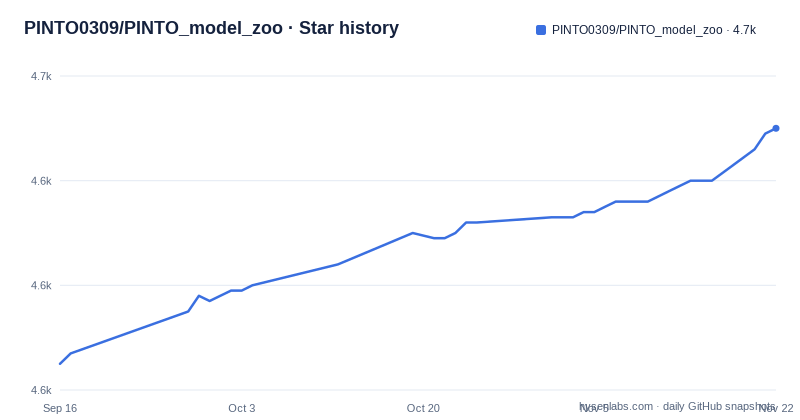
- PINTO0309/PINTO_model_zoo4,650 ★ · +45
| Repository | 2026-09-16 | 2026-11-22 |
|---|---|---|
| PINTO0309/PINTO_model_zoo | 4.6k | 4.7k |
45 Stars in the last 67 days, measured from the daily GitHub snapshot. Compare with other projects
Editorial analysis
Every model folder has its own LICENSE file
The first instruction in the README is about licensing rather than downloading: read the contents of the LICENSE file located directly under each folder before using the model. The reason given is a split between two licenses. The conversion scripts are released under the MIT license, but the license of the source model itself is subject to the license of the provider repository. So the MIT grant covers the tooling that produced the files, not the weights sitting next to it. The consequence for anyone shipping one of these models is that they have to open the folder, read the file inside it, and trace it back to the provider's terms, because no single file in this repository answers the question for the model they picked.
The numbering is the index, and submodules carry some folders
There is no manifest and no package list at the root. There is a sequence of numbered folders, one per model or paper, running at the top level from 001_deeplabv3 and 002_mobilenetv3-ssd through 003_posenet, 004_efficientnet, 016_EfficientNet-lite, and onward to 057_BiSeNetV2. Beside them sit .github/, .gitignore, and .gitmodules. That last file is the one with consequences for a clone: a submodule means some content is pulled in from another repository rather than stored here, so what a checkout gives you depends on the submodule commits it resolves. You navigate this zoo by folder number rather than by name search, and a folder whose contents look missing may simply be a submodule nobody initialized.
The model table's columns are decoded only by a four-line legend
The list of pre-quantized models is a wide table whose columns run No., Model Name, Link, FP32, FP16, INT8, DQ, TPU, WQ, OV, CM, TFJS, TF-TRT, ONNX, and Remarks. Four abbreviations are explained only in the legend beneath it: WQ is Weight Quantization, OV is OpenVINO IR, CM is CoreML, and DQ is Dynamic Range Quantization. Everything else in the header names the thing directly. The consequence is that the header is unreadable on its own, since the OV and CM columns encode OpenVINO IR and CoreML without spelling either out, and a reader has to hold the legend in mind while scanning.
MobileNetV3 and full integer quantization are called out as wrong
Two dated notes sit above the model list. The first, dated January 05, 2020, states that the MobileNetV3 backbone model and the Full Integer Quantization model do not return correctly. That is a defect report about two of the things this repository exists to distribute, and the table rows such as 004 Efficientnet and 010 Mobilenetv3 simply record which formats are present without repeating it. The consequence is that a reader choosing by table cannot see the warning at all, and a reader choosing by folder number learns the same thing the author did: from a sentence near the top of the page that carries a 2020 date.
The Raspberry Pi gap is 32-bit versus 64-bit, worth four times
The second note, dated January 08, 2020, is about the platform rather than the model. For the best performance with RaspberryPi4 and 3 it says to install Ubuntu 19.10 aarch64 (64bit) instead of Raspbian armv7l (32bit), on the grounds that the official Tensorflow Lite is performance tuned for aarch64, and it claims that on aarch64 the performance is about 4 times higher than on armv7l. The consequence is that the same converted file can be several times slower purely because of the word size of the operating system image, which makes the hardware note in this repository a note about which OS you install rather than about which quantized model you download. It also names Ubuntu 19.10, a release that has been gone for years.
No verification code ships, and the README asks for it
On the subject of checking the output the README is direct about a gap. The author says they have been working on quantization of various models as a hobby, but skipped the work of making sample code to check the operation because it takes a lot of time, and welcomes a pull request from volunteers to provide sample code. The consequence is that what you download is a set of weights with no reference script proving they still work on your runtime, so you either write the inference check yourself or you take the folder on trust. The top level offers nothing to fill that gap, since it holds numbered model folders and dotfiles with no test or verification directory among them.
The conversion tools live in sibling repositories
Much of the README's opening is a link list to the author's other projects, and that is where the conversion work actually happens. openvino2tensorflow converts a PyTorch to ONNX to OpenVINO IR model into TensorFlow saved_model, h5, tflite, or pb. onnx2tf converts ONNX NCHW models to TensorFlow NHWC and exists, in the author's words, to solve the massive Transpose extrapolation problem in onnx-tf. tflite2tensorflow generates saved_model, tfjs, tf-trt, EdgeTPU, CoreML, quantized tflite, ONNX, OpenVINO, and .pb files from a .tflite. Alongside sit onnx2json, json2onnx, and a family of ONNX tools for splitting, merging, node deletion, size compression, attribute and constant rewriting, op generation, and opset changes. The consequence is that the general-purpose converters live in those sibling repositories rather than here.
Two framework lists disagree, and MediaPipe appears in one
Which runtimes are covered is stated twice, in different forms. One sentence names TensorFlow, PyTorch, ONNX, OpenVINO, TFJS, TFTRT, TensorFlowLite (Float32/16/INT8), EdgeTPU, and CoreML. Another line reads TensorFlow Lite, OpenVINO, CoreML, TensorFlow.js, TF-TRT, MediaPipe, ONNX, followed by the file extensions the conversions produce:
.tflite
.h5
.pb
saved_model
tfjs
tftrt
mlmodel
.xml/.bin
.onnx
MediaPipe is in the second list and not the first, and EdgeTPU is in the first while no extension in the second is named after it. The consequence is that the list of what this zoo actually covers is not settled by the README alone, and that a person hunting for a MediaPipe bundle has to read both lines and notice the difference.
Editorial conclusion
PINTO_model_zoo suits someone who already knows which model and which target runtime they need, and who reads a folder's LICENSE before shipping the file. It does not suit someone shopping for a model by format alone: the table records which conversions exist but not whether they still work, two families are called out as returning incorrect results, and no verification code comes with the weights. Before you rely on a file, read the LICENSE in that folder, check the two January 2020 notes against your choice, and plan to write your own inference check.
Frequently asked questions
What is PINTO_model_zoo?
It is a repository for storing models that have been inter-converted between frameworks: TensorFlow, PyTorch, ONNX, OpenVINO, TFJS, TFTRT, TensorFlowLite (Float32/16/INT8), EdgeTPU, and CoreML. Each model sits in its own numbered folder, and the README asks you to read the LICENSE file directly under that folder before using it.
Which license applies to a model in PINTO_model_zoo?
The conversion scripts are released under the MIT license, but the license of the source model itself is subject to the license of the provider repository. The terms come from the LICENSE file inside each model folder and from that provider, not from the repository's own MIT grant.
Are the quantized models in PINTO_model_zoo verified to work?
Not by the repository itself. The author says making sample code to check the operation was skipped because it takes a lot of time, and invites pull requests providing it. A note dated January 05, 2020 also says the MobileNetV3 backbone model and the Full Integer Quantization model do not return correctly.
Official sources
Add this badge to your README
If you maintain this project, the badge below links readers to this analysis and shows its maintenance status from the daily GitHub snapshot. Paste the markdown into your README; add ?metric=license or ?metric=stars to the image URL for a different field.

[](https://hysenlabs.com/projects/pinto0309-pinto-model-zoo)Star history chart for your README
[](https://hysenlabs.com/projects/pinto0309-pinto-model-zoo)Was this useful?