pnpm: one content-addressable store, three CLI trees, and a 2x speed claim
Fast, disk space efficient package manager
At a glance
- What is it?
- pnpm is a disk space efficient package manager whose CLI is being rewritten in Rust inside a repository that still carries its old pacquet name. The mechanism that makes it fast and small is also the one that breaks code which reaches for undeclared dependencies.
- Who is it for?
- Adopt pnpm when disk use across many checkouts and a lockfile-gated install matter more than the flat node_modules layout that some tooling assumes. Read pnpm.io/feature-comparison before moving a monorepo, measure the install on your own repository rather than quoting the 2x line, and confirm that nothing in your dependency tree reaches outside its own package.json.
- Can I use it commercially?
- Yes. MIT is a permissive licence: you can use, modify and sell software built on it, as long as you keep its copyright and licence notices.
- Is it still maintained?
- Yes. The repository received new commits within the last day.
- What is it written in?
- Mainly Rust, according to GitHub's language statistics.
Answers come from the project's GitHub data, last synced on November 15, 2026, and from our analysis. They are not legal advice.
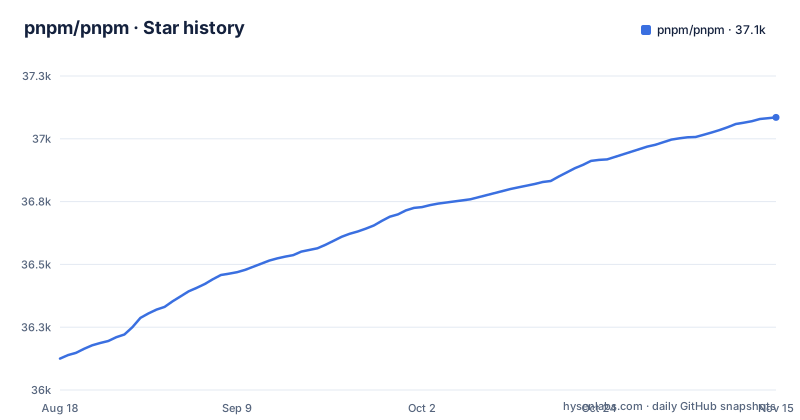
Star history
- pnpm/pnpm37,085 ★ · +960
| Repository | 2026-08-18 | 2026-11-15 |
|---|---|---|
| pnpm/pnpm | 36.1k | 37.1k |
960 Stars in the last 89 days, measured from the daily GitHub snapshot. Compare with other projects
Editorial analysis
A single content-addressable store is what makes node_modules deduplicate
pnpm's central mechanism fits in one sentence: files inside `node_modules` are linked from a single content-addressable storage. The consequence is that a package stored once is reused by every project that asks for it, so a machine with many checkouts pays for one copy of a dependency instead of a copy per checkout. Resolution is pinned by `pnpm-lock.yaml`, and pnpm holds itself to the same rule while building pnpm, since the root justfile installs with
pnpm install --frozen-lockfile --prefer-offlineA contributor who edits a manifest without regenerating the lockfile gets a hard failure instead of a silent resolution change, and the prefer-offline flag makes a warm store the fast path.
Declared dependencies and pnpm’s isolated layout
pnpm uses an isolated node_modules layout that encourages packages to declare their dependencies in package.json. Under a flat node_modules, a library that forgets to declare something may work because another package hoisted it into the same directory. With pnpm, an undeclared import may fail depending on the layout and hoisting configuration. Check build plugins, test helpers and CLI tools for undeclared dependencies before migrating a workspace; pnpm also offers hoisting options for compatibility.
The TypeScript CLI, Rust port and registry server share one repository
The repository contains the TypeScript pnpm CLI, an experimental Rust port called pacquet, and the Rust pnpr registry server. The tree holds `pnpm/`, `pnpm11/`, and `pnpr/` next to `pnpm-workspace.yaml`, and the Cargo workspace confirms the split with members `pnpm/crates/*`, `pnpm/tasks/*`, and `pnpr/crates/*`. Its dependency list names the moving parts one by one: `pnpm-cli`, `pnpm-matcher`, `pnpm-crypto-hash`, `pnpm-crypto-shasums-file`, `pnpm-env-installer`, `pnpm-env-replace`, `pnpm-cmd-shim`, `pnpm-auth-commands`, `pnpm-cargo-resolver`, a family of `pnpm-catalogs-*` crates, a `pnpr` client, and four engine resolvers covering yarn, node, bun, and deno. The naming has not caught up with the code. The README still calls the Rust port pacquet and labels it experimental, and the Cargo workspace description field reads `Pacquet` with a homepage of github.com/pnpm/pacquet. A newcomer searching for pacquet finds working code and inherits a name the project has moved beyond. The repository is MIT licensed, is not archived, and its last push is dated 2026-11-02, so the rename is in flight rather than settled. Version drift runs alongside it: the runtime link points at the 11.x documentation, the newest releases listed are v12.17.0 and v11.28.10, both dated 2026-10-30, so the 11.x and 12.x lines are both being released.
The 2x claim points at a benchmark the README does not print
The first bullet says pnpm is up to 2x faster than the alternatives, then hands the evidence to an anchor labelled benchmark. The qualifier up to makes the headline a ceiling rather than an expected result. A second piece of evidence arrives as a testimonial instead: the Rush team is quoted saying Microsoft uses pnpm in Rush repos with hundreds of projects and hundreds of PRs per day, and has found it very fast and reliable. That is a claim about one large deployment, not a number you can compare with your own repository. The sponsor tables add a third kind of signal, listing bit.cloud, openai, notion, coderabbit, and cloudflare as platinum sponsors and sanity, discord, vite.dev, serpapi, stackblitz, workleap, nx.dev, latitude.so, and syntax.fm among the gold sponsors. Every one of those links carries a `utm_source=pnpm` parameter, which is what funding looks like in a README. Run the install on your own tree before you repeat the speedup to anyone.
Building the Rust CLI means binstalling eight tools and compiling a ninth from source
Working on the Rust side starts with the justfile `init` recipe, and the recipe is itself a description of the toolchain surface. It expects cargo-binstall to be present already, then installs the test runner, watcher, snapshot tester, spell checker, TOML formatter, and build tooling in one line:
cargo binstall cargo-nextest cargo-watch cargo-insta typos-cli taplo-cli wasm-pack cargo-llvm-cov [email protected] -yOne tool cannot be fetched prebuilt, and the file says so, so it is installed from source at a locked version:
cargo install [email protected] --lockedA formatting wrapper follows with `node pnpm/scripts/rustfmt.mjs --install`. For a new contributor this means a source compile of a linting tool happens before you have read a line of package-manager logic. The same discipline shows in the check step, which refuses to move the lockfile and covers every target:
cargo check --locked --workspace --all-targetsThe release binary itself is produced by `cargo build --release --bin pnpm`.
just ready runs six steps and ends by printing your working tree
The default recipe lists recipes rather than building anything, running `just --list -u`, with `r`, `c`, and `t` aliased to ready, codecov, and test. The ready recipe is the clearest statement of the project's own quality bar, because its comment says it runs the same commands as continuous integration:
typos pnpm pnpr
node pnpm/scripts/rustfmt.mjs --all
just check
just test
just lint
git status
Six steps, and the last one hands control back to you by printing the working tree, so a formatter that rewrites files cannot make the run look clean. The typo check covers two source trees, pnpm and pnpr. The neighbouring recipes show where the edges are. `update` is `git pull` followed by `git submodule update --init`, with a comment saying it exists to sync the submodules, so a plain pull leaves the tree incomplete. The watch recipe needs a flag to route around a tool bug:
cargo watch --no-vcs-ignores -x '{{command}}'The file explains that cargo-watch loads every .gitignore including the ones listed in .gitignore, hence the override. The test recipe also warns that a killed test process cannot run `TempDir` cleanup, so an interrupted run abandons its temporary directories; the package.json scripts also call `shx rm -rf ../pnpm_tmp` before the suites run.
The README carries no install command, no Node floor, and no failure catalog
The README links out to the website, where the workspaces guide, the feature comparison with npm and Yarn, and the runtime page live. It also carries a self description as battle tested in production by teams of all sizes since 2016, a platform line for Windows, Linux, and macOS, a role as a Node.js version manager, and the Rush quotation reproduced as a brokered endorsement. The package.json hints at how much of the real workflow lives elsewhere, with the test scripts comparing against origin/main through `git remote set-branches --add origin main` and filtering with `--filter=...[origin/main]`. Practical consequence: rehearse any lockfile migration on a branch before a repository that has to keep building on Friday depends on it.
Editorial conclusion
Adopt pnpm when disk use across many checkouts and a lockfile-gated install matter more than the flat node_modules layout that some tooling assumes. Read pnpm.io/feature-comparison before moving a monorepo, measure the install on your own repository rather than quoting the 2x line, and confirm that nothing in your dependency tree reaches outside its own package.json.
Frequently asked questions
Is pnpm better than npm?
The README claims pnpm is up to 2x faster than the alternatives and links a feature comparison with npm and Yarn at pnpm.io/feature-comparison. Whether it suits you depends on whether linking node_modules from one content-addressable storage and the strict rule that a package sees only its own declared dependencies work for your code.
What is the purpose of pnpm?
pnpm describes itself as a fast, disk space efficient package manager whose files inside node_modules are linked from a single content-addressable storage. It also works as a Node.js version manager, supports Windows, Linux, and macOS, and keeps resolution in a lockfile called pnpm-lock.yaml.
What companies use pnpm?
The README quotes the Rush team saying Microsoft uses pnpm in Rush repos with hundreds of projects and hundreds of PRs per day. It also lists openai, notion, bit.cloud, vite.dev, discord, sanity, and nx.dev among its sponsors, and every sponsor link carries a utm_source=pnpm parameter, so sponsorship and adoption are separate signals.
How to use the pnpm?
The README links the documentation site at pnpm.io, where the workspaces guide and the runtime page live. For contributing to the repository, the entry points are the justfile recipes and the package.json scripts, including pnpm install --frozen-lockfile --prefer-offline and just ready.
pnpm 10 vs pnpm 11
The repository keeps a pnpm11/ directory and the README's runtime link points at the 11.x documentation, while the recent releases listed include v12.17.0 and v11.28.10, both dated 2026-10-30, so the 11.x and 12.x lines are both being released.
Official sources
Add this badge to your README
If you maintain this project, the badge below links readers to this analysis and shows its maintenance status from the daily GitHub snapshot. Paste the markdown into your README; add ?metric=license or ?metric=stars to the image URL for a different field.

[](https://hysenlabs.com/projects/pnpm-pnpm)Star history chart for your README
[](https://hysenlabs.com/projects/pnpm-pnpm)Was this useful?