Popcorn Time rebuilt on Tauri: the catalog and datasets ship, local playback does not
Popcorn Time™ puts everything in one place. Your favorite platforms, your shows, your movies-ready when you are.
At a glance
- What is it?
- The current popcorntime/popcorntime is a full rewrite rather than a fork: a Tauri shell with a React and TypeScript frontend, a Rust backend split across crates, and a catalog published weekly as Parquet datasets. Local media playback is still listed as coming, and the Cargo workspace version is 0.0.1.
- Who is it for?
- Popcorn Time is worth following if you want an open catalog of where content is available, or want its weekly Parquet datasets for your own tooling. It is not yet worth installing for local media playback, which the project lists as coming soon.
- Can I use it commercially?
- Yes. MIT is a permissive licence: you can use, modify and sell software built on it, as long as you keep its copyright and licence notices.
- Is it still maintained?
- Yes. The repository last received commits 72 days ago.
- What is it written in?
- Mainly TypeScript, according to GitHub's language statistics.
Answers come from the project's GitHub data, last synced on November 13, 2026, and from our analysis. They are not legal advice.
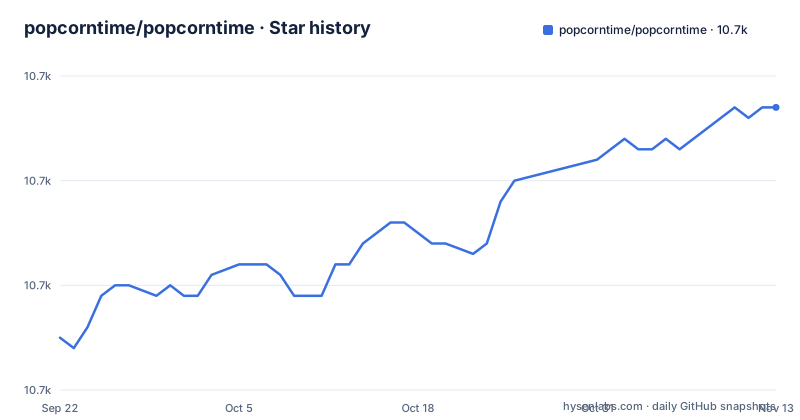
Star history
- popcorntime/popcorntime10,707 ★ · +22
| Repository | 2026-09-22 | 2026-11-13 |
|---|---|---|
| popcorntime/popcorntime | 10.7k | 10.7k |
22 Stars in the last 52 days, measured from the daily GitHub snapshot. Compare with other projects
Editorial analysis
A Tauri shell over a Rust workspace and a React frontend
The application is built on Tauri, with the interface written in React using TypeScript and the backend written in Rust. The Rust side is a Cargo workspace whose membership is declared by a glob rather than an explicit list:
[workspace]
members = ["crates/popcorntime-*"]
resolver = "2"
That single line is the project's map: every crate is named with the popcorntime- prefix, and the named path dependencies follow the same convention, covering a session crate, a settings crate, an error crate, a GraphQL client crate with its own macros crate, and a Tauri splash crate. On the JavaScript side, pnpm drives a workspace and turbo runs the tasks, while the root package is marked private and pinned to [email protected] through packageManager. The practical consequence for contributors is that adding a crate means naming it popcorntime-something and letting the glob pick it up.
The weekly Parquet catalog is the durable artifact
The part most useful outside the app is the dataset. The catalog is released weekly as Parquet files for developers and researchers, tracked as issue #3113 in the repository. That positioning is explicit: JustWatch and Reelgood are described as directories that show where content might be but do not let you do much beyond clicking through to a service, while this project publishes its data. The choice of Parquet means the weekly release is consumable by data tooling rather than only by the application, which changes what a downstream project can depend on. The consequence for a reader is that you can judge the project on its data pipeline without installing anything, and the app itself is the least interesting way to consume the output.
Local playback is on the roadmap, not in the build
Playing your own files is listed under what is new, and the qualifier attached to it is soon. Everything else in that list is stated as current: cross-platform coverage across desktop, mobile, and TV, an open source community-driven build, the weekly databases, and a legal, modern positioning relative to earlier versions of Popcorn Time. Local media playback is the exception, and it is the one capability that separates this project from the link-out directories it compares itself against, and the rest of its stated differences rest on the catalog instead: the databases are published weekly for developers and researchers, the code is public, and direction is said to come from contributors rather than corporate agendas. None of that depends on the player. The consequence is straightforward. If your reason for opening Popcorn Time is to point it at a folder of files you already own, that use case is not available yet.
Schema codegen assumes a GraphQL server is already listening
The client schema is not hand-written. It is introspected from a server that has to be running already, which is visible in the root scripts block:
  "scripts": {
    "codegen:graphql": "cynic introspect http://localhost:8080 -o ./crates/popcorntime-graphql-client/gql/schema.graphql",
    "dev:web": "turbo watch --filter @popcorntime/web dev",
    "dev:desktop": "pnpm tauri dev",
The command points cynic at http://localhost:8080 and writes the result to the GraphQL client crate under gql/schema.graphql. Because the introspection target is a live endpoint rather than a checked-in SDL file, regenerating the client on a fresh checkout fails until something is serving that port. The Rust side is consistent with a real service rather than a mock: async-graphql with chrono, time, and dataloader features on the server, poem as the web framework, cynic and cynic-codegen as the client, and dataloader for batching. Tokio is declared with default-features = false, so the async runtime is assembled explicitly rather than through library defaults, and tracing-subscriber is configured for time, json, and env-filter output, which is the shape you want when logs get parsed instead of simply read.
Shared dependencies pin release candidates and Apple bindings
Two dependency choices in the workspace list deserve attention before you build. First, specta is pinned with an exact requirement, and tauri-specta is pinned the same way, both at release candidate versions rather than stable ones. Exact pins mean a routine dependency bump is a deliberate act rather than something a lockfile update does for you. Second, the shared dependency list includes objc2, objc2-foundation, and objc2-app-kit with the NSView feature enabled, which are Apple platform bindings declared in the workspace's shared dependency list; this file does not show which crates use them or on which targets.
Two formatters, two lockfiles, one pinned pnpm
The JavaScript toolchain declares both biome and prettier in devDependencies, but only biome is exposed as scripts: format runs biome check. --write while format-check runs biome check. with no write. Prettier is pinned at a caret range and biome at an exact version, so the two coexist rather than one replacing the other. Alongside them sit biome.json, tsconfig.json, turbo.json, a shared @popcorntime/typescript-config package referenced through the workspace protocol, .nvmrc for the Node version, and .rustfmt.toml for the Rust side. Both pnpm-lock.yaml and Cargo.lock are committed. The format scripts run biome only, so biome is the tool to run before opening a review. The Tauri side adds its own set of plugins to the shared dependencies: logging, filesystem access, deep links, the updater, process control, single-instance enforcement, and the opener, which is most of what a desktop build needs before any application code is written.
No tagged releases, and the workspace version is 0.0.1
The repository publishes no GitHub releases at all, and the Cargo workspace declares its version as 0.0.1. The two together mean there is no tagged release to pin. The distribution path runs through the website instead, where unstable nightly releases are published, and the project describes itself as the home for ongoing development, documentation, and releases even though those releases live off-repository. The repository itself is not archived and its last push is dated 2026-09-04, so work is continuing, but a last-push date is not a version history. The practical consequence is that anyone tracking this project should record commit identifiers themselves, and anyone evaluating stability should look at the nightly channel rather than searching the repository for a version number.
Editorial conclusion
Popcorn Time is worth following if you want an open catalog of where content is available, or want its weekly Parquet datasets for your own tooling. It is not yet worth installing for local media playback, which the project lists as coming soon. Before committing, read LEGAL.md, and expect nightly builds or a source build rather than a tagged release.
Frequently asked questions
Is Popcorn Time still working?
The repository is not archived and its last push is dated 2026-09-04. It publishes no GitHub releases, so what ships to users comes from the nightly downloads linked on popcorntime.app rather than from tags in the repository.
How safe is Popcorn Time?
The project describes this rebuild as modern, safer, and legal, and it is MIT licensed with a LEGAL.md and a SECURITY.md in the repository root. It ships no tagged binaries of its own, so nothing here can tell you whether a given downloaded build is trustworthy; that check is yours.
What is the real Popcorn Time?
This repository is a complete rebuild rather than a fork or a patch, started from a clean foundation with new goals, and the README positions it against directory services such as JustWatch and Reelgood by publishing its catalog instead of only linking outward.
What is the latest version of Popcorn Time?
The repository has no GitHub releases and the Cargo workspace still declares version 0.0.1. Unstable nightly builds are published through the download section on popcorntime.app, which is where version tracking currently happens.
How do you install Popcorn Time?
For end users, the site links downloads and an unstable nightly channel. For building the code yourself, CONTRIBUTING.md covers the contribution guidelines and DEVELOPMENT.md is the file to read when you want the project to compile.
Official sources
Add this badge to your README
If you maintain this project, the badge below links readers to this analysis and shows its maintenance status from the daily GitHub snapshot. Paste the markdown into your README; add ?metric=license or ?metric=stars to the image URL for a different field.

[](https://hysenlabs.com/projects/popcorntime-popcorntime)Star history chart for your README
[](https://hysenlabs.com/projects/popcorntime-popcorntime)Was this useful?