PRAW's recommended install is uv, and one dependency checks for updates
PRAW, an acronym for "Python Reddit API Wrapper", is a python package that allows for simple access to Reddit's API.
At a glance
- What is it?
- PRAW is a Python wrapper around Reddit's API that handles rate limiting so callers do not write sleep calls. The packaging tells two stories worth knowing: the recommended installer is not pip, and one of the five runtime dependencies is a version checker. The test suite records and replays HTTP traffic instead of calling the live API.
- Who is it for?
- PRAW fits a Python 3.10 or newer project that needs to read or write Reddit data as a script-type application and would rather not manage its own rate limiting. It does not fit an asynchronous service, because the page directs that case to a separate official package, and it does not fit anyone who needs a client with no outbound network activity, since one of the five runtime dependencies checks for new versions.
- Can I use it commercially?
- Yes. BSD-2-Clause is a permissive licence: you can use, modify and sell software built on it, as long as you keep its copyright and licence notices.
- Is it still maintained?
- Yes. The repository last received commits 6 days ago.
- What is it written in?
- Mainly Python, according to GitHub's language statistics.
Answers come from the project's GitHub data, last synced on November 15, 2026, and from our analysis. They are not legal advice.
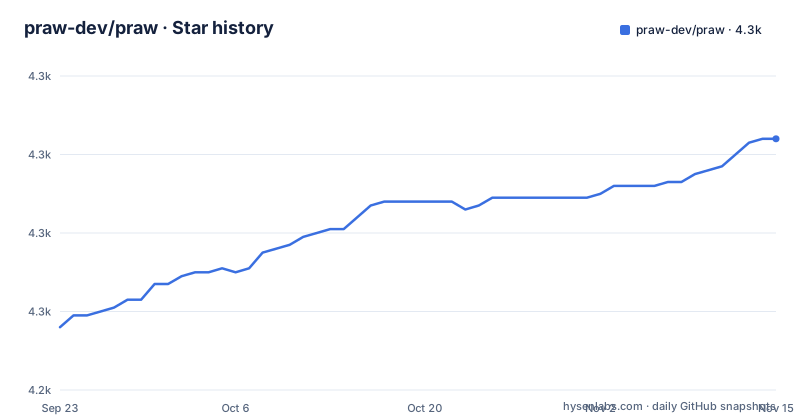
Star history
- praw-dev/praw4,304 ★ · +48
| Repository | 2026-09-23 | 2026-11-15 |
|---|---|---|
| praw-dev/praw | 4.3k | 4.3k |
48 Stars in the last 53 days, measured from the daily GitHub snapshot. Compare with other projects
Editorial analysis
The recommended install command is not pip
The installation section gives two commands and ranks them.
uv add prawpip install prawThe first is called the recommended way, and it uses uv rather than pip. The second is the alternative, and it is the one most search results will print.
There is a third command for the development version, and it does not go through the package index.
pip install --upgrade https://github.com/praw-dev/praw/archive/main.zipThat is an archive URL for the default branch, so the development install tracks whatever is on the branch at the moment you run it, with no version floor.
The interpreter requirement is stated once and simply: Python 3.10 or newer, and the package classifiers agree, listing 3.10 through 3.14.
Nothing about the three commands requires credentials. What does require credentials is the next section, and it says so: you need a script-type OAuth application before you can instantiate anything.
The readme is reStructuredText and the project follows it through
Most projects of this age have a Markdown readme. This one does not.
The documentation file carries the reStructuredText extension, and its internals match: headings are underlined with rows of asterisks, inline literals use a doubled backtick, code blocks are introduced by a directive rather than a fence, and even the badge row is written as image directives with alternative text and target URLs rather than as Markdown image syntax.
The rest of the documentation follows the same convention. There is an authors file and a change log file, both with that extension.
Why it matters is practical rather than aesthetic. Anything that assumes Markdown will render the badge block as plain text and mis-handle the underline characters in the heading lines. Copying a section heading out of this file and pasting it into a Markdown document will not work.
The test suite records and replays HTTP traffic
The test dependency group is short and one entry in it changes how you run the suite.
The group holds a test runner, a coverage tool, a pinned range for the HTTP client library, and a record-and-replay library for HTTP interactions.
That last entry is the important one. A library that records and replays HTTP exchanges lets the suite run without network access and without credentials, because the responses are on disk. For a wrapper around a third-party API, that is the difference between a test suite anyone can run and one that needs a live account and burns against rate limits.
The pinned range on the HTTP client is also telling: it allows any release from 2.20.1 up to but not including 3, which is a ceiling rather than a single version.
So the suite tests against recorded traffic, and the recordings have to be refreshed whenever the upstream API changes shape. That maintenance is invisible from the outside and is the price of the convenience.
Dependency groups compose, so lint pulls in the documentation toolchain
The packaging declares five dependency groups, and three of them are defined by including other groups.
The development group includes the lint group and the test group. The lint group includes the docs group. The type group includes the test group.
That last composition is the one to notice. Installing the type-checking group gives you a type checker and the whole test stack, including the record-and-replay library.
And the lint group gives you a linter, a hook runner, and the documentation toolchain: a theme, a documentation generator and an extension for annotating types in generated API pages.
Nothing breaks, but the group you pick does not give you what its name implies.
The type checker is pyright, the linter is ruff, and the build backend is hatchling.
One runtime dependency is pinned exactly and one checks for updates
There are five runtime dependencies, and they are constrained in three different styles.
dependencies = [
  "defusedxml==0.7.1",
  "prawcore>=4,<5",
  "typing-extensions; python_version <= '3.10'",
  "update_checker>=1.0,<2.0",
  "websocket-client>=0.54.0,<2"
]
One is pinned to a single patch version with no range at all. Three, including the core library, are bounded above and below. One carries an environment marker so it installs solely on the oldest supported interpreter.
The version checker is the interesting one. A version checker is a runtime dependency of a library whose stated purpose is to talk to one API, which means installing PRAW installs something whose job is to find out whether a newer PRAW exists. Whether it phones home on import, on first use or on a schedule is not stated on the page.
Each major version is a rewrite, and the history stops at the fourth
The page ends with a dated history, and the dates are the interesting part.
The project began as a different name under a different owner in August 2010, was registered on the package index as a differently named package in March 2011, changed maintainers in December of that year, and was renamed to its current name and moved to a new organisation in June 2012.
Then the history jumps to February 2016 and starts work on the fourth major version, described as a complete rewrite.
The package is currently on version eight, with v8.0.3 released on 2026-08-12.
Asynchronous work is directed to a separate official package
There is one routing decision on the page and it is stated firmly.
If you plan to use the library in an asynchronous environment, examples given are a popular Discord library and the standard library's own async support, you are strongly recommended to use a different package: the asynchronous version, which has its own documentation site.
The page is careful about what that means. It is the official asynchronous version, its usage is similar, and it has the same features.
Similar rather than identical, and same features rather than the same API. So this is a second implementation maintained alongside the first, not a mode you switch on.
The practical consequence is that the dependency you install differs depending on whether your program awaits anything. Nothing in the synchronous package adapts itself, and nothing on the page tells you which one to choose when you are unsure beyond the async rule.
Three support venues, and a rule against messaging contributors
The support section is the most prescriptive part of the page.
It starts by routing beginners to a Python learning subreddit rather than to the project's own channels.
For everything else there is a named forum on the platform itself, described as the best place to ask, with two conditions: tag your post so it is findable, and search first. Then there is a chat workspace, with a note to file an issue if the invitation link has expired.
The last rule is the one people break. Do not directly message any of the contributors through any of those channels unless they have indicated otherwise, and help other people with their questions instead.
For bugs there is a matching procedure: search the issue tracker first, react to the existing issue rather than opening a duplicate, and add a comment if you have more information.
Editorial conclusion
PRAW fits a Python 3.10 or newer project that needs to read or write Reddit data as a script-type application and would rather not manage its own rate limiting. It does not fit an asynchronous service, because the page directs that case to a separate official package, and it does not fit anyone who needs a client with no outbound network activity, since one of the five runtime dependencies checks for new versions. Before you depend on it, check four things. Which OAuth application type you registered, because the quickstart assumes the script type and its credentials. Whether the version checker is acceptable in your environment. That you are on the right major version. And which install path you use, because the recommended one is not the one most tutorials print.
Frequently asked questions
What does PRAW stand for?
Python Reddit API Wrapper. It is a Python package for simple access to Reddit's API that follows the platform's API rules internally, which means you do not need to add sleep calls to your own code to respect rate limits. Give the client an appropriate user agent and it is set up.
How do I install PRAW?
The recommended command is uv add praw. The alternative is pip install praw. A development version can be installed from the archive of the default branch. PRAW requires Python 3.10 or newer, and you also need credentials for a script-type OAuth application before you can create an instance.
Can I use PRAW in an async Python program?
The project strongly recommends a separate package for asynchronous environments such as discord.py or asyncio. That package is the official asynchronous version of PRAW, its usage is similar, and it has the same features.
Official sources
Add this badge to your README
If you maintain this project, the badge below links readers to this analysis and shows its maintenance status from the daily GitHub snapshot. Paste the markdown into your README; add ?metric=license or ?metric=stars to the image URL for a different field.

[](https://hysenlabs.com/projects/praw-dev-praw)Star history chart for your README
[](https://hysenlabs.com/projects/praw-dev-praw)Was this useful?