PyTorch-Adventures is a notebook curriculum that starts with an autograd engine and ends at JEPA
This repository contains an exhaustive coverage of a hands on approach to PyTorch along side powerful tools to accelerate model tuning and training
At a glance
- What is it?
- PyTorch-Adventures is a large Jupyter notebook collection that walks from PyTorch mechanics through datasets and transfer learning, into networks built from scratch, then out to computer vision, NLP, audio, transformers, generation, and reinforcement learning. It is written as a learning record rather than a library, its README is titled something else entirely, and its dependency file is one flat pinned list covering every domain it touches.
- Who is it for?
- PyTorch-Adventures fits someone who learns architectures by reading and rewriting working code rather than by following a course, and the ordering from mechanics to from-scratch gradients to real models is the part worth copying. It does not fit someone who needs a maintained library or benchmarked results, since the author labels every example a proof of concept and invites corrections on the grounds of being more wrong than right.
- Can I use it commercially?
- Yes. MIT is a permissive licence: you can use, modify and sell software built on it, as long as you keep its copyright and licence notices.
- Is it still maintained?
- Yes. The repository last received commits 24 days ago.
- What is it written in?
- Mainly Jupyter Notebook, according to GitHub's language statistics.
Answers come from the project's GitHub data, last synced on October 21, 2026, and from our analysis. They are not legal advice.
Star history
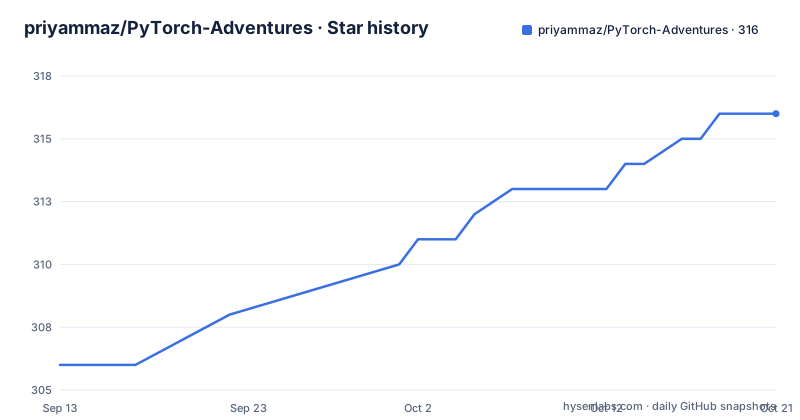
- priyammaz/PyTorch-Adventures316 ★ · +10
| Repository | 2026-09-13 | 2026-10-21 |
|---|---|---|
| priyammaz/PyTorch-Adventures | 306 | 316 |
10 Stars in the last 38 days, measured from the daily GitHub snapshot. Compare with other projects
Editorial analysis
The README is called Exploratory Data Adventures, the repository is not
The first oddity is that the repository is `PyTorch-Adventures` while the README is headed Exploratory Data Adventures. The title mismatch is small, but it reflects how the project is framed: the description calls it an exhaustive coverage of a hands on approach to PyTorch alongside tools for accelerating model tuning and training.
The author is explicit about the intent. The repository acts as a documentation of their own exploration and an attempt to teach everything they learn, with an undertaking to cite everyone referenced along the way. The stated motivation is that the open nature of the field is what made it possible to learn at all, since these models are made completely available to the public.
The contribution policy is unusually candid: the author says they are typically more wrong than right, that finding an error means there is an error in their knowledge, and asks to be told about it. Pull requests are submitted for review by the author.
No release tags exist for this repository, and the last push to `main` is dated 2026-05-16, so there is no version to pin and no changelog to track against.
Every example is called a proof of concept because there is no GPU fleet
The limitation is stated before any notebook is introduced. The main limitation for researchers in this field, as the README puts it, is that we normally do not have buckets of GPUs just sitting around to train with. Every example is therefore a proof of concept, with the stated aim of reproducing any model that is feasible.
That framing has direct consequences for how you should read the code. Numbers reproduced in a notebook are demonstrations that the architecture runs and that the pipeline is wired correctly, not measurements anyone has validated. The repository is also honest about error: the author expects to be wrong and asks for corrections rather than shipping a polished library surface.
The practical mitigation for the hardware problem is the link structure. Almost every entry in the index pairs a YouTube recording with a Colab notebook link, which means the intended execution environment is frequently a hosted GPU runtime rather than the machine the repository is cloned onto. That is what makes a curriculum covering diffusion models and Masked Autoencoders plausible for a solo learner.
The remaining question is what runs where. A notebook that needs a data folder on disk and a pinned dependency set is not the same artefact as a Colab link, and the two paths have different setup costs.
The curriculum runs mechanics, then from-scratch gradients, then real models
The index is organised as a path, and the order is the argument. Foundations come first: an introduction to PyTorch exploring the mechanics, datasets and dataloaders, leveraging pre-trained models for transfer learning, and an introduction to vision digging into convolutions and AlexNet.
Two entries in that first block are about failure rather than capability. The Curse of Backprop introduces residual connections by way of implementing ResNet, and the recurrent notebooks cover both classification on IMDB and text generation from the Harry Potter corpus, so the same architecture appears as a classifier and as a generator.
From there the repository branches by domain. Computer vision adds UNet for segmentation, a move from convolutions to the Vision Transformer, masked image modelling with Masked Autoencoders, and JEPA. Natural language processing covers causal language modelling with GPT, masked language modelling with RoBERTa, CLIP as a vision and language representation, seq2seq attention for translation, Llama 4, and language diffusion models. Audio adds audio processing from first principles, Connectionist Temporal Classification loss, and automatic speech recognition.
The directory listing goes further than the index does, with separate top level folders for transformers, generation, reinforcement learning, and tools, so the tree is broader than what the visible index enumerates.
ManualGrad and MyTorch come before any pretrained model
Two notebooks sit in a section of their own, under neural networks from scratch rather than under any application domain. `ManualGrad` is described as a simple neural network implementation, and `MyTorch` as building a simple autoGrad engine.
Placing them before the transfer learning material is the sequencing decision that makes the repository different from a list of architectures. A framework hides its most important mechanism, and the only way to stop treating backpropagation as a black box is to write the gradient computation by hand at least once. Having done that, the reader can look at what the framework does differently.
The names are honest about scope. This is not a from-scratch framework intended for use; it is a gradient demonstration small enough to read in one sitting, positioned as the foundation for everything above it in the index.
Distributed training is handled the same way, by delegation rather than by invention. There is a notebook on distributed training with Hugging Face Accelerate instead of a hand-written launcher, so the repository teaches the library path for multi-GPU work and reserves the from-scratch treatment for autodiff alone.
Datasets split into a download script and a manual grab
Four datasets are installed by a script: Cats vs Dogs, IMDB movie reviews, MNIST handwritten digits, and the Harry Potter corpus. The instruction is concrete about placement, requiring a `/data` folder in the root of the repository before running:
bash download_data.shThree more are excluded from automation, and the reason given is size and inconsistency rather than preference. CelebA, MS-COCO, and ADE20K are used in the more advanced architectures, are described as inconsistent to download automatically, and may be too large to train in Google Drive. The instruction for those is to download from the link and save them into the same `/data` folder.
That split maps onto the curriculum. The scripted sets serve the earlier classification, regression, and text generation work, while the manual sets belong to the segmentation and scene parsing notebooks, where the input is large and shaped differently.
There is also a `prep_data.py` at the repository root, which is the place to look for how images and text are turned into tensors before a dataset object sees them.
requirements.txt pins every domain flat, CUDA packages included
The dependency file is a single flat list with exact pins for everything the notebooks touch, which is the practical cost of a repository this wide. Alongside the expected PyTorch stack it carries `accelerate==1.6.0`, `datasets==2.20.0`, `diffusers==0.32.2`, `einops==0.8.0`, `evaluate==0.4.2`, `albumentations==1.4.16`, and `huggingface-hub==0.30.1`.
Several pins tie you to a specific accelerator or environment. `cupy-cuda12x==13.3.0` is a CUDA 12 build, `flash-attn==2.6.3` needs a matching CUDA toolchain to build, and `bitsandbytes==0.45.2` is the quantization library. Those three exist for the large-model notebooks, and installing the file on a machine without a matching CUDA setup is where a fresh clone is most likely to stall.
Domain-specific pins reveal the curriculum. `box2d-py==2.3.5` with `gymnasium==1.0.0` is for reinforcement learning, `jiwer==3.0.4` is the word error rate metric for the speech recognition notebooks, `hmmlearn==0.3.3` is for hidden Markov work, `imbalanced-learn` and `img2dataset` are for data handling, and `celluloid` is for writing video from notebooks.
Because the list is flat, there is no way to install only what the vision notebooks need. That is the trade for having one file that works across the whole index.
Editorial conclusion
PyTorch-Adventures fits someone who learns architectures by reading and rewriting working code rather than by following a course, and the ordering from mechanics to from-scratch gradients to real models is the part worth copying. It does not fit someone who needs a maintained library or benchmarked results, since the author labels every example a proof of concept and invites corrections on the grounds of being more wrong than right. Before installing, read `requirements.txt` as a whole, because it pins CUDA-specific packages for topics you may never open, and decide early whether you are running locally or in the Colab links the index provides.
Frequently asked questions
What is PyTorch and why is it used?
In this repository PyTorch is the subject of a hands-on curriculum rather than a library being extended: notebooks cover its mechanics, datasets and dataloaders, transfer learning from pre-trained models, and then networks written from scratch before moving into vision, NLP, audio, and reinforcement learning. The stated reason for writing it down is that the open availability of these models is what makes the field learnable at all.
How do I get the datasets for PyTorch-Adventures?
Create a /data folder in the repository root and run bash download_data.sh to fetch Cats vs Dogs, IMDB movie reviews, MNIST, and the Harry Potter corpus. CelebA, MS-COCO, and ADE20K are excluded from the script because they are large and inconsistent to fetch, so they are downloaded by hand into the same folder.
Do the PyTorch-Adventures notebooks need a local GPU?
The repository states that most researchers do not have spare GPUs and that every example is a proof of concept. Most index entries link to both a video and a Colab notebook, so the intended way to run the heavier topics is a hosted Colab runtime rather than a local machine.
What is in requirements.txt for PyTorch-Adventures?
One flat pinned list covering the whole curriculum, including accelerate, datasets, diffusers, einops, albumentations, gymnasium and box2d-py for reinforcement learning, and jiwer for speech recognition word error rate. It also pins cupy-cuda12x, flash-attn, and bitsandbytes, which expect a CUDA environment to build.
Which order should I work through PyTorch-Adventures in?
The index implies one: PyTorch mechanics, then datasets and dataloaders, then transfer learning, then the from-scratch notebooks ManualGrad and MyTorch, and only then the domain sections for vision, NLP, and audio. The repository also has separate directories for transformers, generation, reinforcement learning, and tools.
Official sources
Add this badge to your README
If you maintain this project, the badge below links readers to this analysis and shows its maintenance status from the daily GitHub snapshot. Paste the markdown into your README; add ?metric=license or ?metric=stars to the image URL for a different field.

[](https://hysenlabs.com/projects/priyammaz-pytorch-adventures)Star history chart for your README
[](https://hysenlabs.com/projects/priyammaz-pytorch-adventures)Was this useful?