Nevermore: 278 Roblox packages, two release toolchains, and a generated table with typos
ModuleScript loader with reusable and easy unified server-client modules for faster game development on Roblox.
At a glance
- What is it?
- Nevermore is a Luau library of reusable server and client modules for Roblox games, installed from npm or pnpm and synced into Studio with rojo. The details worth reading are structural: every package versions on its own, the root carries both auto-it and lerna, and the package table in the README is generated rather than curated.
- Who is it for?
- Nevermore suits Roblox developers who want proven modules rather than a framework, especially teams already using rojo to sync a project, since the install path is a normal npm dependency and the well-known packages have their own documentation pages. Before you adopt it, expect to pin per package rather than per project, because version numbers diverge widely across the set and a single install does not move all of them at once.
- Can I use it commercially?
- Yes. MIT is a permissive licence: you can use, modify and sell software built on it, as long as you keep its copyright and licence notices.
- Is it still maintained?
- Yes. The repository last received commits 1 day ago.
- What is it written in?
- Mainly Lua, according to GitHub's language statistics.
Answers come from the project's GitHub data, last synced on November 13, 2026, and from our analysis. They are not legal advice.
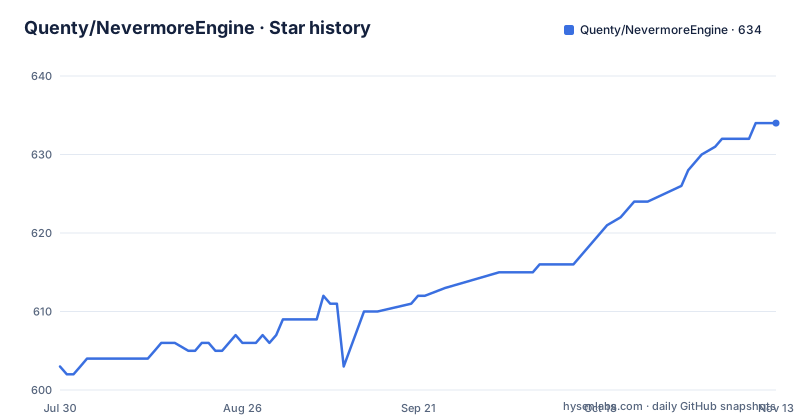
Star history
- Quenty/NevermoreEngine634 ★ · +31
| Repository | 2026-07-30 | 2026-11-13 |
|---|---|---|
| Quenty/NevermoreEngine | 603 | 634 |
31 Stars in the last 106 days, measured from the daily GitHub snapshot. Compare with other projects
Editorial analysis
Every package versions on its own schedule
Nevermore is not a single package with a single version. It is 278 packages, each published under the `@quenty` scope and each carrying its own changelog, and the release feed shows what that means in practice. Three tags from the same publish run on 2026-09-30 sit seconds apart: `@quenty/time` at 2.6.2, `@quenty/tie` at 10.51.2 and `@quenty/templateprovider` at 11.54.2. The version numbers have nothing to do with each other, because a package that has not changed does not move. The practical consequence is that upgrading is per package: adding one dependency can pull a new version of something else you never touched, and pinning the whole set means choosing 278 version numbers rather than one. The root manifest is private and named `@quenty/nevermore`, so the repository itself is a workspace rather than a distributed library.
The package table is generated, and it carries three naming slips
The list of all packages sits between generated markers in the README, with columns for description, install command, docs, source, changelog and npm. Being generated, it reflects exactly what the extractor emitted, including three disagreements between a package's name and the rest of its row. `AdorneeBoundingBox` installs as `@quenty/adorneeboundingbox` but its docs link points at an `AdorneeBoundingBoxUtils` path. `Aggregator`, described as aggregating async promise requests, links to `AggregatorUtils`. And `AdorneeUtils` installs as `@quenty/adorneeutils`, with an extra e in the scope name. So the lowercase install string is not always a faithful transformation of the package name, which is the sort of detail that costs an afternoon when a scripted install fails on one row.
auto-it and lerna both sit in the root manifest
The release tooling is doubled up. The dev dependencies include the auto-it suite, with plugins for conventional commits, first-time-contributor labelling, npm publishing and released notes, alongside a matching `.autorc` at the root. They also include `lerna` at version 9, with a `lerna.json` in the tree, while package management itself runs through pnpm, pinned to 10.27.0 with `pnpm-workspace.yaml` and `pnpm-lock.yaml`. Two version-management systems in one repository is a choice rather than an accident, but it means release behaviour is split across configuration files written for different tools. Documentation is a third system: `moonwave` and `moonwave.toml` generate the site at the project home page, and a lint script runs the moonwave extractor across `src` through lerna in parallel.
Luau linting cannot start until generated files exist
The Luau analysis step has a bootstrap that no other lint task needs. `lint:luau` invokes `luau-lsp analyze` against `src`, but it needs two artifacts first: a `sourcemap.json` and a `globalTypes.d.lua` of Roblox type definitions. The `prelint:luau` hook produces both, by running the build that asks rojo to emit a sourcemap from `default.project.json` and then calling the project's own CLI to download the Roblox types. The analyzer is also told to ignore `node_modules`, `*.story.lua`, `*.client.lua` and `*.server.lua`, and it runs with the LuauSolverV2 flag turned off. Two more linters cover the same source with different rules: selene for lint, configured from the root, and stylua for formatting, run in check mode across `src`, `games` and `plugins`.
lint:ts and build:ts are the same command
The TypeScript side of the repository is small and the scripts reflect that. Both `build:ts` and `lint:ts` expand to one command: a recursive pnpm run restricted to the `./tools/**` filter, with `./tools/nevermore-vscode` excluded. One script type-checks and the other rebuilds; neither covers the Luau that most of the repository is written in, which is handled by the selene, stylua and luau-lsp passes described earlier. Prettier covers the TypeScript trees with an ignore path taken from `.gitignore`, and it is the one dependency in the manifest pinned to an exact version, 2.7.1, while every other entry uses a range. Formatting the Lua side is a separate command, stylua invoked with the root config across `src`, `games` and `plugins`.
Copy and paste works until a package becomes a feature
There are two ways in, and the project is candid that they are not equal. The supported route is a package manager: install from npm or pnpm, then sync into Roblox with rojo.
npm install @quenty/maidThe fallback is to copy the source into ModuleScripts and refactor it into place, which works for small utilities and stops being ergonomic as a package approaches a full gameplay feature. The example the project gives for that limit is the inverse-kinematics package. That framing also explains the shape of the library. Maid, Rx, Binder, Spring, AccelTween, Signal, Promise, Octree, Blend, DataStore and the layered Camera system are infrastructure-shaped, and the claim attached to them is reach rather than novelty: code from Nevermore has powered over a billion play sessions on Roblox, and it is used in all Studio Koi Koi games.
Four tool managers and three editor configs in one root
The root directory is a good map of the project's conventions. Tool installation is declared twice, through `aftman.toml` and `foreman.toml`, and `.autorc` covers the release automation. Linting and formatting have their own config files: `selene.toml`, `stylua.toml`, `.styluaignore`, `.luaurc`, `.prettierrc` and `.prettierignore`. Editors are covered three ways, with `.vscode/`, a `Nevermore.code-workspace` file and a `Nevermore.sublime-project` file, plus a `.devcontainer/` for a containerised environment. Two Rojo project files sit side by side, `default.project.json` and `deploy.nevermore.json`, which separate local mapping from deployment mapping. There is also a `testez.toml` for the TestEZ runner, a `games/` directory of example projects, a `plugins/` directory, and both `CLAUDE.md` and a `.claude-plugin/` directory, so the repository ships its own agent instructions alongside its Lua tooling.
Editorial conclusion
Nevermore suits Roblox developers who want proven modules rather than a framework, especially teams already using rojo to sync a project, since the install path is a normal npm dependency and the well-known packages have their own documentation pages. Before you adopt it, expect to pin per package rather than per project, because version numbers diverge widely across the set and a single install does not move all of them at once. Read the generated table with care: at least three package names and install commands disagree with their documentation paths. If your game leans on the largest gameplay-level packages, check the copy-and-paste route first, since the project itself says ergonomics degrade there.
Frequently asked questions
How many packages does Nevermore contain?
The generated package table states 278 packages. Each is published separately under the @quenty scope with its own changelog and its own version number.
How do I install a Nevermore package for Roblox?
Install it from npm or pnpm, for example npm install @quenty/maid, then sync the package into Roblox with rojo. The alternative is copying the source into a ModuleScript and refactoring it, which the project says becomes less ergonomic as a package approaches a full gameplay feature.
What does the Nevermore package named Maid do?
Maid is a utility object for cleaning up connections, one of the packages the project highlights alongside Rx for reactive programming, Binder for binding Roblox objects and instances, Signal, Promise and Octree.
Why do Nevermore package versions differ so much?
Each package versions independently, so numbers like @quenty/time 2.6.2, @quenty/tie 10.51.2 and @quenty/templateprovider 11.54.2 can be published in the same run while sharing nothing but the scope. Upgrading is therefore per package.
Official sources
Add this badge to your README
If you maintain this project, the badge below links readers to this analysis and shows its maintenance status from the daily GitHub snapshot. Paste the markdown into your README; add ?metric=license or ?metric=stars to the image URL for a different field.

[](https://hysenlabs.com/projects/quenty-nevermoreengine)Star history chart for your README
[](https://hysenlabs.com/projects/quenty-nevermoreengine)Was this useful?