Quoroom: webhooks authenticated by their own URL, and an npm package that ships three files
Open-source earning-focused swarm intelligence engine. Self-governing AI collectives (queen, workers, quorum voting) running locally via MCP. Works with Claude Code, Codex, or pay-per-use APIs.
At a glance
- What is it?
- An open research project for autonomous agent collectives. A Queen plans, Workers execute, a Quorum votes, and a human Keeper funds an EVM wallet. The governance rules and the money handling are described down to the cipher mode, while the two entry points are thinner than the pitch line suggests.
- Who is it for?
- Quoroom is a research tool with unusually explicit self-description, and it is honest about being one, calling itself experimental in its own package description. Read it as a framework for studying agent collectives rather than a product to deploy.
- Can I use it commercially?
- Yes. MIT is a permissive licence: you can use, modify and sell software built on it, as long as you keep its copyright and licence notices.
- Is it still maintained?
- Activity is slowing. The repository last received commits 7 months ago.
- What is it written in?
- Mainly TypeScript, according to GitHub's language statistics.
Answers come from the project's GitHub data, last synced on November 15, 2026, and from our analysis. They are not legal advice.
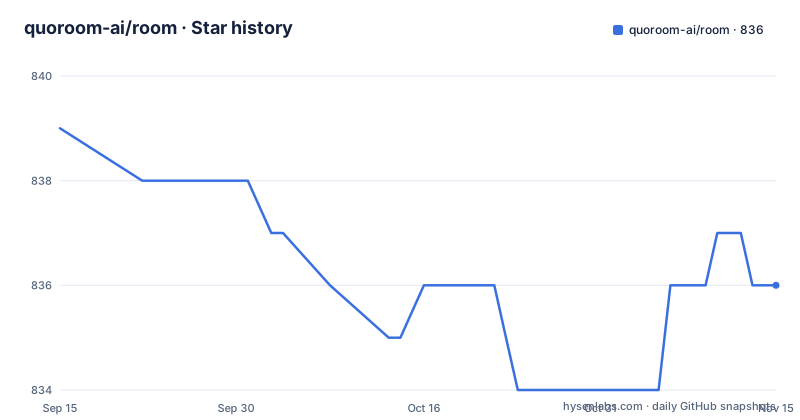
Star history
- quoroom-ai/room836 ★ · -3
| Repository | 2026-09-15 | 2026-11-15 |
|---|---|---|
| quoroom-ai/room | 839 | 836 |
-3 Stars in the last 61 days, measured from the daily GitHub snapshot. Compare with other projects
Editorial analysis
Webhooks authenticate with the URL itself
Tasks can be triggered by HTTP from any external service. The feature entry names GitHub push, Stripe payment and monitoring alerts as the kind of caller, and states that any system able to POST to a URL can drive the agents.
The security model is stated in the same breath: per-task and per-room tokens, 30 requests per minute of rate limiting, and no auth setup required beyond the URL.
So the secret is the URL, and the URL is the capability. A token scoped to one task is still a token that triggers agent work, and agent work happens in a room with a wallet that the Keeper funds, with self-modification available to the agents that receive the call.
The rate limit is the only numeric control given. There is no signature verification, no shared secret in a header, no allowlist of source addresses and no expiry described for those tokens in this document.
Agents edit their own files, and a webhook can wake them
The self-modification feature is described in one line: agents edit their own skills and files with a full audit trail and one-click revert.
Skills sit next to it, as reusable agent capabilities with activation contexts and versioning, and the framing is that agents learn and improve over time. Goals are hierarchical with progress tracking, so a top-level objective is broken down by the agents themselves.
Put the three together and the shape becomes clear. A POST to a webhook URL wakes the queen, the queen plans, workers execute, and one of the capabilities available to them is editing files in the repository. The audit trail and the revert are the mitigation, and the feature list treats them as sufficient, since no permission scope, no allowlist of editable paths and no separate approval step for self-modification is described.
Memory is the fourth piece: entities, observations and relations with semantic vector search over 384-dimension embeddings, persisting across sessions.
The npm package is three files, and the container is the whole product
The published files array in the manifest has three entries: out/mcp/cli.js, out/mcp/server.js and out/mcp/api-server.js. The package main points at out/mcp/server.js, and the single binary, quoroom, points at out/mcp/cli.js.
The dashboard is not among them. The React SPA is served by the local Quoroom server at http://localhost:3700 or whatever port you configure, and it ships in the container rather than in the npm tarball, because the Dockerfile copies both out/mcp and out/ui out of the build stage.
The container also installs two third-party coding tools globally, @openai/codex and @anthropic-ai/claude-code, alongside python3, make and g++, exposes 3700, and starts with node out/mcp/cli.js serve.
So the two install surfaces are genuinely different products. A global npm install gives you a CLI and an MCP server with no interface and no bundled CLIs. The image gives you the interface, the two agent CLIs the Queen can drive, and a build toolchain, all in a node:20-slim base.
Version 0.1.43 in the manifest against v0.1.42 as the newest tag
The manifest declares version 0.1.43. The three most recent releases are v0.1.40 on 2026-03-01 at 22:12 UTC, v0.1.41 the same night at 23:35, and v0.1.42 on 2026-03-02 at 03:07.
Three patch versions inside five hours, then a gap. The default branch was last pushed on 2026-04-12, which is roughly six weeks after the last tag, so the branch has moved well past anything a release page points at.
The build scripts show how much is expected to churn. There are separate entry points for parallel builds, fast builds with the type check skipped, a Windows local build, a UI build through vite with a config inside src/ui, and MCP-only builds. Six of the scripts are port and process management: kill:ports, kill:dev-ports targeting 3700, 3702, 4700, 3715, 5173 and 5174, kill:quoroom-runtime, and a dev:room script that wipes the development runtime before rebuilding.
The dev:room script also redirects the data directory to $HOME/.quoroom-dev and sets a flag that skips MCP registration, which is how the project separates a scratch run from a real one.
The keeper and the workers vote with equal weight, and the queen breaks ties
The four roles are defined tightly. The Queen is the strategic brain and supports a free local model, Claude Code CLI, Codex CLI, and the OpenAI, Claude and Gemini APIs. Workers are specialised agents that inherit the Queen's model by default, or can run a separate one, including a free local model. The Quorum deliberates and votes. The Keeper is the human who sets goals and funds the wallet.
The voting rule is the interesting part. Thresholds are majority, supermajority or unanimous, and all voters, the keeper and the workers together, have equal weight. Ties are broken by the Queen's vote by default.
So the human holds one vote among many rather than a veto, and the component described as the strategic brain is the tie-breaker. That is a coherent design for a collective, and it is worth naming plainly that the equal-weight rule is what makes the system self-governing rather than supervised.
The Keeper still holds the two things the agents do not: the goals and the funds.
A fail-closed local model path, and limits that depend on your provider
The free local model feature is specific. One-click setup for ollama:qwen3-coder:30b appears in the Queen, Clerk and Workers setup flows. Quoroom runs compatibility checks, installs Ollama, pulls the pinned model, streams the install progress, and applies the result across active rooms. The path is described as local-only and fail-closed, meaning no paid fallback.
Activity controls are the other safety surface. The Queen can be throttled per room with a configurable cycle gap between runs, a maximum number of turns per cycle, and quiet hours during which the Queen rests. Defaults are plan-aware and are chosen automatically from the model provider when a room is created.
That last point has a consequence nobody spells out. The default limits for a room running a 30-billion-parameter model on your own hardware are not the defaults for a room calling a paid API, so a quiet hours setting that is generous enough for one is not necessarily appropriate for the other.
Cloud rooms behave differently again: a single swarm runtime host is provisioned per room and all queen and worker execution runs there, with no additional execution routing layer.
The earning claim is in the description, the wallet is in the README, the loop is in neither
The repository description calls Quoroom an earning-focused swarm intelligence engine. The README never uses the word earning. What it documents is the wallet: an EVM wallet with multi-chain support, USDC and USDT on Base, Ethereum, Arbitrum, Optimism and Polygon, keys encrypted with AES-256-GCM, one address that works on every chain with the balance aggregated across networks, and ERC-8004 agent identity on Base so rooms register as on-chain agents with discoverable metadata.
The description of that identity ends with the word reputation-ready, and no reputation mechanism, revenue split, payout rule or fee schedule appears anywhere in the document. The Cloud Mode section, which is where such a mechanism would be described, is the sentence the page ends on.
Against that, the repository carries a trademark and anti-scam notice, which is unusually defensive: the code is MIT licensed but the name, logo and branding are not, third-party tokens using the name are not endorsed, and the project states it will never ask for wallet seed phrases or private keys. Official channels are quoroom.ai for the local app, quoroom.io for the cloud app, and a Telegram bot, with impersonation reports going to [email protected].
Editorial conclusion
Quoroom is a research tool with unusually explicit self-description, and it is honest about being one, calling itself experimental in its own package description. Read it as a framework for studying agent collectives rather than a product to deploy. Before running one, decide who holds the Keeper keys, treat every webhook URL as a credential because that is exactly what it is, and remember that the npm package contains no dashboard while the container image contains both the UI and two third-party coding CLIs.
Frequently asked questions
What is Quoroom and what are Queen, Workers, Quorum and Keeper?
Quoroom is an open research project on autonomous agent collectives, where each collective is called a Room. The Queen is the strategic brain, Workers are specialised agents that execute, the Quorum deliberates and votes on decisions, and the Keeper is the human who sets goals and funds the wallet.
Can Quoroom run without a paid API?
Yes, through a local Ollama model. One-click setup for ollama:qwen3-coder:30b appears in the Queen, Clerk and Workers flows, with compatibility checks, an Ollama install, a pinned model pull and streamed progress applied across active rooms. The path is described as local-only and fail-closed, with no paid fallback.
How are Quoroom webhooks secured?
By the URL itself. Each task and each room has its own token, rate limiting is 30 requests per minute, and the documentation says no auth setup is required beyond the URL. Any system that can POST to that URL can trigger a task and wake the queen in a room whose agents can edit their own files.
What does installing the quoroom npm package include?
Three files: out/mcp/cli.js, out/mcp/server.js and out/mcp/api-server.js, with the package main at out/mcp/server.js and the quoroom binary at out/mcp/cli.js. The React dashboard is not part of the package; the Dockerfile is what copies out/ui and installs the Codex and Claude Code CLIs.
How can a Quoroom room be throttled or controlled?
Per room, the Queen can be throttled with a cycle gap between runs, a maximum number of turns per cycle, and quiet hours when the Queen rests, with defaults chosen from the model provider in use. Rooms also run in a keeper-controlled mode with full dashboard and API control, while cloud member tokens stay read-only apart from limited collaboration endpoints.
Official sources
Add this badge to your README
If you maintain this project, the badge below links readers to this analysis and shows its maintenance status from the daily GitHub snapshot. Paste the markdown into your README; add ?metric=license or ?metric=stars to the image URL for a different field.

[](https://hysenlabs.com/projects/quoroom-ai-room)Star history chart for your README
[](https://hysenlabs.com/projects/quoroom-ai-room)Was this useful?