recall's context.md is your transcript rearranged, not written by a model
Stop wasting tokens and re-explaining your project every session. Recall gives Claude Code , Opencode durable memory — entirely offline.
At a glance
- What is it?
- Recall is a Claude Code plugin that logs sessions to a local file and condenses them with TF-IDF and TextRank instead of a model call. Nothing is installed and nothing leaves the machine, which makes the summarizer deterministic, the output extractive, and the failure mode silence.
- Who is it for?
- Recall earns its place for a person on a Claude Code subscription who re-explains the same project every session and does not want a memory tool that phones a model endpoint with the transcript. Two things are worth checking before you rely on it.
- Can I use it commercially?
- Yes. MIT is a permissive licence: you can use, modify and sell software built on it, as long as you keep its copyright and licence notices.
- Is it still maintained?
- Yes. The repository last received commits 78 days ago.
- What is it written in?
- Mainly Python, according to GitHub's language statistics.
Answers come from the project's GitHub data, last synced on November 24, 2026, and from our analysis. They are not legal advice.
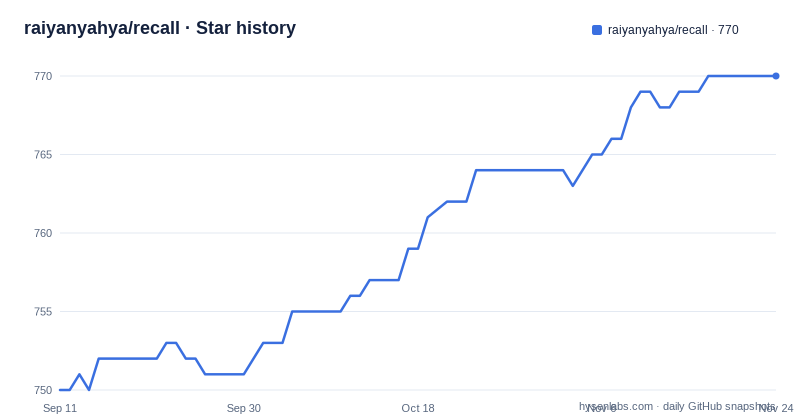
Star history
- raiyanyahya/recall770 ★ · +20
| Repository | 2026-09-11 | 2026-11-24 |
|---|---|---|
| raiyanyahya/recall | 750 | 770 |
20 Stars in the last 74 days, measured from the daily GitHub snapshot. Compare with other projects
Editorial analysis
The summary is extractive, so context.md is your own sentences reordered
The summarizer in `scripts/summarizer.py` does not write anything. It ranks sentences and keeps the winners. Four steps: TF-IDF sentence vectors, a cosine-similarity graph between those sentences, TextRank as a PageRank power iteration over the graph to score them, and then the top N are kept in their original order. The page calls this extractive summarization, which is the single fact that determines what you get in `context.md`. Every sentence in the summary is a sentence that appeared in the transcript.
That has consequences a reader should know before trusting the file. The summary cannot merge two facts into one conclusion, because nothing in the pipeline combines sentences. It cannot resolve a contradiction you corrected mid session, because the corrected wording may simply not rank. It cannot phrase a next step you never said out loud. What it does is pick the sentences a graph algorithm considers central and paste them back in sequence.
How many sentences is a config value, `summary_sentences`, with a default of 8. Eight sentences of your own transcript is the whole prose budget of a session summary, and everything else in `context.md` comes from somewhere more reliable. The `history.md` log underneath it is append-only, and every session is captured as it happens: prompts, replies, files touched and commands run. So the summary is a view over a log, and the log is the record.
The summarizer sees the newest 200,000 characters while the goal field remembers the first ask
There is a documented tension between two behaviours in this plugin, and it only shows up on a project you have worked on for a while. `max_input_chars` defaults to 200000 and is a cap on the text fed to the summarizer, with the oldest characters dropped. Meanwhile the summary is described as being wrapped with deterministic facts pulled straight from the transcript and git: the goal, which is defined as your first ask, plus files touched, commands run, where you left off, and `git diff --stat`.
So the prose half of `context.md` summarizes the tail of your work, while the goal field keeps reporting the very first request you made to the project. On a repository where the sum of all sessions exceeds 200,000 characters, the two sections describe different eras. Nothing reconciles them and nothing warns you, because both are documented as working as intended.
The other half of that boundary is the log itself. `history.md` is append-only, and the page describes no rotation, no cap and no pruning step for it. The 200,000 character limit bounds what the summarizer reads on each run, not what the file accumulates. A long-lived checkout therefore keeps a growing plaintext transcript that only its newest slice is ever summarized, which is the cheapest arrangement to run and the one that costs the most disk.
Redaction strips what looks like a secret, and the log stays plaintext either way
The privacy claim is unusually specific: Recall makes no network calls, uses no API key, and loads no third-party model, with the summarizer being local Python. The page also names the risk in its own words, saying transcripts carry code, paths and sometimes secrets. Against that, the `redact` setting defaults to true and its purpose is given as stripping obvious secrets before writing the md files.
Two things follow. The redaction is a heuristic applied at write time, so the class it targets is whatever the code recognises as an obvious secret, and the page does not enumerate that class. And the output format is described in its own comparison table as plaintext in `.recall/`, diffable and shareable. A file designed to be diffed and shared, containing transcripts, is a file worth thinking about before it goes anywhere.
The contrast the page draws is with tools that pipe your context to a model endpoint. That part is a clean difference and it holds on the evidence given, since the summarizer is four lines of classic ranking code with no network call in it. The weaker point is not the network, it is what lands on disk. `capture_history` defaults to true, so the log starts writing as soon as the plugin loads, and the only documented off switch besides editing config is a file: create `.recall/.capture-paused` in the output directory, and delete it to resume. That pause switch is a good thing to know about, because it means the log is running by default rather than waiting for you.
context.md is fenced as untrusted data so a past session cannot issue instructions
The most interesting line in the comparison table is the one about how Claude treats each kind of memory. Hand-written `CLAUDE.md` is treated as instructions. `--continue` and `--resume` are treated as the conversation. Recall's output is fenced as untrusted reference data.
That third choice is the reason this plugin is safe to load without reading first. `context.md` is built from text that came out of a transcript, including Claude's own replies, which means it contains material the model produced earlier in a session under different instructions. Feeding that back as instructions would be a way to smuggle behaviour changes across sessions. Fencing it as reference data keeps the digest in the same category as file contents you asked it to read rather than in the category of policy.
The table also puts a number on the benefit. Resuming from Recall is listed at about 1 to 2K tokens for a compact digest, against a large cost for `--continue`, which replays the full transcript, and a small cost for `CLAUDE.md`, which is short but hand maintained. The same table lists upkeep as none, written as you work, which is true because the hooks write the log while you type and you never edit it by hand.
Where it fits is stated plainly: `CLAUDE.md` is how you want the assistant to work, and Recall is what you did last time and where you stopped. The first is a policy file, the second is a diary.
Every hook swallows its exceptions, and the untested entry point is the one that starts the session
The tool configuration is where the trade-offs in this project are written down most honestly, because the suppressions come with written justifications rather than being quietly absent. Bandit runs with four codes skipped:
[tool.bandit]
# Reviewed and accepted, with justification:
#  B404/B603/B607 — the only subprocesses are git and the opencode CLI. Both
#    are invoked with a static argv list (never shell=True) and found on PATH
#    by name; git is additionally hardened against untrusted-repo config (see
#    scripts/common.py:git_info, scripts/harness_opencode.py:_run_opencode).
#  B110 — the lifecycle hooks deliberately `except Exception: pass` so a failure
#    in Recall can never crash a Claude Code session. This is a hard design
#    requirement (see CONTRIBUTING.md), used only in hook entry points.
skips = ["B404", "B603", "B607", "B110"]
B110 is the one that matters for a memory tool. The lifecycle hooks catch every exception and pass, so that a failure inside Recall can never crash a Claude Code session. That is described as a hard design requirement rather than an oversight. The cost is equally clear: a plugin that cannot crash your session is also a plugin that fails without telling you.
The coverage configuration names the gap that follows from it. `scripts/session_start.py` is left out of coverage, and the comment explains why: it is a thin lifecycle entry point exercised only inside a live Claude Code session, so it cannot be meaningfully unit-tested here. The entry point that decides whether you are offered a resume is therefore the one with no tests around it, and the failure mode for it is silence. Coverage is otherwise set up properly, with `scripts` as the source and branch coverage enabled.
So the practical consequence is not that Recall is fragile, it is that you verify it yourself. Check that `context.md` changes after a session before you trust it as your only memory.
Automatic saving is off by default, so the summary only refreshes when you ask
Everything is configured through one JSON file dropped in the project root, `recall.config.json`, and the repository ships its own copy at the root so the defaults are readable as a file. Seven keys:
| `output_dir` | `".recall"` | Where `history.md` / `context.md` live. |
| `capture_history` | `true` | Append session activity to `history.md`. |
| `auto_save_context` | `"off"` | Regenerate `context.md` when a session ends: `"off"` or `"on_end"`. |
| `summary_sentences` | `8` | How many sentences the summary keeps. |
| `redact` | `true` | Strip obvious secrets before writing the md files. |
| `include_git` | `true` | Add `git diff --stat` + recent commits to `context.md`. |
| `max_input_chars` | `200000` | Cap on text fed to the summarizer (oldest dropped). |
The asymmetry in those defaults is the thing to notice. Logging is on, and redaction is on, but regenerating the summary is off. Out of the box the `context.md` you are offered at the next session start is the one from whenever you last ran the save, which by default is whenever you last remembered to. Three commands cover the rest: `/recall:save` runs the summarizer and overwrites `context.md`, `/recall:show` prints it, and `/recall:log` tails `history.md`.
`auto_save_context` set to `on_end` closes that gap, regenerating the file every time a session ends. `include_git` is on by default, so the deterministic part of the digest already carries `git diff --stat` and recent commits, which is the part that stays true regardless of how the ranked sentences came out.
OpenCode support is opt-in in v0.4.0, and nothing has been released since July
The newest release is v0.4.0, titled as OpenCode support and marked opt-in, published 2026-07-18. The two before it are v0.3.6 from 2026-06-25 and v0.3.5 from 2026-06-22. The last commit in the repository is dated 2026-09-07, which puts roughly seven weeks of work past the most recent tag.
What that means for a second agent runtime is visible in the layout. The tree carries an `integrations/` directory and a `.claude-plugin/` directory side by side, and the bandit justification in the tool configuration names `scripts/harness_opencode.py` alongside `scripts/common.py` as the two places subprocesses are invoked. The repository description names both Claude Code and OpenCode, and the badge row near the top of the page links to an `#opencode` anchor. Meanwhile the heading on that page still reads fully-local project memory for Claude Code.
The visible part of the page stops partway through the privacy paragraph, so whatever the OpenCode section says is past that point. What can be read directly is the opt-in label in the release title and the presence of a separate harness file in the tree, which is enough to say the second runtime is a target and not yet the default.
The repository also keeps `CHANGELOG.md`, `SECURITY.md`, `PRIVACY.md` and `CONTRIBUTING.md` at the top level, and the contributing file is referenced from the tool configuration as the place where the exception swallowing is specified as a requirement. A `benchmarks/` directory sits beside `tests/`, and the single Markdown file at the root, `claude-code-context-plugin.md`, is the one path excluded from the linter, which suggests it is a large pasted document rather than code.
Editorial conclusion
Recall earns its place for a person on a Claude Code subscription who re-explains the same project every session and does not want a memory tool that phones a model endpoint with the transcript. Two things are worth checking before you rely on it. First, the summary is extractive, so context.md is your own words in your own order, and the extractive half of it is capped at the newest 200,000 characters while the goal field still reports your very first ask. Second, the hooks swallow every exception on purpose and the session start entry point has no unit tests, so a Recall failure shows up as a context file that quietly stops updating. The last release is v0.4.0 from 2026-07-18 and the last commit is 2026-09-07, so pin to a commit rather than a tag.
Frequently asked questions
Does recall send my Claude Code sessions to a model?
No. Recall makes no network calls, uses no API key, and loads no third-party model, with the summarizer being local Python. There is no LLM call anywhere: the summary comes from TF-IDF plus TextRank, an extractive method, and numpy is only an optional accelerator with a pure Python fallback.
What is the difference between recall and CLAUDE.md?
CLAUDE.md is hand-written memory: rules and notes you curate, loaded as instructions Claude follows, and it does not record what actually happened. Recall is an automatic capture of each session written to `.recall/` and condensed into a summary, fenced as untrusted reference data rather than as instructions.
How many tokens does it cost to resume a session with recall?
The comparison table puts Recall at about 1 to 2K tokens for a compact digest, against a large cost for `--continue` and `--resume`, which replay the full prior transcript, and a small cost for CLAUDE.md. The saving comes from loading a summary instead of re-explaining the project from scratch.
Does recall rotate or prune its history.md log?
No rotation or pruning is described. `history.md` is append-only and captures each session as it happens, while `max_input_chars`, defaulting to 200000, caps only the text fed to the summarizer with the oldest characters dropped. To stop logging without editing config, create `.recall/.capture-paused` and delete it to resume.
How do I make recall regenerate context.md automatically?
Set `auto_save_context` to `"on_end"` in `recall.config.json` in the project root, which regenerates `context.md` every time a session ends. The default is `"off"`, so the summary only refreshes when you run `/recall:save` yourself. `/recall:show` prints the file and `/recall:log` tails `history.md`.
Official sources
Add this badge to your README
If you maintain this project, the badge below links readers to this analysis and shows its maintenance status from the daily GitHub snapshot. Paste the markdown into your README; add ?metric=license or ?metric=stars to the image URL for a different field.

[](https://hysenlabs.com/projects/raiyanyahya-recall)Star history chart for your README
[](https://hysenlabs.com/projects/raiyanyahya-recall)Was this useful?