Spicy Monopoly: a dice board game where the dealer is the model you talk to
A two-player board game you play with your AI — dice, tiles, spicy tasks, all run by code (18+)
At a glance
- What is it?
- Spicy Monopoly is an 18+ two-player board game that runs through an AI: one dependency-free Python file handles dice, tiles, coins and task draws, while the model acts as dealer and, optionally, as the other player. The interesting engineering is in the safety switches rather than the game loop.
- Who is it for?
- Use this if you want a two-player game with dice and coins that an AI can referee, and you are willing to read its safety settings before the first turn. Skip it if you need multiplayer today, an offline release you can pin, or content the model generates itself, since the task library is a fixed JSON file.
- Can I use it commercially?
- Check first. The repository uses a licence we do not classify automatically, so read its LICENSE file before any commercial use.
- Is it still maintained?
- Yes. The repository last received commits 115 days ago.
- What is it written in?
- Mainly Python, according to GitHub's language statistics.
Answers come from the project's GitHub data, last synced on November 25, 2026, and from our analysis. They are not legal advice.
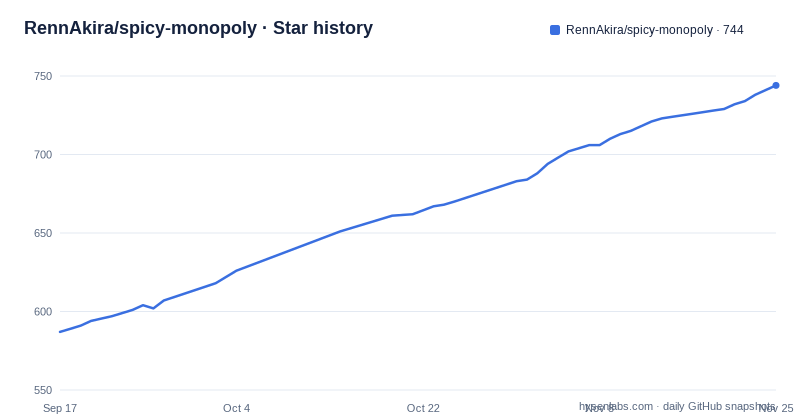
Star history
- RennAkira/spicy-monopoly744 ★ · +157
| Repository | 2026-09-17 | 2026-11-25 |
|---|---|---|
| RennAkira/spicy-monopoly | 587 | 744 |
157 Stars in the last 69 days, measured from the daily GitHub snapshot. Compare with other projects
Editorial analysis
One dependency-free Python file runs the whole board
The engine is `monopoly_play.py`, written against the Python standard library with no third-party packages, so the mode you hand to the model is the mode you can read. You give the AI an operator manual and three commands, one per turn:
python monopoly_play.py new "Alice:男:攻" "Bob:女:受" heavy 0.5 18   # 开局
python monopoly_play.py roll                                          # 每回合就这条
python monopoly_play.py status                                        # 看棋盘和账
The `new` line takes two player descriptors, an intensity tier, and two numbers whose meaning the operator manual does not spell out in the README. The same loop works for two humans with the model acting only as dealer, so the engine is not tied to a second AI player. Alongside it sit the JSON data files (`monopoly-library.v2.json`, `monopoly-truths.json`, `monopoly-identities.json`) and four manuals, one written for the model and one for people.
Twenty tiles, a coin economy, and one final command
The board has 20 tiles. Players take turns rolling dice, moving, and drawing whatever the tile they land on calls for. Coins come from completing tasks and from rent on tiles you own, and the player holding more coins when the round count runs out wins, which is where the pressure comes from. The winner is also allowed to issue one final instruction to the loser.
The variability does not come from the dice alone. Each player holds an identity card that stays in play for the whole session, one player hides a mark for the other to guess, landing on the same tile as another player can trigger a duel, and function cards plus chance and unknown tiles sit alongside the task draws. Genders and roles are independent of whether a seat is a person or a model, so mixed, male and female pairs all work.
A hosted instance and an MCP URL remove the install
The quickest path hands your AI two things: an address and the API manual.
https://spicy-monopoly.lolThat is a public hosted instance. The local library draws the tasks, no key is needed, and it is rate limited, so the README asks for considerate use rather than scraping. If your client speaks remote MCP over Streamable HTTP, the same service is behind another URL:
https://spicy-monopoly.lol/mcpBoth routes keep the game state on someone else's machine, which is the tradeoff for having nothing to install. Self-hosting the API yourself is three commands, and the last one is the one people miss:
pip install -r requirements.txt
uvicorn monopoly_api:app --host 0.0.0.0 --port 8069
Binding to 0.0.0.0 without an authentication or rate limit layer in front is why the README tells you to add your own.
Six MCP tools, with the fiddly cases folded into game_action
The remote MCP surface presents six high-level tools to the model: start, roll, game operations, query, manage, and help. Skipping a task, swapping a card, duels, function cards and identity events are all collected inside a single `game_action`, which is the design decision that matters. A model does not need to know how to compose HTTP to handle them.
Running your own copy needs Node 18 or newer and one install:
npm install
npm run mcp:http
The server defaults to forwarding to the public hosted instance, so a local run is still a client for someone else's game unless you point it elsewhere with `SPICY_MONOPOLY_BASE_URL=http://127.0.0.1:8069`. Clients without remote MCP support can use local stdio instead with `node mcp-server.js`. The package itself is marked private at version 0.1.0 and depends only on the MCP SDK and zod.
Safety is four separate switches, not one disclaimer
The consent design is mechanical rather than a request at the top of a README. A safeword of `404` stops the game immediately for anyone at any time, with no follow-up question. Redlines are set at the start, in a `redline` list of categories neither player wants, and the engine routes around them automatically, with a second content filter catching cards that were not labelled. Tasks of that kind stay off by default, opened per person only when asked for, and a `no_penetration` flag applies to any hole for anyone who sets it. A task can also be skipped outright, or swapped for another at a cost.
Because each control is separate, each has to be checked separately before a game, and the README asks that both players agree on them at the start rather than discovering them later.
Intensity is announced before the first turn and can change
Content intensity has three settings: `light` for flirtation and touching without explicit sex, `medium` for explicit sex with penetration only in the second half, and `heavy` for the most explicit tier. `medium` is the default, and the underlying cards sit on a one to six scale that runs from teasing only, through contact with the body, to external contact, to oral service, to penetration, and finally to the loss-of-control layer.
The dealer states at the start of a game how far up that scale the session will go, and the tier can be changed at any point afterwards. Announcing it first is the mechanism, not the caveat: the number is said out loud before anything is drawn, so consent covers a specific level rather than a general agreement.
The 900 card library is plain JSON you can edit by hand
Cards live in `monopoly-library.v2.json` as placeholder text written against roles such as actor and partner, which the engine renders with the players' own names at the start of a game. That has a second effect: the library never contains anyone's actual name, so a card file is safe to read, fork, and share. The schema is flat enough to edit by hand, with fields for intensity, type of play, kink, dominant and submissive requirements, and the placeholder content.
Hand editing is the only route the project currently offers. The toolchain for generating new corpora at scale has not shipped with the core release, so extending the library means writing more JSON yourself. If you fork the game, that JSON file is where your changes land.
Two records disagree about the licence, and nothing is pinned
The README states CC BY-NC 4.0 with a LICENSE file at the root, allowing use, modification and sharing as long as it is not commercial. The recorded metadata calls the licence unasserted instead, so the file in the repository is the one to trust and the non-commercial term is the one to honour.
There are no GitHub releases, the npm package is marked private, and the last push to main is dated 2026-08-02, so there is nothing to pin and no changelog to diff against. The README says the two-player version is stable before multiplayer work begins, and asks readers to treat the GitHub repository as authoritative over the bundled manuals. Feedback goes to Issues, with an optional `POST /feedback` endpoint that is never raised unprompted during a game.
Editorial conclusion
Use this if you want a two-player game with dice and coins that an AI can referee, and you are willing to read its safety settings before the first turn. Skip it if you need multiplayer today, an offline release you can pin, or content the model generates itself, since the task library is a fixed JSON file. Before starting a game, set the safeword, the redlines and the intensity tier together, and treat the repository as the authority when the bundled manuals disagree.
Frequently asked questions
What is Spicy Monopoly and how do I start a game?
It is an 18+ two-player board game played through an AI, on a 20 tile board with dice, coins, rent and task cards. To start with the local engine you hand your AI the manual and the data files, then run one command per turn: new to deal, roll to move, status to see the board and the accounts.
Do I need to install anything to play Spicy Monopoly?
No, if you point your AI at the public hosted instance at spicy-monopoly.lol, which needs no key and is rate limited. Remote MCP clients can use spicy-monopoly.lol/mcp instead. Self-hosting needs Python with fastapi, uvicorn and pydantic, or Node 18 or newer for the MCP server.
How does Spicy Monopoly handle safewords and limits?
Saying 404 stops the game immediately with no follow-up question. Redlines entered at the start are avoided automatically by the engine, with a second content filter for unlabelled cards, tasks of that kind stay off unless opened per person, and any task can be skipped or swapped for a cost.
What intensity settings does Spicy Monopoly support?
Three: light for flirtation and touching, medium for explicit sex with penetration only in the second half, which is the default, and heavy for the most explicit tier. Cards sit on a one to six scale, the dealer states the level at the start of a game, and the tier can be changed at any point.
Can I add my own task cards to Spicy Monopoly?
Yes. The library is plain JSON with fields for intensity, type of play, kink, dominant and submissive requirements, and placeholder content, so cards can be added or edited by hand. The tooling for generating new corpora at scale has not shipped with the core release.
Official sources
Add this badge to your README
If you maintain this project, the badge below links readers to this analysis and shows its maintenance status from the daily GitHub snapshot. Paste the markdown into your README; add ?metric=license or ?metric=stars to the image URL for a different field.

[](https://hysenlabs.com/projects/rennakira-spicy-monopoly)Star history chart for your README
[](https://hysenlabs.com/projects/rennakira-spicy-monopoly)Was this useful?