Riptide Networking: a thin C# transport for multiplayer games
Lightweight C# networking solution for multiplayer games.
At a glance
- What is it?
- Riptide Networking is a lightweight C# library for establishing connections and sending data in multiplayer games, usable in Unity and in other .NET environments, with UDP and TCP transports built in and a Steam transport kept in a separate repository. It suits a developer who wants to own the message layer rather than hand it to an engine, and it provides reliable and unreliable message modes while leaving application-level message design to you.
- Who is it for?
- Riptide Networking suits a Unity or .NET developer who wants a small networking layer with the message format under their control, and who is prepared to design their own application messages and choose suitable delivery modes. It does not suit a team that wants a batteries included stack with lag compensation, matchmaking or state replication.
- Can I use it commercially?
- Yes. MIT is a permissive licence: you can use, modify and sell software built on it, as long as you keep its copyright and licence notices.
- Is it still maintained?
- Yes. The repository last received commits 80 days ago.
- What is it written in?
- Mainly C#, according to GitHub's language statistics.
Answers come from the project's GitHub data, last synced on November 7, 2026, and from our analysis. They are not legal advice.
Star history
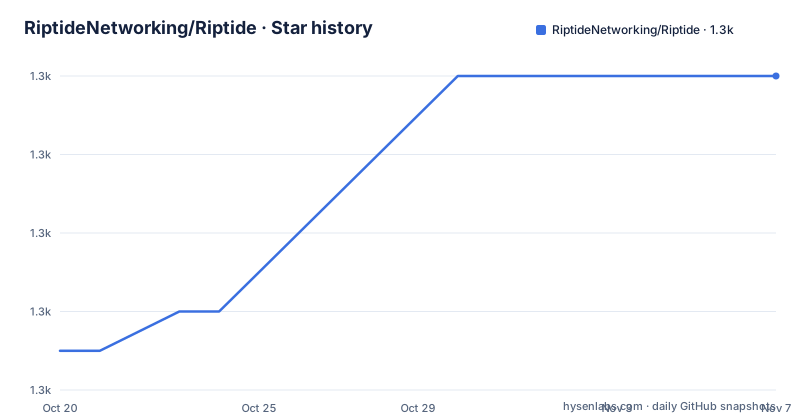
- RiptideNetworking/Riptide1,296 ★ · +7
| Repository | 2026-10-20 | 2026-11-07 |
|---|---|---|
| RiptideNetworking/Riptide | 1.3k | 1.3k |
7 Stars in the last 18 days, measured from the daily GitHub snapshot. Compare with other projects
Editorial analysis
A transport layer, not a networking stack
Riptide Networking is a lightweight C# networking library primarily designed for use in multiplayer games, and it can be used in Unity as well as in other .NET environments such as console applications. The readme describes the scope precisely. It provides functionality for establishing connections and sending data back and forth, and it leaves it up to you to decide what data you want to send and when.
That last clause is the whole design position, and the readme names the audience it suits: people who like to be in control of their code and know what is going on under the hood. It is a deliberate contrast with the heavier networking stacks that come with a game engine, where the library may dictate a larger part of the message format and networking architecture. Riptide provides reliable message delivery modes while leaving application-level data and sending decisions to you.
The topic list on the repository includes both client and server, gamedev, multiplayer and unity, and the repository layout reflects a library rather than an application. The RiptideNetworking/ directory holds the library source, with a Transports/ subdirectory inside it, and there is a Demos/ directory, a Docs/ directory, and an UPDATING.md file at the top level for people moving between major versions. The transports split into those built in and those not. UDP and TCP are built in. The Steam transport is a separate repository at RiptideNetworking/SteamTransport, which is a meaningful choice for a game library, since the Steam transport is what lets players connect without a relay server and it carries its own dependency on the Steamworks SDK.
UDP, TCP and the trade-off between them
The built-in transports include UDP and TCP. Riptide offers Unreliable, Reliable and Notify message modes. Unreliable messages suit frequently replaced position updates; Reliable resends until acknowledged and can be used for chat, but it does not guarantee message order. Notify provides delivery feedback without guaranteed delivery.
If chat messages must arrive in order, the manual describes waiting for delivery confirmation before sending the next message, at the cost of latency. Consult the transport documentation for how to configure the client and server.
The Steam transport deserves a second thought before you commit, because it is the one that changes the shape of your deployment. With it, connections ride on the Steam network and your server does not have to be reachable from the public internet, which removes a class of hosting and NAT problems. The cost is that the Steamworks SDK is involved, that the library has to be licensed through Steam, and that your game is tied to the Steam distribution channel. Keeping it in a separate repository rather than in the core is a good structure for that, because the core stays usable by people who are not shipping on Steam at all.
Getting started means reading the manual, not running a command
The README does not contain an install command or a code sample, and it does not pretend to. It points to the documentation for installation instructions and for a guide on setting up the basics, both on the project's documentation site, and it offers a video tutorial for setting Riptide up in a project, which the readme notes was made using v1.1.0, with the upgrade guides provided for moving a project to newer versions afterwards. There is no official package snippet in the repository to copy, and a reader looking for one will not find it here.
That is worth being explicit about, because the usual expectation for a game networking library is a package reference and a Hello World. What you get instead is a manual. The manual is the documentation site at the project homepage, which also carries the reference material and the upgrade guides, and the repository has a Docs/ directory as well, so some of the material lives in both places.
The upgrade path deserves attention because the library has a v2 line. The readme points at an update to v2 guide, and the release history shows v2.1.2 in December 2023, v2.2.0 in January 2024 and v2.2.1 in July 2025. So the 2.x line has been stable for a while, and a project on 1.x has a documented route to move forward. UPDATING.md in the repository root is the file to read first if you are crossing that line, since a networking library that changes its connection or message handling affects every call site in your codebase.
Ports to other languages, maintained by other people
The readme lists implementations of Riptide in other programming languages, and the framing around them is careful. These ports are managed and maintained separately and independently by their respective owners, and they are not affiliated with Riptide in any official capacity. As a result they may not function interchangeably with all versions of Riptide or with each other. The readme says they may provide a starting point if you need to use Riptide with a language other than C# on one end.
Three are listed. Pytide is a Python implementation, the Riptide Dart Port covers Dart and Flutter, and GodotRiptideSteamTransport is a C# Godot Steam transport, which is a slightly different thing since it is a transport rather than a full port and it is written in C#.
The disclaimer is the important part, and it is the sort of caveat that saves a week of debugging. A wire protocol that is not specified in a formal document, but rather implied by the reference implementation, drifts when the reference implementation changes. A port that tracks an older version of the protocol will silently misbehave against a current server, and the failure will look like packet loss rather than a version mismatch. If a cross language client is part of your plan, the version compatibility between the two ends is the thing to pin down before anything else.
There is also a Discord link and a GitHub Sponsors link in the readme, and the project states that Riptide is 100 percent free to use, with the option of funding development through sponsors. The licence is MIT, which is one of the most permissive licences available, so there is no obstacle to using it in a commercial game.
Where Riptide Networking is the wrong tool
Three cases argue against it. The first is a team that wants a complete multiplayer solution. Riptide gives you connections and data transfer and nothing else. There is no client side prediction, no lag compensation, no interpolation of remote entities, no matchmaking, no state synchronisation and no session management. Each of those is a substantial piece of work that a real time game needs, and a developer who expects a library to supply them will find that they have to write all of it.
The second case is a team with a non C# client and no protocol document. The porting situation described above is the risk. The Python and Dart ports exist, but they are maintained by other people on their own schedules, and the readme is candid that they may not interoperate with all versions. If your client is in a language without a port, you are writing a Riptide compatible implementation from scratch against a reference implementation rather than a specification.
The third case is a project that needs a specific transport and assumes it comes in the box. The Steam transport is in a different repository, and it brings the Steamworks SDK with it. If your plan was to use Riptide with Steam networking and you assumed the main package covered it, there is an extra dependency and an extra version to track.
On the maintenance picture, the readme asks you to read the contribution guidelines before submitting a pull request, and the repository has a CONTRIBUTING.md as well as a Demos/ directory, which is a sign of a project that expects to be used by reading and running things. The licence is MIT, which means you can read the whole of it, and the licence file is at LICENSE.md in the repository root. The last push was on 2026-08-19 and the newest listed release is v2.2.1 from 2025-07-14, so the 2.2 line is the current one to build against.
Editorial conclusion
Riptide Networking suits a Unity or .NET developer who wants a small networking layer with the message format under their control, and who is prepared to design their own application messages and choose suitable delivery modes. It does not suit a team that wants a batteries included stack with lag compensation, matchmaking or state replication. Before you adopt it, read the installation page and the get started guide, pick your transport knowing that the Steam one lives in a separate repository, and note that the last push was on 2026-08-19 with the newest release at v2.2.1 from 2025-07-14.
Frequently asked questions
What is Riptide Networking used for?
It is a lightweight C# library for multiplayer games that provides functionality for establishing connections and sending data back and forth, leaving you to decide what data to send and when. It works in Unity and in other .NET environments such as console applications.
Which transports does Riptide support?
UDP and TCP are built in, and the Steam transport is provided by a separate repository, RiptideNetworking/SteamTransport. The readme also lists a C# Godot Steam transport project for Godot users.
Is Riptide available outside C#?
The readme lists ports for Python as Pytide and for Dart and Flutter as the Riptide Dart Port, but states they are maintained independently by their respective owners, are not officially affiliated with Riptide, and may not function interchangeably with all versions.
How do I update a project from Riptide v1 to v2?
The readme points at the update to v2 upgrade guide in the documentation. The repository also has an UPDATING.md file at the top level, and the releases show the current line at v2, with v2.2.1 the most recent listed release from 2025-07-14.
Official sources
Add this badge to your README
If you maintain this project, the badge below links readers to this analysis and shows its maintenance status from the daily GitHub snapshot. Paste the markdown into your README; add ?metric=license or ?metric=stars to the image URL for a different field.

[](https://hysenlabs.com/projects/riptidenetworking-riptide)Star history chart for your README
[](https://hysenlabs.com/projects/riptidenetworking-riptide)Was this useful?