openrelay repoints the quota you already hold, and its manifest version trails its release by two generations
Hundreds of free AI model quotas, one-click access to local projects.
At a glance
- What is it?
- openrelay is a local proxy that finds the AI quota you already have, from desktop applications you have logged into and from API keys you enter, and serves all of it from one port on localhost. The engineering is small and legible: one runtime dependency, one binary, and a URL path that selects the source. The parts worth reading closely are the licensing, which is not what the manifest says, and the security surface of a proxy that every tool on your machine is told to trust.
- Who is it for?
- Before anything else, read the terms of the subscriptions and tools you intend to route this way. The quota being moved is quota you paid for or were granted, so the question is not whether you are entitled to it but whether the provider's terms permit spending it from a different client, and that is a decision you have to make per provider, not a fact this repository can supply.
- Can I use it commercially?
- Yes. MIT is a permissive licence: you can use, modify and sell software built on it, as long as you keep its copyright and licence notices.
- Is it still maintained?
- Yes. The repository last received commits 11 days ago.
- What is it written in?
- Mainly TypeScript, according to GitHub's language statistics.
Answers come from the project's GitHub data, last synced on November 4, 2026, and from our analysis. They are not legal advice.
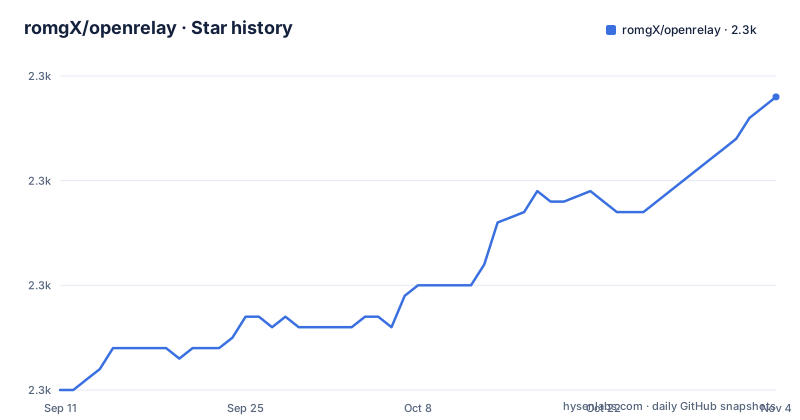
Star history
- romgX/openrelay2,328 ★ · +28
| Repository | 2026-09-11 | 2026-11-04 |
|---|---|---|
| romgX/openrelay | 2.3k | 2.3k |
28 Stars in the last 54 days, measured from the daily GitHub snapshot. Compare with other projects
Editorial analysis
One port, and the path picks the subscription
The mechanism fits in a paragraph. OpenRelay starts a local HTTP endpoint, discovers the AI sources already available on the machine, and serves them from that one address. A client is pointed at it with two environment variables:
# macOS / Linux
export ANTHROPIC_BASE_URL=http://localhost:18765
export ANTHROPIC_API_KEY=unused
The second one is set to the literal word unused, which is the clearest possible signal that the proxy does not check it. Selecting which subscription to spend is done with a path suffix: the same local base URL with a trailing segment naming one of the discovered sources routes requests to that source's quota. So the whole routing model is a base URL, a meaningless API key, and a path. That simplicity is the project's main appeal and also the reason to read the security section below, because the same simplicity applies to anything else on the machine that can open a socket to that port.
The manifest says MIT, the page describes an open core split
The package manifest declares the licence as MIT and lists the licence file among the files it publishes. The page describes something more complicated: an open core arrangement where the framework parts, meaning the proxy, the format conversion and the configuration, are MIT, while a set of Pro features is under a separate commercial licence. Model grouping is named as one of the Pro features, and so is a higher request limit. The commercial licence file is published alongside the MIT one, and the page offers a month's trial code to people who star the repository and join the community channels. So the metadata on the package is accurate about the framework and silent about the tier above it. Anyone considering the project commercially should read both files rather than the manifest field, because a higher request limit is exactly the kind of thing a commercial licence exists to restrict.
One dependency, one binary, and no build script
The dependency list has a single entry, a WebAssembly build of SQLite, and that is the whole runtime surface for a project that does proxying, request transformation, credential handling and remote procedure proxying. The manifest registers one executable, declares the module as ES modules, and requires Node 18 or newer. Then the notable absence: there is no scripts section at all, so the repository as published contains no build command, and the page's own advice is to download a prebuilt executable for your platform rather than install anything. The page says so explicitly, telling the reader that no package installation and no Node environment are needed, and offering separate builds for Windows on x64, macOS for both processor families, and Linux on both x64 and ARM. The manifest version reads 0.8.3 while the newest release is 0.10.68, so the published metadata also lags the shipped binaries by two minor generations.
Three IDEs are proxied by three different mechanisms
The table of editor integrations is the most interesting part of the feature list because each row names a different technique rather than a different product. Two editors are reached through a remote procedure proxy speaking a specific protocol over HTTP/2, which is how a client that expects to talk to its own backend is redirected to someone else's. A third is reached through a bring-your-own-key bridge, so a local model server becomes the backend for a subscription product. A fourth is reached by proxying a REST interface and re-pointing it. Three mechanisms, four products, and the page's claim is that the editor cannot tell the difference. That claim is where the review effort belongs, because protocol level redirection is harder to reason about than an environment variable, and it is the part of this project most likely to break when a vendor ships a protocol change.
The local endpoint is described with no authentication at all
The security section is unusually specific and mostly reassuring. Credentials stay on the machine, application tokens and cookies are read locally and used only to reach the original provider, keys added through the tool are stored in its own configuration directory, and requests travel from the machine directly to the provider with the project's own server not in the path. Prompt content is not written to logs, cache or storage by default, and only appears when local request shape debugging is switched on deliberately. Licence and update checks may reach the project's endpoints, without provider credentials or conversation content. The credential handling code is named as a file to audit. What none of this mentions is authentication on the local endpoint itself. The configuration the page tells you to apply sets the API key to a placeholder, which is consistent with no check at all, and every tool you configure is then pointed at that address. Anything running on the machine can reach it.
Credentials arrive from other applications' sessions
The discovery list is where the project's real dependency on other software lives. It names desktop applications and command line tools it connects to, including several commercial coding assistants and two editor integrations, and it notes that some sources require you to have logged in to the original application first or to have configured a key in it. That means the tool is not inventing access; it is reusing sessions that already exist on your disk. The page is direct about this: it says the application token or cookie is read from your machine and used only to connect to the original supplier. On Linux the storage detail differs, with credentials going through the desktop keyring utility or a file cache, and two of the listed desktop sources have no Linux version at all. The page also points at separate disclaimer and privacy documents for the detail, which is the right place to look before you connect a paid subscription.
Fifty eight is two different things wearing one label
The headline number counts providers, and it is built from two populations that are not the same kind of thing. One figure covers direct API or local endpoints, where you enter a key or an address yourself: named examples include two fast inference providers, a model vendor API, a local model server and others. The other figure covers the applications discovered on the machine, where access comes from an existing session rather than from a key you supplied. Adding them produces the advertised total, and the arithmetic is defensible, but the label hides the distinction that matters most to a reader deciding whether to connect something. A key you typed in is yours; a session lifted out of another application is that application's, and the terms covering the two are not the same. The same distinction explains why the higher request limit is the commercial feature, since the cost being limited is someone else's.
Editorial conclusion
Before anything else, read the terms of the subscriptions and tools you intend to route this way. The quota being moved is quota you paid for or were granted, so the question is not whether you are entitled to it but whether the provider's terms permit spending it from a different client, and that is a decision you have to make per provider, not a fact this repository can supply. Setting that aside, openrelay is a compact and readable piece of work whose single dependency and single port make it easy to audit, which matters more here than usual. Two things to check next. The licensing, because the manifest declares MIT while the page describes an open core split with a commercial tier for model grouping and higher request limits. And the security surface, because the local endpoint is described with no authentication at all, and every coding tool on the machine is pointed at it, so anything that can reach that port can spend everything you have connected. Read the disclaimer and privacy documents before you connect a paid subscription, and treat the credential store as the thing to protect.
Frequently asked questions
What is openrelay?
A local proxy that finds the AI quota you already have, both from desktop applications you have logged into and from API keys you enter, and exposes it through one local endpoint so other coding tools can use it.
What does openrelay need in order to run?
Node 18 or newer, or a prebuilt executable for Windows, macOS or Linux. On Linux credentials go through the system keyring or a file cache, and two of the supported desktop sources have no Linux version.
How do I point a coding tool at openrelay?
Set the tool's base URL to the local endpoint and give it any placeholder key. A path suffix selects which discovered source to spend, so a segment naming one source routes requests to that source's quota.
Does openrelay send my data to an openrelay server?
The page states that requests go directly from your machine to the provider you selected and that the project's own server is not in the request path. Licence and update checks may reach the project's endpoints without provider credentials or conversation content.
Is openrelay free to use?
The proxy, format conversion and configuration are MIT licensed. Model grouping and higher request limits are described as Pro features under a separate commercial licence, with trial codes offered through the community channels.
Official sources
Add this badge to your README
If you maintain this project, the badge below links readers to this analysis and shows its maintenance status from the daily GitHub snapshot. Paste the markdown into your README; add ?metric=license or ?metric=stars to the image URL for a different field.

[](https://hysenlabs.com/projects/romgx-openrelay)Star history chart for your README
[](https://hysenlabs.com/projects/romgx-openrelay)Was this useful?