routatic-proxy translates your prompts to another provider, and the fallback chain is silent
route Claude Code requests through multiple upstream providers (OpenCode Go, OpenCode Zen, and AWS Bedrock) with automatic model selection and format transformation.
At a glance
- What is it?
- A Go proxy that sits between Claude Code and an upstream model, rewriting Anthropic-format requests into OpenAI, Anthropic, Responses or Gemini shapes and back. Two things on the page deserve attention: the container image builds on Go 1.25 while the module asks for 1.26, and the model answering a given request can change between turns without you seeing it.
- Who is it for?
- routatic-proxy fits a developer who has a subscription or a contract that makes one provider the cheaper or only sensible option, and who accepts that their prompts, diffs and tool results travel to that provider instead. It does not fit anyone who needs a predictable answer trail, because routing by context and fallback chains mean two turns of the same conversation can be handled by different models with different tool-call behaviour.
- Can I use it commercially?
- Yes, with strict conditions. AGPL-3.0 is a network copyleft licence: if people use a modified version over a network, for example as a hosted service, you must offer them its source code under the same licence.
- Is it still maintained?
- Yes. The repository last received commits 5 days ago.
- What is it written in?
- Mainly Go, according to GitHub's language statistics.
Answers come from the project's GitHub data, last synced on November 25, 2026, and from our analysis. They are not legal advice.
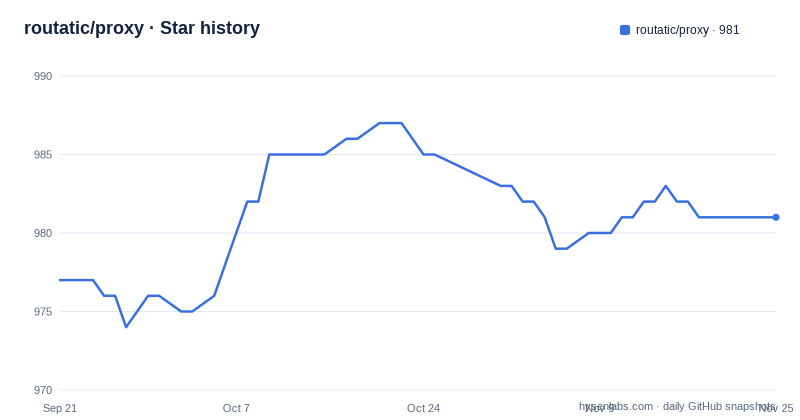
Star history
- routatic/proxy981 ★ · +4
| Repository | 2026-09-21 | 2026-11-25 |
|---|---|---|
| routatic/proxy | 977 | 981 |
4 Stars in the last 65 days, measured from the daily GitHub snapshot. Compare with other projects
Editorial analysis
The hop is local, the destination is whoever you configured
The setup is six steps and the two environment variables at the end are the whole mechanism:
# 3. Set your API key
export ROUTATIC_PROXY_API_KEY=sk-opencode-your-key-here

# 4. Start the proxy
routatic-proxy serve

# 5. Configure Claude Code
export ANTHROPIC_BASE_URL=http://127.0.0.1:3456
export ANTHROPIC_AUTH_TOKEN=unused
Claude Code is pointed at a loopback address and told that its own credential is the word unused, which is a deliberate placeholder rather than an oversight. The real key lives in the proxy, and the proxy decides where the request goes. What leaves your machine is therefore everything Claude Code would have sent to Anthropic: your prompts, the files it read, the diffs it produced, tool results, all of it forwarded to whichever provider you configured, rewritten into that provider's request shape and rewritten back. The page is straightforward about the mechanics, intercepting Anthropic API requests and transforming them to the appropriate format, OpenAI, Anthropic, Responses or Gemini, and about the effect, that Claude Code thinks it is talking to Anthropic while the requests go to the models you configured. Nobody has to be tricked for that to happen; it is the product, and it is worth being clear that this is a change of destination for your source code, not a caching layer.
Routing by scenario, and a chain that moves without telling you
Model selection is not one setting. Requests are routed automatically by context, with the scenarios named as default, thinking, long context and background, and a separate section of the configuration reference covers routing for streaming requests specifically. On top of that sit three mechanisms that change which model answers. Fallback chains try the next model in your configured chain when one fails. A circuit breaker tracks model health and skips failing models to avoid latency spikes. And an anthropic-first mode keeps Claude on Anthropic, using another provider only during rate limits or outages. The engineering here is sensible and the consequence deserves stating plainly. A conversation can start on one model and continue on another without a visible marker, and the tool-calling translation between formats is the part most likely to behave differently across providers. If you are reviewing code with this in the loop, the reviewer may change mid-task. The documentation has dedicated pages for custom routing and for debugging routing decisions, which is the right amount of warning for a feature of this kind.
Tool calls are translated, not forwarded
The reason this is more than a URL rewrite is stated in one feature line and it is the load-bearing one: proper translation of Anthropic tool_use and tool_result blocks to and from OpenAI and Gemini function calling. Every other capability on the list depends on it. Streaming is full server-sent events with the format transformation applied live rather than buffered, so a long response is relayed as it is produced. Hot reload watches the config file and reloads on change, which means editing a route takes effect without a restart, and the dashboard Settings tab edits the same file. Self-update installs the latest release with one command. What none of this changes is the boundary: a tool call that your client believes is local, such as a file write or a shell command, still round-trips through whatever provider answered, and the translated schema is the contract both sides agree on. Provider-specific extensions to either dialect are the place to look when a tool behaves differently under a fallback, and the page does not claim otherwise.
The module asks for Go 1.26, the container builds on 1.25
The dependency manifest opens with a line that the container contradicts:
module github.com/routatic/proxy

go 1.26.0
and the image starts from a 1.25 builder:
FROM golang:1.25-alpine AS builder
WORKDIR /app
COPY go.mod go.sum ./
RUN go mod download
COPY . .
ARG VERSION=docker
RUN CGO_ENABLED=0 go build -ldflags "-s -w -X main.version=${VERSION}" -o /app/routatic-proxy ./cmd/routatic-proxy
Go refuses to build a module declaring a newer language version than the toolchain provides, so the image as written cannot build the manifest as written, and a from-source build needs a newer toolchain than the image does. Two other details in the same file are worth noting. The build is forced to `CGO_ENABLED=0`, which is what makes a static binary for Alpine, and that is the same switch the macOS interface turns back on, since the native window and system tray are described as requiring CGO. And the version is injected at link time with a build argument that defaults to the word docker, so a container built without passing it reports a version of docker rather than a release number. The runtime stage runs as a non-root user, exposes port 3456, and health-checks a `/health` endpoint with wget every 30 seconds.
The image listens on every interface, the walkthrough does not
The runtime stage sets the host to a wildcard:
ENV ROUTATIC_PROXY_HOST=0.0.0.0
EXPOSE 3456
ENTRYPOINT ["routatic-proxy", "start", "--headless"]
while the documented quick start points Claude Code at `http://127.0.0.1:3456`. The two are not contradictory, they are just different defaults, and the difference matters if you run the image on a host with a routable address, because the wildcard publishes a proxy that holds your API key to anything that can reach the port. The dashboard is the opposite case: the page says it is available at `http://127.0.0.1:3445` when using `start` rather than `serve`, so the interface with the request history is loopback-only. There is a second mismatch in the same file. The image entrypoint calls `start` with a `--headless` flag, while the command list describes `serve` as the headless option and `start` as the variant that also brings up the dashboard. Both are documented; which one your build uses is not.
Windows gets a command line, macOS gets a window, Linux gets a browser
The interface story is three different answers. macOS gets a native Cocoa window with system tray integration, which requires CGO, delivered as a dmg from the releases page. Linux gets a browser-based interface through `xdg-open`, which is the default and needs no CGO, and a tray is available if you build with CGO enabled and install an appindicator package, named per distribution as `libappindicator-gtk3-devel` on Fedora and `libayatana-appindicator3-dev` on Ubuntu and Debian. Windows is not supported at all, command line only. Underneath all three the dashboard is the same, with an Overview tab for real-time metrics and the model distribution, a History tab holding the last 1000 requests with filters, and a Settings tab that edits the configuration with hot reload. The tray library in the dependency list is the source of those per-distribution packages, and its own transitive dependencies are pinned to 2019 pseudo-versions, which is a small thing to notice in a project that otherwise tracks its releases weekly.
The old name lives in the binary, the environment and the config path
The project was renamed and did not clean up, which is mostly helpful. The page states that `oc-go-cc` remains as a compatibility alias, that existing `OC_GO_CC_*` environment variables are still recognised, and that an existing `~/.config/oc-go-cc/config.json` is still read. The environment template keeps the old names as commented-out fallbacks:
# Legacy fallback names (still supported for migration)
# OC_GO_CC_API_KEY=sk-opencode-your-key-here
# OC_GO_CC_HOST=0.0.0.0
# OC_GO_CC_PORT=3456
and the container makes the alias real with a symlink from the new binary name to the old one. So a configuration written against either name works, and an old install does not break on upgrade. Two smaller signals. The release history shows v0.6.5 published alongside beta.8 and beta.6 on the same morning, twenty-odd minutes apart, which is a project shipping from a test branch. And the repository's homepage is a DeepWiki page, a generated wiki, rather than a site the project controls, while the tree itself is documentation-heavy: configuration, model reference, installation, troubleshooting, design, a walkthrough, a release process, and an `llms.txt` at the root, plus a JavaScript manifest whose only devDependency is Tailwind, which is how the dashboard styling is built inside a Go project.
Editorial conclusion
routatic-proxy fits a developer who has a subscription or a contract that makes one provider the cheaper or only sensible option, and who accepts that their prompts, diffs and tool results travel to that provider instead. It does not fit anyone who needs a predictable answer trail, because routing by context and fallback chains mean two turns of the same conversation can be handled by different models with different tool-call behaviour. Four things to check before you point your editor at it: which provider the default scenario actually resolves to, since a fallback chain silently changes the responder; whether the local port is bound to all interfaces, because the container image sets the host to 0.0.0.0 while the walkthrough uses 127.0.0.1; which Go version builds your copy, since the module declares 1.26.0 and the container builds on 1.25; and what the licence means for you, since the project is AGPL-3.0 and the image labels itself AGPL-3.0-only. The license is worth reading before you wrap it in anything. The newest release is v0.6.5 from September 11, 2026, and the last commit is dated October 2, 2026.
Frequently asked questions
What is routatic-proxy?
A Go proxy that sits between Claude Code and an upstream provider, intercepting Anthropic-format requests and transforming them into OpenAI, Anthropic, Responses or Gemini formats and back. Claude Code is pointed at a local address, and the proxy decides which provider answers.
How do I point Claude Code at routatic-proxy?
Set `ANTHROPIC_BASE_URL=http://127.0.0.1:3456` and `ANTHROPIC_AUTH_TOKEN=unused`, then run `routatic-proxy serve` with your own provider key in `ROUTATIC_PROXY_API_KEY`. The placeholder token is deliberate: the proxy holds the real credential.
Does routatic-proxy have a GUI?
On macOS, a native Cocoa window with a system tray, which requires CGO and ships as a dmg. Linux uses a browser-based interface by default, with an optional tray needing CGO and a per-distribution appindicator package. Windows is command line only.
What happens when a model in routatic-proxy fails?
A fallback chain tries the next model in your configured list, and a circuit breaker tracks model health and skips failing models to avoid latency spikes. There is also an anthropic-first mode that keeps Claude on Anthropic and uses another provider only during rate limits or outages.
What does routatic-proxy do with my code?
Forwards it upstream to the provider you configured, in that provider's request format, and translates tool calls and results between formats on the way back. Prompts, files read, diffs produced and tool results all reach that provider rather than Anthropic.
Official sources
Add this badge to your README
If you maintain this project, the badge below links readers to this analysis and shows its maintenance status from the daily GitHub snapshot. Paste the markdown into your README; add ?metric=license or ?metric=stars to the image URL for a different field.

[](https://hysenlabs.com/projects/routatic-proxy)Star history chart for your README
[](https://hysenlabs.com/projects/routatic-proxy)Was this useful?