React Suite (rsuite) 6.x: a React component kit with a separate stylesheet, a two-version browser window and a 5.x support clock
🧱 A suite of React components .
At a glance
- What is it?
- rsuite is an MIT-licensed set of React components written in TypeScript, published on npm with CommonJS and ESM builds and documented at rsuitejs.com. It fits teams on current browsers and recent frameworks; teams on older browsers or still on 5.x have dates and limits to check first.
- Who is it for?
- rsuite suits React teams that target the last two versions of Firefox, Chrome, Safari and Electron, want server side rendering with Next.js, and are ready to start on or move to 6.x. It is a poor fit if you must support browsers outside that window or plan to stay on 5.x long term, since 5.x gets no new features and only time-limited fixes.
- Can I use it commercially?
- Yes. MIT is a permissive licence: you can use, modify and sell software built on it, as long as you keep its copyright and licence notices.
- Is it still maintained?
- Yes. The repository last received commits 1 day ago.
- What is it written in?
- Mainly TypeScript, according to GitHub's language statistics.
Answers come from the project's GitHub data, last synced on November 14, 2026, and from our analysis. They are not legal advice.
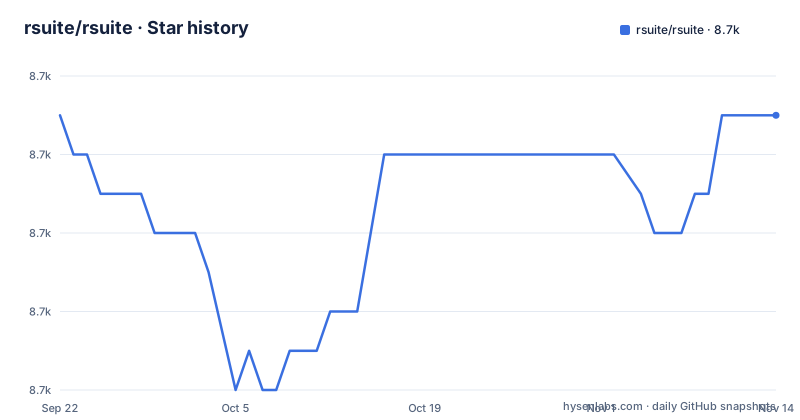
Star history
- rsuite/rsuite8,697 ★ · +0
| Repository | 2026-09-22 | 2026-11-14 |
|---|---|---|
| rsuite/rsuite | 8.7k | 8.7k |
0 Stars in the last 53 days, measured from the daily GitHub snapshot. Compare with other projects
Editorial analysis
Components and stylesheet are two separate imports
React Suite ships as the rsuite package on npm, installable with any of the four common clients:
# with npm
npm install rsuite

# with Yarn
yarn add rsuite

# with pnpm
pnpm add rsuite

# with Bun
bun add rsuite
The minimal usage example pulls a component from the package and the styles from a prebuilt CSS file in a second line:
import { Button } from 'rsuite';
import 'rsuite/dist/rsuite.css';

function App() {
  return <Button appearance="primary">Hello World</Button>;
}
The practical point is that the stylesheet is your responsibility. Importing Button does not bring the look with it; you have to wire rsuite/dist/rsuite.css into your bundler or app entry. The appearance prop on Button, set to primary here, is how the example picks a visual variant. Further getting-started guides live at rsuitejs.com/guide/usage/.
One package, built three ways from TypeScript and SCSS
package.json for version 6.2.5 points main at lib/cjs/index.js, module at lib/esm/index.js and typings at lib/esm/index.d.ts, so CommonJS and ES module consumers each get their own entry and TypeScript users get declarations without a separate types package. The build script chains four steps: build:ts runs gulp with gulpfile.js, build:scss runs scripts/build-scss.js, dist runs webpack once in development mode and once in production mode, and build:types emits declarations for both lib/cjs and lib/esm with tsc and then fixes path aliases with resolve-tspaths.
For contributors this means a full build touches gulp, webpack, tsc and a custom SCSS script, not a single bundler. Styles are written in SCSS under src and linted with stylelint through format:style. The repository also carries a benchmark for one component, run with bench:select-picker, plus vitest configuration, a storybook directory and a check:component-types script that verifies generated component names.
Browser support stops at the last two versions
The supported-browser table is short: Edge, and the last 2 versions of Firefox, Chrome, Safari and Electron. Nothing older is listed.
The consequence is concrete for anyone shipping to managed corporate machines, kiosks, or users who do not update Safari. If your audience includes browsers older than those two most recent releases, you are outside what React Suite says it supports, and a rendering bug there is yours to work around. Electron apps fare better, since you choose the Electron version you bundle, and the repository includes an examples/with-electron folder. Server side rendering is supported, and Next.js is named as the framework for building such applications.
Staying on 5.x now runs against a support clock
Documentation for the current release lives at rsuitejs.com, with older versions on their own sites: v5.rsuitejs.com, v4.rsuitejs.com and v3.rsuitejs.com. The policy for 5.x is spelled out. It will no longer receive new features, and upgrading to the latest 6.x releases is recommended. Bug fixes for 5.x continue for a period of time that is not given as a date, and security fixes are supported until 7.x is in progress.
For a team on 5.x, that means the end of security fixes is tied to the start of the next major version, not to a calendar date you can plan around. Budget the 6.x migration now rather than waiting for a cutoff announcement. Detailed changes for each release are kept in the GitHub release notes, and CHANGELOG.md sits at the repository root.
Only four frameworks get step-by-step guides
React Suite publishes framework guides for Next.js with the App router, Next.js with Pages, Create React App and Vite. Everything else falls back to the examples directory, which is much wider: cdn, custom-i18n, custom-multiple-themes, with-babel-preset-rsuite, with-flow, with-gatsby, with-nextjs-pages-and-less, with-parcel, with-postcss-rtl, with-preact, with-react-router, with-reason-webpack, with-remix, with-rollup, with-rtlcss, with-snowpack, with-styled-components, with-typescript and with-umi, alongside create-react-app, with-electron, with-nextjs-app, with-nextjs-pages and with-vite.
If you use Remix, Gatsby, Preact or Parcel, your starting point is example code, not a written walkthrough, so expect to read a sample project to work out the setup. The custom-multiple-themes, custom-i18n, with-rtlcss and with-postcss-rtl folders are the places to look for theming, localisation and right-to-left layouts.
Release cadence and a bilingual community
The project is not archived, and the last push landed on 2026-11-01. Recent releases came close together: v6.2.3 and v6.2.4 both on 2026-08-21, then v6.2.5 on 2026-10-04, which matches the version in package.json on the main branch.
The project runs in two languages. There is a README_zh.md and a CONTRIBUTING.zh-CN.md next to the English files, separate English and Chinese Gitter rooms, and a Discord server. Gitee recognises it as a GVP, Gitee Most Valuable Open Source Project. Vercel hosts the documentation site, CodeSandbox and Stackblitz power live component previews, and CodeCov monitors test coverage. Financial backing goes through OpenCollective, and the repository has a SECURITY.md for reporting vulnerabilities.
Editorial conclusion
rsuite suits React teams that target the last two versions of Firefox, Chrome, Safari and Electron, want server side rendering with Next.js, and are ready to start on or move to 6.x. It is a poor fit if you must support browsers outside that window or plan to stay on 5.x long term, since 5.x gets no new features and only time-limited fixes. Before adopting it, check that your framework has one of the four step-by-step guides or a matching folder under examples/, and read the 6.x release notes on GitHub.
Frequently asked questions
What is React Suite (rsuite)?
React Suite, published on npm as rsuite, is an MIT-licensed set of React components written in TypeScript for building web applications. It supports server side rendering with Next.js and is documented at rsuitejs.com.
Which browsers does rsuite support?
rsuite lists Edge and the last 2 versions of Firefox, Chrome, Safari and Electron. Older browser versions are not in the support table.
Is rsuite 5.x still supported?
rsuite 5.x no longer receives new features and the project recommends upgrading to 6.x. Bug fixes continue for a period of time, and security fixes are supported until 7.x is in progress.
How do I add rsuite styles to my app?
rsuite components and styles are imported separately. The usage example imports Button from rsuite and then imports rsuite/dist/rsuite.css.
Official sources
Add this badge to your README
If you maintain this project, the badge below links readers to this analysis and shows its maintenance status from the daily GitHub snapshot. Paste the markdown into your README; add ?metric=license or ?metric=stars to the image URL for a different field.

[](https://hysenlabs.com/projects/rsuite-rsuite)Star history chart for your README
[](https://hysenlabs.com/projects/rsuite-rsuite)Was this useful?