ruby/ipaddr: the default gem that keeps an address and its netmask together
A class to manipulate an IP address
At a glance
- What is it?
- A small standard-library gem for manipulating IP addresses, IPv4 and IPv6, where the CIDR prefix stays attached to the object and masking returns a new address. It ships with Ruby as a default gem, which means you probably already have a version of it and may have to pin a newer one.
- Who is it for?
- Use ipaddr when a job is small and specific: parsing an address, keeping a prefix attached to it, or narrowing one with a mask, with no gem declaration needed because it already ships with Ruby. Do not reach for it when you need range iteration, richer address maths or broader protocol coverage, because the README points at the ipaddress gem for exactly that case and keeps a compatibility layer with ipaddr.
- Can I use it commercially?
- Yes. BSD-2-Clause is a permissive licence: you can use, modify and sell software built on it, as long as you keep its copyright and licence notices.
- Is it still maintained?
- Yes. The repository received new commits within the last day.
- What is it written in?
- Mainly Ruby, according to GitHub's language statistics.
Answers come from the project's GitHub data, last synced on November 14, 2026, and from our analysis. They are not legal advice.
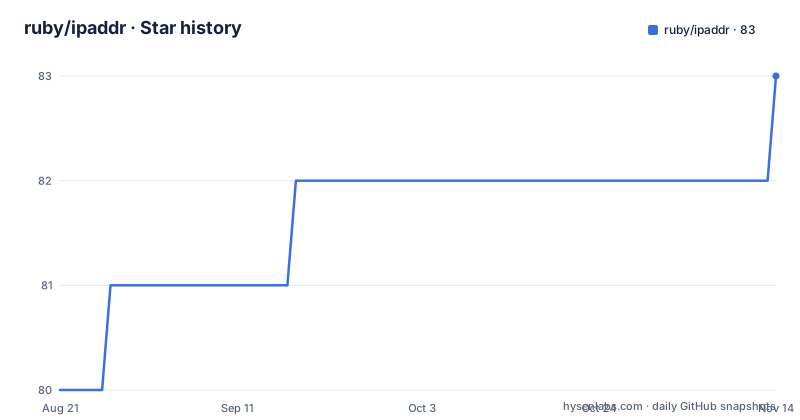
Star history
- ruby/ipaddr83 ★ · +3
| Repository | 2026-08-21 | 2026-11-14 |
|---|---|---|
| ruby/ipaddr | 80 | 83 |
3 Stars in the last 85 days, measured from the daily GitHub snapshot. Compare with other projects
Editorial analysis
You probably already have it, at whatever version Ruby shipped
This library is part of the standard Ruby distribution as a default gem, synchronized periodically, which is the first thing to establish before adding a dependency. Being a default gem does not mean being fixed: the copy you get is the one your Ruby version bundles, and that copy is only as new as your Ruby is. The documented reason to depend on it explicitly is a version constraint, the case where you need a newer ipaddr than older Ruby versions bring along.
gem 'ipaddr', '~> 1.2'With that line in the Gemfile, the install step is the usual one.
$ bundleOr, without a Gemfile at all, the gem installs itself.
$ gem install ipaddrSo the decision is not whether to install ipaddr but whether to accept the bundled version or pin a range, and the recent tags in the 1.2 line are what a `~> 1.2` constraint is written against.
mask returns a new address and leaves the original alone
The usage example is short enough to read in full, and every line of it shows something about the design.
require 'ipaddr'

ipaddr1 = IPAddr.new "3ffe:505:2::1"

p ipaddr1                   #=> #<IPAddr: IPv6:3ffe:0505:0002:0000:0000:0000:0000:0001/ffff:ffff:ffff:ffff:ffff:ffff:ffff:ffff>

p ipaddr1.to_s              #=> "3ffe:505:2::1"

ipaddr2 = ipaddr1.mask(48)  #=> #<IPAddr: IPv6:3ffe:0505:0002:0000:0000:0000:0000:0000:0000/ffff:ffff:ffff:0000:0000:0000:0000:0000>

p ipaddr2.to_s              #=> "3ffe:505:2::"

ipaddr3 = IPAddr.new "192.168.2.0/24"

p ipaddr3                   #=> #<IPAddr: IPv4:192.168.2.0/255.255.255.0>
`mask(48)` takes a prefix length and hands back a different IPAddr, with the mask applied and the host bits cleared. Nothing mutates in place, so `ipaddr1` still prints the full ffff mask after the call, which is the behaviour you want when you are walking a list of prefixes and need to keep the original around.
p expands every group while to_s keeps the compressed form
The same object prints two different ways, and the difference is not cosmetic. Inspecting `ipaddr1` shows every hextet expanded and padded, 3ffe:0505:0002:0000:0000:0000:0000:0001, followed by the prefix written as a mask of ffff values. `to_s` on the same object returns the compressed text you typed, 3ffe:505:2::1. After masking to 48, the compressed form collapses further to 3ffe:505:2:: because the remaining host bits are all zero, while the inspected form still shows the full eight groups plus a mask of ffff:ffff:ffff:0000 and four zero groups. Practical consequence: use `to_s` for anything a human or a log line will read, and expect the inspected form in debugging output to be much longer than the value you passed in.
A CIDR string arrives with its prefix already attached
Constructing from a slash notation keeps the prefix in the object, so there is no separate netmask argument to keep in sync. `IPAddr.new "192.168.2.0/24"` inspects as IPv4:192.168.2.0/255.255.255.0, which shows the dotted netmask form for IPv4 where the IPv6 example showed the colon-separated one. Both families are handled by the same class, and both keep address and prefix in a single value, so an address that came from configuration does not need its netmask reconstructed later. The library's stated scope is a set of methods to manipulate an IP address, with IPv4 and IPv6 supported, and the README does not walk through the wider method list, so the examples above are the documented surface rather than the whole of it. Anything beyond parsing, printing and masking, such as walking a range of addresses, has to be checked against the source in lib/ rather than assumed from the examples.
The alternative the README names is ipaddress, with a shim for ipaddr
One competitor is recommended by name, and the recommendation comes with a condition rather than a preference. The ipaddress gem is described as a popular, extensive library for manipulating IP addresses that carries a layer of compatibility with `ipaddr`, and the guidance is to try it if you need a richer set of features than ipaddr has. So the choice is a size trade: ipaddr is the smaller default gem that is already present and needs no declaration, while ipaddress is the larger library whose compatibility layer means existing ipaddr-shaped code can move across. What the README does not offer is a feature-by-feature comparison, so the practical test is whether the specific operation you need exists in ipaddr at all, since the escape hatch is only worth taking once you know what is missing.
Releasing is a version.rb edit and one rake task
The development workflow is spelled out for anyone working on the gem itself. After checking out the repository, `bundle install` installs dependencies and `rake test` runs the tests. To put the gem on a local machine, `bundle exec rake install` does it. Releasing is a two-step affair: update the version number in `version.rb`, then run `bundle exec rake release`, which creates a git tag for the version, pushes git commits and tags, and pushes the `.gem` file to rubygems.org. That last task does tagging, pushing and publishing in one command, so a release is a single invocation after the version bump and nothing else. The tree is correspondingly plain: a Rakefile, ipaddr.gemspec, Gemfile, lib/, test/, a CHANGELOG.md, LICENSE.txt and a .document file. Testing runs in GitHub Actions through a workflow file under .github/actions/workflows/test.yml, which is the badge the README links to, so a change to the library is exercised on every push rather than only on a maintainer's machine.
The tags show a long pause, then two releases two days apart
Version history is worth reading before you decide how much to trust the library. v1.2.7 was published on 2024-10-19, then nothing for the better part of a year and a half until v1.2.8 on 2026-04-23, with v1.2.9 following on 2026-04-25. So the recent pattern is two tags two days apart after a long quiet stretch, rather than a steady trickle of fixes. The last push to master is dated 2026-09-09, which is more recent than any tag. Licensing is the 2-Clause BSD License, and bug reports and pull requests are taken on GitHub at the repository, with no separate process described beyond that.
Editorial conclusion
Use ipaddr when a job is small and specific: parsing an address, keeping a prefix attached to it, or narrowing one with a mask, with no gem declaration needed because it already ships with Ruby. Do not reach for it when you need range iteration, richer address maths or broader protocol coverage, because the README points at the ipaddress gem for exactly that case and keeps a compatibility layer with ipaddr. Before you pin a version, check which one your Ruby ships, since the default gem is only synchronized periodically and the last releases landed on 2026-04-23 and 2026-04-25 after a long quiet stretch.
Frequently asked questions
What is my IP address and netmask?
With ipaddr both live in one object, because the CIDR prefix stays attached. IPAddr.new "192.168.2.0/24" inspects as IPv4:192.168.2.0/255.255.255.0, and an IPv6 address masked to 48 shows ffff:ffff:ffff:0000 and the rest of its groups as zero.
Does Ruby already include ipaddr?
Yes, it is part of the standard Ruby distribution as a default gem and is synchronized periodically, so the version you have is the one your Ruby bundles. You can add gem 'ipaddr', '~> 1.2' to a Gemfile when you need a newer version than older Ruby versions provide.
What does the ipaddr mask method return?
A new IPAddr with the mask applied and the host bits cleared, leaving the original untouched. In the README example, mask(48) on 3ffe:505:2::1 returns an address whose to_s is 3ffe:505:2:: while the original still prints the full ffff mask.
Why does inspecting an IPAddr show more text than to_s?
The inspected form expands every hextet and pads it, 3ffe:0505:0002:0000:0000:0000:0000:0001, and prints the prefix as a mask of ffff values, while to_s returns the compressed address as written. Use to_s when the value is read by a person or a log.
What is the alternative to the ruby ipaddr gem?
The README names the ipaddress gem, described as a popular, extensive library for manipulating IP addresses that includes a layer of compatibility with ipaddr. The guidance is to switch when you need a richer set of features than ipaddr provides.
Official sources
Add this badge to your README
If you maintain this project, the badge below links readers to this analysis and shows its maintenance status from the daily GitHub snapshot. Paste the markdown into your README; add ?metric=license or ?metric=stars to the image URL for a different field.

[](https://hysenlabs.com/projects/ruby-ipaddr)Star history chart for your README
[](https://hysenlabs.com/projects/ruby-ipaddr)Was this useful?