DeepAnalyze puts an 8B agent on the whole data pipeline, from raw table to finished report
DeepAnalyze is the first agentic LLM for autonomous data science. Your AI data analyst that automatically analyzes large volumes of data and generates professional analysis reports with one click.
At a glance
- What is it?
- A research group release from Renmin University and Tsinghua that lets one model do data preparation, analysis, modeling, visualization and report writing, with the weights, the code and the training set all published. The cost is that autonomy means the model writes and runs code, and that nothing is versioned yet.
- Who is it for?
- DeepAnalyze fits a data scientist or researcher who wants an analyst-grade report from their own data without writing the analysis, and who is willing to host the weights and read the code the agent runs. It does not fit a pipeline that needs reproducible versioned behaviour, because the repository publishes no releases and the model, the code and the training set move separately.
- Can I use it commercially?
- Yes. MIT is a permissive licence: you can use, modify and sell software built on it, as long as you keep its copyright and licence notices.
- Is it still maintained?
- Yes. The repository last received commits 13 days ago.
- What is it written in?
- Mainly Python, according to GitHub's language statistics.
Answers come from the project's GitHub data, last synced on November 15, 2026, and from our analysis. They are not legal advice.
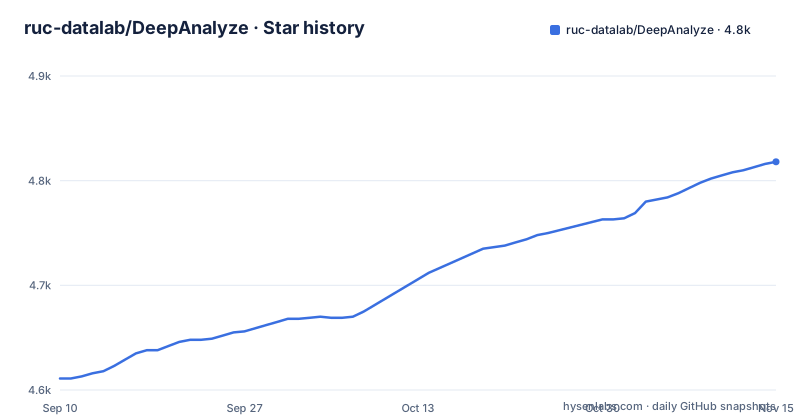
Star history
- ruc-datalab/DeepAnalyze4,818 ★ · +207
| Repository | 2026-09-10 | 2026-11-15 |
|---|---|---|
| ruc-datalab/DeepAnalyze | 4.6k | 4.8k |
207 Stars in the last 66 days, measured from the daily GitHub snapshot. Compare with other projects
Editorial analysis
One agent for preparation, modeling, visualization and the report
The claim is narrow and checkable: this is an agentic large language model for autonomous data science, and it is meant to complete data centric tasks without human intervention. The pipeline it names runs from data preparation through analysis and modeling to visualization and report generation, so the unit of work is a finished analyst grade report rather than an answer to a single question. That framing explains the design. A system that stops at a chart or a dataframe leaves the writing to you; one that generates the report is aiming at the handoff to a reader. The provenance is academic and stated up front: the authors are Shaolei Zhang, Ju Fan, Meihao Fan, Guoliang Li and Xiaoyong Du, from Renmin University of China and Tsinghua University, with the paper on arXiv as 2510.16872 and a project page at ruc-deepanalyze.github.io. It is also a project with a public track record rather than a demo: 4,769 GitHub stars.
Structured, semi structured and unstructured data in one pass
Open ended research is claimed across three data shapes, and the formats are named rather than left vague. Structured data means databases, CSV and Excel. Semi structured means JSON, XML and YAML. Unstructured means TXT and Markdown. That list matters more than it first appears, because a pipeline that only reads CSV leaves the report half written for anyone whose source of truth is an API response or a runbook. The dependency list backs this up: openpyxl is there for spreadsheets, pandas and numpy for tables, and pypandoc sits in the web UI group for document conversion.
Four artifacts that move independently, and no version tags
Open sourcing here means four separate downloads: the model weights as DeepAnalyze-8B, the code, the training data as the DataScience-Instruct-500K dataset, and a demo. All four are linked from the root page. The licence is MIT and the default branch is main, but the repository publishes no GitHub releases, so there is no tag to pin and no stated compatibility between a given code revision and a given weight revision. For a research codebase that is normal. For anyone who intends to run this in a repeated batch process, it is the practical cost: you are tracking a moving main branch and two artefacts hosted elsewhere, and the project does not publish a matrix telling you which combination was tested. The last push is 2026-11-02, so work is landing; what is missing is the release discipline around it, not the activity.
requirements.txt leaves vllm commented out
The dependency file is short and readable, and one line in it is commented out:
numpy
pandas
openpyxl
scikit-learn
seaborn
torch
transformers
matplotlib
plotly
statsmodels
Above that block sits a commented vllm>=0.8.5. Read plainly, the default path is torch and transformers, and vLLM is something you add when you want faster inference on your own hardware. That choice keeps the install small for anyone already running Python data work, and it also means the performance people associate with vLLM is not what you get by default. A second group covers the web interface:
requests
websockets
python-multipart
uvicorn
fastapi
openai
pypandoc
The presence of both fastapi and uvicorn explains how a browser front end talks to the agent. So the file tells you the local serving path and the server path in one screen, which is more than the prose does.
Five front ends in demo/, and only one of them needs Docker
The repository keeps several interfaces side by side, which is where you should look first to pick the one that matches your job:
deepanalyze.py
run.py
quantize.py
demo/chat/
demo/chat_v2/
demo/cli/
demo/jupyter/
demo/mock_vllm/
Alongside those sits a deepanalyze_general demo and an API/ directory at the top level. The directory names point to chat, chat_v2, command line and Jupyter front ends. A mock_vllm demo directory suggests the interface can be exercised without a real inference server. The cost of this variety is that a newcomer has six directories to read before knowing which one to start.
Autonomy means the model writes and runs code on your data
There is no human in the loop by design, and the sibling benchmark makes the mechanics plain. CoDA-Bench, released in June 2026, evaluates agents in a Linux sandbox with hundreds of data files, and the agent has to discover the relevant data, write executable code and produce the final answer. That is the same shape of task DeepAnalyze targets, so the group is measuring the difficulty of the thing it built. For a reader the consequence is direct: your tables go in, and a language model decides what code to write and executes it. Which route you take decides where that happens. Running the weights yourself keeps the data near your machine.
A pipeline that keeps growing around the model
The news entries read like a roadmap for an agent platform rather than for a single model. In 2026.06 the CoDA-Bench benchmark arrived for evaluating code agents on analytical work. On 2026.05.31 an entry covers DA-Studio, which has its own arXiv paper. In September 2026 came EvoOntology, described as a self evolving ontology layer for data agents, and SkillAdam, a plugin that improves agent skills from a SKILL.md and integrates with Codex, Claude Code, Cursor Agent and GitHub Copilot. One entry is explicitly future tense: DeepPrep, the data preparation companion, is something the group says it looks forward to releasing, so a reader should not treat it as available. Reading these together, the honest summary is that the model is the centre and the scaffolding around it is what is being built.
Editorial conclusion
DeepAnalyze fits a data scientist or researcher who wants an analyst-grade report from their own data without writing the analysis, and who is willing to host the weights and read the code the agent runs. It does not fit a pipeline that needs reproducible versioned behaviour, because the repository publishes no releases and the model, the code and the training set move separately. Before you point it at anything sensitive, check whether you are running the weights yourself or sending your data to someone else's inference.
Frequently asked questions
What is DeepAnalyze and what does it automate?
It is described as an agentic large language model for autonomous data science, meant to finish data centric tasks without human intervention. It names data preparation, analysis, modeling, visualization and report generation as the stages it covers.
Which data formats can DeepAnalyze read?
Structured data means databases, CSV and Excel. Semi structured data means JSON, XML and YAML. Unstructured data means TXT and Markdown, and the project claims analyst grade research reports over all three shapes.
What do I need to run DeepAnalyze on my own machine?
The dependency file lists numpy, pandas, openpyxl, scikit-learn, seaborn, torch, transformers, matplotlib, plotly and statsmodels, with a vllm>=0.8.5 line left commented out, plus fastapi, uvicorn, openai, websockets and pypandoc for the web interface. You also need the DeepAnalyze-8B weights from Hugging Face, and the entry points sit in deepanalyze.py, run.py and the demo directories.
Does DeepAnalyze have version tags I can pin?
No. The repository publishes no GitHub releases and works from the main branch, so there is no tag to pin and no stated pairing between a code revision and a weight revision. The model, the code and the DataScience-Instruct-500K training set are released as separate artifacts.
Which interfaces does DeepAnalyze expose?
There is a web interface with a v2 directory, a command line terminal UI, a Jupyter interface, and an API directory at the top level, going by the demo/ and API/ directories in the repository.
Official sources
Add this badge to your README
If you maintain this project, the badge below links readers to this analysis and shows its maintenance status from the daily GitHub snapshot. Paste the markdown into your README; add ?metric=license or ?metric=stars to the image URL for a different field.

[](https://hysenlabs.com/projects/ruc-datalab-deepanalyze)Star history chart for your README
[](https://hysenlabs.com/projects/ruc-datalab-deepanalyze)Was this useful?