TransmogrifAI's stable release is a 2020 tag and its install snippet names jcenter
TransmogrifAI (pronounced trăns-mŏgˈrə-fī) is an AutoML library for building modular, reusable, strongly typed machine learning workflows on Apache Spark with minimal hand-tuning
At a glance
- What is it?
- Salesforce's AutoML library for structured data on Spark, written in Scala with a compile-time typed feature API. The library is genuinely well documented for what it is, and the documentation is anchored in 2020: Spark 2.4, Scala 2.11, Java 8, a Gradle snippet using the retired compile configuration, and a repository block pointing at a service whose status the page never discusses.
- Who is it for?
- Read this as a library to study rather than a dependency to adopt, unless your stack is already the one it targets. If you are on Spark 2.4, Scala 2.11 and Java 8, the typed feature DSL is a genuinely instructive design and the test suite, test data and template modules make it readable.
- Can I use it commercially?
- Yes. BSD-3-Clause is a permissive licence: you can use, modify and sell software built on it, as long as you keep its copyright and licence notices.
- Is it still maintained?
- Yes. The repository last received commits 166 days ago.
- What is it written in?
- Mainly Scala, according to GitHub's language statistics.
Answers come from the project's GitHub data, last synced on November 15, 2026, and from our analysis. They are not legal advice.
Star history
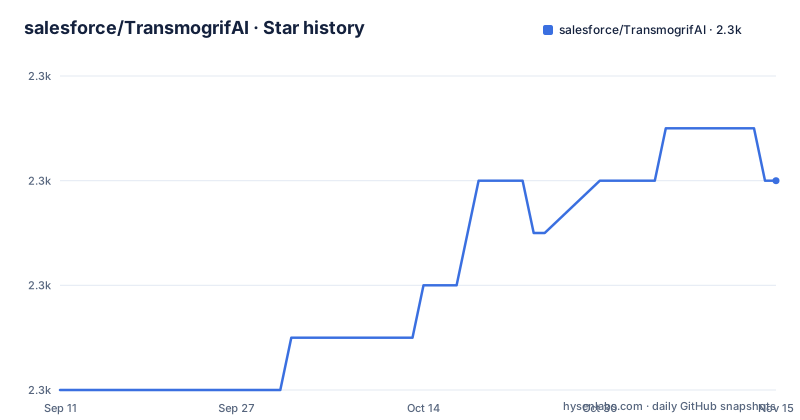
- salesforce/TransmogrifAI2,280 ★ · +4
| Repository | 2026-09-11 | 2026-11-15 |
|---|---|---|
| salesforce/TransmogrifAI | 2.3k | 2.3k |
4 Stars in the last 65 days, measured from the daily GitHub snapshot. Compare with other projects
Editorial analysis
The newest tag is from 2020 and the branch is an unreleased 0.7.1
The release list has three entries and the newest is 0.7.0, published on 2020-06-11, preceded by 0.6.1 in September 2019 and 0.6.0 in July 2019. The version matrix then adds a detail the release list does not: it names 0.7.1 as unreleased on the default branch, with 0.7.0 marked as the stable choice. So the branch has been carrying an unreleased 0.7.1 for six years, and the last commit on it is dated 2026-06-02. Nothing here is hidden, and the page does not claim the library is under active development; it simply presents a stable version that is six years old next to a branch that is a day short of four. If you pin to stable you get 2020 code. If you track the branch you get 2026 code that no artifact has ever been published for, and the README's own advice, take the stable one, is the safer read.
The dependency snippet names a retired repository and the old configuration
Both build snippets are worth reading literally. The Gradle block opens with a repositories section listing a legacy hosted repository before Maven Central, and the dependency line inside uses the old `compile` configuration:
compile 'com.salesforce.transmogrifai:transmogrifai-core_2.11:0.7.0'The SBT block names the same repository through its own resolver constant and pins the compiler:
scalaVersion := "2.11.12"Two observations. The page never states a minimum version for Gradle or SBT, so whether `compile` is accepted depends entirely on the build you already have, since that configuration name was removed from later Gradle releases. And the repository entry is named ahead of Maven Central without a word of explanation, while the badges at the top of the page point at a different index, where the artifacts are searchable by group and the javadoc link resolves the same core artifact. An optional second artifact is commented out in both snippets, described as carrying pretrained models such as part-of-speech and named-entity taggers.
The support matrix tops out at Spark 2.4 and never mentions a newer major
The matrix has three rows covering six releases. The stable 0.7.0 line and the unreleased 0.7.1 on the default branch map to Spark 2.4, Scala 2.11 and Java 1.8. The 0.6 and 0.5 releases map to Spark 2.3 on the same Scala and Java. The oldest two rows, 0.4.0 and 0.3.4, map to Spark 2.2. There is no row for any later Spark. That is the practical limit, and it is encoded in the artifact name rather than stated in prose: every coordinate on the page ends in `_2.11`, which is the Scala binary version, so a project on a different Scala version is not looking at a different version of this library but at no artifact at all. The page's stated purpose, building production machine learning applications in hours, is a 2019 proposition, and the honest reading is that this is a library from the Spark 2 era that is still readable rather than a current option for a Spark 3 or 4 cluster.
The hundred-fold claim sits next to no methodology at all
The second line of the introduction, in italics, says the library achieves accuracies close to hand-tuned models with almost a hundred-fold reduction in time. No dataset, no baseline definition, no measurement protocol and no hardware description accompany it. The nearest thing to evidence on the page is the Titanic walkthrough further down, which shows a model selection run over three folds with a precision-recall metric and reports ranges for two model families, which is a demonstration that the library runs rather than a measurement of the claim. This is the pattern the page invites you to accept: a quantified headline, a tutorial that demonstrates function, and a blog post plus three conference talks linked underneath as the authority for the reasoning. None of that makes the library worse, but a reader deciding whether to adopt it should notice that the number is a marketing line in a repository whose release cadence stopped in 2020.
The Titanic walkthrough stops twice, once mid-expression and once mid-table
The example that opens the page is the Titanic survivor prediction, and it is cut off in two separate places. The Scala listing ends on the line that extracts the response and predictor features, mid-expression, with no closing of the statement. The printed model summary below it ends inside a table of the selected model's parameters, on the row for its binning setting, after having reported that sixteen random forest models were evaluated within a precision-recall range and that three logistic regression models were evaluated within another. Everything after those two blocks is complete: the install instructions, the support matrix, both dependency snippets, the import list, the documentation links and the author list. So the parts a newcomer reads first are the damaged parts, while the parts aimed at someone who already decided are intact. Anyone following the walkthrough has to reconstruct the feature extraction call from the documentation site.
Two build systems ship for one library
The root carries both a Gradle build with a settings file and a Gradle wrapper, including the Windows batch variant, and a Maven project file. A library that maintains two build definitions for the same artifact set carries the cost of that choice in every release, and it is visible here in the fact that the README has two dependency snippets to keep in step, which they are, down to the commented-out optional artifact in both. The module layout follows the Scala packages rather than a feature grouping: a core module, a features module, a readers module, a utils module, a models module, a command-line module, a testkit, a template module, a small example project, a repl entry, a local directory, test data and a resources directory. That is a lot of modules for a library whose public story is one typed feature API, and it explains why the API list in the import section has five lines of internal imports plus an optional block of five Spark extension imports.
Three CI integrations and a migration tool in the root
The badge row at the top of the page shows links to a hosted continuous integration service, a second hosted service configured through a directory in the repository, and a code-quality badge from a third service, while the root also carries a GitHub directory. So there are three continuous integration configurations to keep working rather than one, and the page gives no indication of which is authoritative or whether the older ones still run. Next to them sits a directory whose name refers to migrating issues out of a hosted forge, a leftover from the era when the project was hosted elsewhere. The documents in the root are conventional for a project of this age: a changelog, a code of conduct, a contributing guide, a licence file, a roadmap and a security policy. The roadmap is the file worth opening first, because a release that stopped in 2020 is easier to evaluate against a plan than against a marketing claim.
The type-safety claim is the product, and the escape hatch is documented
Everything in the positioning rests on one API idea: features are typed at compile time, so a pipeline that misuses a column does not compile. The import list shows how that is enforced in practice, with separate packages for feature types and feature builders alongside readers and aggregators, and the page insists the workflows are modular and reusable as a direct consequence. It is also careful to say what the automation is not for. The paragraph after the Titanic example notes that for anyone who wants more control the library lets you specify every feature being extracted and every algorithm in the pipeline by hand, and calls the automatic version perhaps a bit too magical. That is an unusual admission to put on a landing page, and it is the honest framing for the whole library: the automation is a set of defaults with a typed interface in front of it, and the value is in the typing, not in the guessing.
Editorial conclusion
Read this as a library to study rather than a dependency to adopt, unless your stack is already the one it targets. If you are on Spark 2.4, Scala 2.11 and Java 8, the typed feature DSL is a genuinely instructive design and the test suite, test data and template modules make it readable. If you are anywhere else, the page itself is the obstacle: the version matrix has no row for a newer Spark, the artifact name encodes the Scala binary version, and the newest published release is from 2020 while the branch carries commits to 2026 with no release attached. Two things to check before you start: whether the repository entry in the dependency snippet still resolves anything, since the badges point at a different index, and whether your build accepts the older configuration name used in the snippet. Either way, pin the version you actually use rather than tracking the branch.
Frequently asked questions
What is TransmogrifAI?
It is Salesforce's BSD-3-Clause licensed AutoML library for structured data, written in Scala and running on Apache Spark, with an API built around compile-time type safety, modularity and reuse. The page positions it for building production machine learning applications quickly without deep machine learning expertise, and for pipelines where you want full control over the features and algorithms rather than defaults.
Which Spark, Scala and Java versions does TransmogrifAI support?
The support matrix covers six releases in three rows: the stable 0.7.0 and the unreleased 0.7.1 on the default branch target Spark 2.4, Scala 2.11 and Java 1.8; the 0.6 and 0.5 releases target Spark 2.3; and 0.4.0 and 0.3.4 target Spark 2.2. There is no row for a later Spark, and every artifact coordinate ends in the Scala binary version 2.11.
How do I add TransmogrifAI to a project?
As a regular dependency, with a Gradle snippet using the core artifact and a commented-out models artifact for pretrained taggers, and an equivalent SBT snippet that sets the Scala version to 2.11.12. Both snippets name a hosted repository before Maven Central and the Gradle one uses the old compile configuration, and the page states no minimum build tool version.
What is the release state of TransmogrifAI?
The newest published release is 0.7.0 from 2020-06-11, after 0.6.1 and 0.6.0 in 2019, while the default branch has commits through 2026-06-02 and the support matrix labels the branch as an unreleased 0.7.1. The page recommends taking the stable version when unsure, which is the 2020 tag.
Official sources
Add this badge to your README
If you maintain this project, the badge below links readers to this analysis and shows its maintenance status from the daily GitHub snapshot. Paste the markdown into your README; add ?metric=license or ?metric=stars to the image URL for a different field.

[](https://hysenlabs.com/projects/salesforce-transmogrifai)Star history chart for your README
[](https://hysenlabs.com/projects/salesforce-transmogrifai)Was this useful?