EthList: a reading list written as unchecked GitHub tasks
The Comprehensive Ethereum Reading List
At a glance
- What is it?
- A crowdsourced Ethereum reading list whose entire body is a checkbox list, ordered by how deep the reader wants to go. It is two files in the repository, and at least one entry's label and destination do not match.
- Who is it for?
- Take EthList as a reading order rather than as a reference, since it is organised by depth rather than by topic, starting with visual demonstrations and moving to the yellow paper and fork history. Check three things before you rely on it.
- Can I use it commercially?
- Not without permission. GitHub finds no licence file in the repository, and without a licence all rights are reserved by default: you may read the code but not reuse it. Check the README, or ask the authors, before using it.
- Is it still maintained?
- Activity is slowing. The repository last received commits 6 months ago.
- What is it written in?
- GitHub does not report a main language for this repository.
Answers come from the project's GitHub data, last synced on November 22, 2026, and from our analysis. They are not legal advice.
Star history
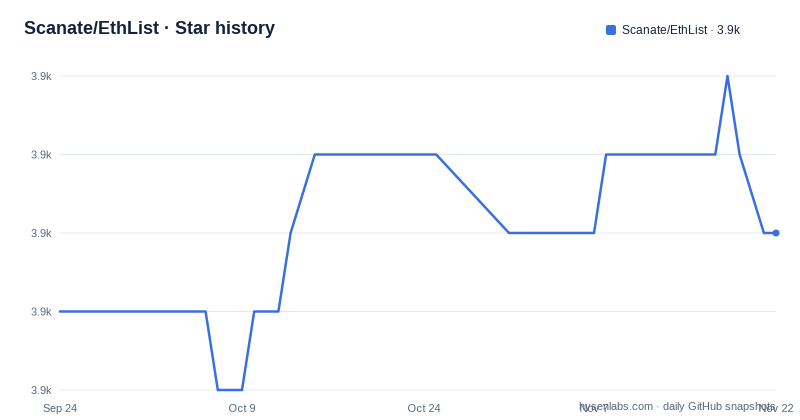
- Scanate/EthList3,872 ★ · +1
| Repository | 2026-09-24 | 2026-11-22 |
|---|---|---|
| Scanate/EthList | 3.9k | 3.9k |
1 Stars in the last 59 days, measured from the daily GitHub snapshot. Compare with other projects
Editorial analysis
Every entry is an unchecked box, so nobody shares progress
The formatting decision defines the project's character. Every reading item is written as a GitHub task item, rendered as an empty checkbox, which means a reader can click one and the file changes. That is a real interaction and a real limitation: the tick lives in whatever copy the reader has, so checking off fifty links produces a personal fork and tells the maintainers nothing. There is no completion state in the project itself, and the second file in the repository makes that explicit. The tree contains exactly two entries, `README.md` and `myprogress.md`, and the second one is a personal progress file, so somebody's checklist is committed next to the list. For a crowdsourced resource that is at least internally consistent: the contribution mechanism is a pull request, as the header invites, and the header also links an old share link pointing at a domain that is not the repository.
Seven sections, ordered by how deep the reader wants to go
The top navigation is a table of seven sections, and the ordering is by difficulty rather than by subject: Introduction, Getting Started, Ecosystem, Thought Pieces, Trading, Programming, and Legal. That means a programming question and a tax question are in different places in the document because of who the reader is assumed to be, not because the topics relate. The Introduction section then splits further. There is a subsection for simple explanations of Ethereum, which is dominated by videos and beginner guides, a subsection for deeper explanations, and a subsection for history articles. The deeper subsection is where the specifications live, linking the general White Paper, the technical Yellow Paper as a PDF, the Minimum Viable Blockchain post, and a platform overview PDF. So the entry point for a newcomer is a video, and the entry point for someone who wants the actual protocol definition is a link out to the Ethereum wiki and a PDF rather than anything hosted here.
Hard fork entries carry block numbers, and one date disagrees with its own link
The protocol history section is the most valuable part and the most dated. Each entry pairs a fork name with a block number and a date, followed by links. The Olympic pre-release on testnet, chain #0, dated 9 May 2015. Frontier, the public release, at Ethereum Genesis, chain #1, dated 30 July 2015. Homestead at block 1,150,000, dated 14 March 2016. The DAO Fork at block 1,920,000, dated 20 July 2016, with a link to the opposition discussion on r/EthereumClassic. And the DoS Fork at block 2,463,000, dated 18 October 2016. The pattern of pairing a block number with a date is what makes this list useful, since it lets you look up a block and know which rules applied. The Homestead entry has an internal inconsistency worth noting: the heading says 14 March 2016 while the blog post it links is dated 29 February in its own path. One of the two is wrong, and the list does not resolve which.
Devcon is listed only up to year three
The conference section lists the annual Ethereum Developer Conference by year and city: Devcon 0 in Berlin in 2014, Devcon 1 in London in 2015, Devcon 2 in Shanghai in 2016, and Devcon 3 in Cancún in 2017. Each is a link to talks and videos, with the first three pointing at specific YouTube playlists and the fourth pointing at a channel rather than a playlist. So the list stops at the fourth conference. Given the fork history also stops in 2016 in the visible portion, the two sections are consistent with a resource that was last substantially extended around then, even though later entries exist elsewhere in the document. The deeper section carries one item that is much newer, a piece on proof-of-stake and the decentralisation debates, which shows the list has been appended to in places rather than uniformly kept current.
One link's label and destination do not match
In the simple explanations subsection, the entries are described as visual demonstrations, hands-on CLI learning, and explanatory articles, and most of them are what they claim. The first three are a visual blockchain demo site, a minimal blockchain learning repository with a hands-on CLI, and a coin demo site. The fourth is labelled a visual demonstration of a blockchain, and it points at a URL under a different domain whose path reads as a best bitcoin wallet guide for 2026. So that entry is a wallet guide sitting in a list of blockchain visualisations, and it is the only entry in the section dated 2026 in its own path. This is the sort of thing that happens to a crowd-sourced list over years: somebody added a link that has since been repurposed, or the label and the URL drifted apart. It is also a reminder to check what a link resolves to rather than trusting a description written by a volunteer.
Contributors are named with their organisations, and the licence is not stated
The header credits thirteen contributors and attaches an affiliation to most of them, which is unusual for a link list and useful context for who curates it. Kingsong Chen is the repository owner, and the others are named with organisations including Fortune Magazine, Aragon, CoinFund, Santiment, Status, and Giveth.io, plus several contributors given only as names, one as Eeks, and one as Anonymous. The affiliations span journalism, investment funds, prediction markets, and an Ethereum client project, which tells you the list was assembled by people who work in the space rather than by a documentation team. What the page does not do is state a licence, and the project is recorded as having no identifiable licence in its metadata, with no LICENSE file among the two repository entries. For a list people are invited to submit pull requests to, that is worth raising with the owner rather than assuming.
Editorial conclusion
Take EthList as a reading order rather than as a reference, since it is organised by depth rather than by topic, starting with visual demonstrations and moving to the yellow paper and fork history. Check three things before you rely on it. The entire list is written as unchecked GitHub task items, which means a reader can tick them off but that state lives in their own fork rather than in a shared list, so nobody else benefits from your progress. The repository is two files, `README.md` and `myprogress.md`, and the second is a personal progress file rather than project documentation. And the maintenance date is concrete rather than a cadence: the default branch was last pushed on 2026-05-04, and fork entries stop at the DoS fork on 2016-10-18 in the visible portion of the list.
Frequently asked questions
What is EthList used for?
It is a crowdsourced Ethereum reading list, organised into seven sections covering introduction, getting started, ecosystem, thought pieces, trading, programming, and legal topics, with entries ordered by how much depth the reader wants.
How do I add a resource to EthList?
The header asks readers who find a great resource to add it by submitting a pull request. Every entry in the list is written as an unchecked checkbox, so ticking one only changes your own copy rather than recording progress for anyone else.
Does EthList document Ethereum hard forks?
Yes, with each fork paired to a block number and date, from the Olympic pre-release on 9 May 2015 and Frontier on 30 July 2015 through Homestead, the DAO Fork, and the DoS Fork on 18 October 2016, each linking a blog post and relevant EIPs.
Where are the official Ethereum specifications linked from EthList?
The deeper explanations section links the general White Paper on the Ethereum wiki, the technical Yellow Paper as a PDF, a platform overview PDF, and the Minimum Viable Blockchain post. None of them is hosted in the repository.
Official sources
Add this badge to your README
If you maintain this project, the badge below links readers to this analysis and shows its maintenance status from the daily GitHub snapshot. Paste the markdown into your README; add ?metric=license or ?metric=stars to the image URL for a different field.

[](https://hysenlabs.com/projects/scanate-ethlist)Star history chart for your README
[](https://hysenlabs.com/projects/scanate-ethlist)Was this useful?