Vocabulary is added on evidence of use, release planning lives in Issue #1, and elegance is explicitly refused
Schema.org - schemas and supporting software
At a glance
- What is it?
- The schemaorg repository holds the schemas, examples and publishing software behind Schema.org, not the site itself. Its readme is really a governance document: what counts as a good reason to add a term, which reorganisations will be declined, which outside standards get blended in, and where a release is planned.
- Who is it for?
- Read this repository as a governance record rather than as a library to install. If you want to embed Schema.org, the site is the place to go, and the useful question for a proposal is not whether the term is elegant but whether a named consuming application would use it.
- Can I use it commercially?
- Yes. Apache-2.0 is a permissive licence: you can use, modify and sell software built on it, as long as you keep its copyright and licence notices.
- Is it still maintained?
- Yes. The repository last received commits 3 days ago.
- What is it written in?
- Mainly HTML, according to GitHub's language statistics.
Answers come from the project's GitHub data, last synced on November 15, 2026, and from our analysis. They are not legal advice.
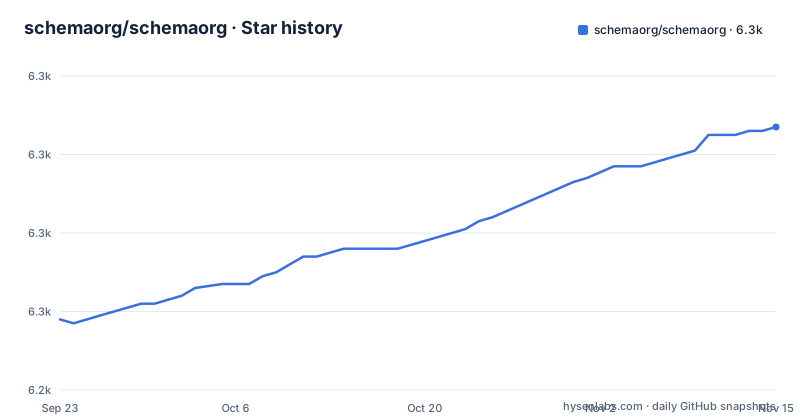
Star history
- schemaorg/schemaorg6,307 ★ · +49
| Repository | 2026-09-23 | 2026-11-15 |
|---|---|---|
| schemaorg/schemaorg | 6.3k | 6.3k |
49 Stars in the last 53 days, measured from the daily GitHub snapshot. Compare with other projects
Editorial analysis
New vocabulary needs a consuming application, and search engines do not count
The readme states its own admission rule in plain terms. The project tries to prioritise simple fixes and improvements to existing schemas, examples and documentation over the addition of new vocabulary, and it is most likely to add a new schema when there is evidence that some consuming application, preferably a large-scale one, will make use of the data. Then it defines who counts as a consumer, and the list is deliberately wider than the usual answer: consuming applications need not be search engines, and open source tools, markup-enriched approaches to web analytics, browser add-ons and cloud tools are all named as rich areas. One sentence closes the loophole people usually walk through, saying it is not sufficient to justify additions on the basis that search engines generally try to use Schema.org-based structured data. Smaller changes, and changes that stay backwards compatible, are described as easier to incorporate. The collection has been growing gradually since launch in 2011, which is the pace the same paragraph implies.
Reorganising the terminology for elegance will be declined
One paragraph exists purely to say no. The project is described as highly unlikely to take on large-scale reorganisations of its terminology if they are motivated solely by considerations of elegance, proper modeling, ontological purity or conceptual unification. The reasoning follows: the founders and team are familiar with those traditions and respectful of them, but the scale, scope and nature of the project have required a trade of elegance and global consistency for incremental evolution and a pragmatic tolerance for a style that would be out of place in a formal ontology. Proposals for unifying cross-domain logic-based knowledge structures are redirected to a community forum for ontological work. A related sentence covers the other half of the same trade: types are sometimes introduced without dedicated property associations, simply for markup usability, which a formal ontology would call poor modeling but which avoids errors from publishers who do not know the underlying formal concepts.
The vocabulary is meant to stay incomplete, and other vocabularies mix in
Two statements sit close together and pull in the same direction. The first says Schema.org does not attempt to capture the full detail of web content, that it is necessarily a simplification of something more complex, and that in the interests of keeping it simple and usable for publishers and webmasters the project will often choose not to add detail even where adding it looks possible. The second says the vocabulary is not a closed system, and that other initiatives, naming Wikidata and GS1, have defined many other terms that can be mixed in alongside the ones defined here. Extension is expected to happen through the web standards themselves: JSON-LD, Microdata and RDFa are named as the mechanisms that allow independent extension, with GS1's vocabulary given as the example. So the design is a small, deliberately incomplete core plus a documented path for putting more in without asking this project to absorb it.
Five outside standards shaped the vocabulary, and the readme names each one
The credit list is unusually specific, and it is organised by domain. For bibliographic and cultural heritage work the project names MARC, BibFrame and FRBR. For e-commerce it says it collaborated with Good Relations and with GS1. The news-related terms were heavily influenced by incorporating IPTC's rNews design, alongside collaborations with fact checkers and with the Trust Project. TV and music vocabularies are described as heavily influenced by working with the BBC and the European Broadcasting Union, alongside a music ontology and MusicBrainz. The stated philosophy is collaboration over purity: the project prefers to blend and integrate such designs rather than produce its own pure model in isolation, and it says it makes efforts to align with external standards even when that reduces the elegance of Schema.org considered alone. The result, in its own words, may lack global elegance but brings the work into alignment with related efforts worldwide.
Release planning is Issue #1, and the last three tag names are inconsistent
Release coordination is described as living in a single issue. Issue number 1 is called the entry point for release planning, expected to provide an overview of upcoming work in terms of broad themes, specific issues and release milestones, and to link to per-release entry points; otherwise navigation happens by label or milestone inside GitHub. The cadence is stated as every month or so, after final review by the Schema.org Steering Group and the wider community, which produces a formal release. Substantive changes are recorded in release notes on a page under the documentation path, and a preview of the draft notes for the next release is published on a staging host, so a reader can see what is coming before it ships. The recent tags are v30.1 and v30.0 alongside v29.4-release, so one of the three carries a release suffix and the other two do not, which is the kind of detail that breaks a script parsing tag names.
Governance runs through a W3C community group, and issues are asked to stay concrete
Who decides is answered by pointing at a W3C community group. Issues and proposals are managed by collaborators around the project, especially participants of the W3C Schema.org community group, and the readme invites newcomers to join there, introduce themselves and file issues in this repository. For anyone new to the hosting tools it points at an introduction to Git and GitHub kept in the W3C wiki, an address that still carries a 2006 path. Continuous integration tests check incoming pull requests, and the readme states that every change to the site comes via discussions in this repository. The tone shifts for proposals: issues tracking usability and readability are welcome, but the readme asks for a focus on concrete situations, giving how to describe repeating events as the model, rather than global philosophical concerns, giving whether a Reservation or Action is really an Event as the thing to avoid. The readme says the project prioritises local coherence.
This repository is the source, not the site, and much of the software is imported
The first thing the introduction settles is where things are. This repository contains all the schemas, examples and software used to publish Schema.org, and anyone looking for the site itself is sent to schema.org instead. The top-level layout matches that division: data, docs, software and templates directories, a versions.json file at the root, a codespell configuration, and a license file. The primary language recorded for the repository is HTML, which follows from a vocabulary whose deliverable is a set of web pages rather than an importable package. One sentence is worth repeating because it explains why the code is hard to find here: much of the supporting software is imported from a sub-module named sdopythonapp, so the tooling that assembles the site is not entirely written in this tree. Licensing is the other loose end, and the readme declines to settle it, pointing readers to an entry in the site FAQ for questions about Creative Commons and open source licenses covering documents and software separately.
Editorial conclusion
Read this repository as a governance record rather than as a library to install. If you want to embed Schema.org, the site is the place to go, and the useful question for a proposal is not whether the term is elegant but whether a named consuming application would use it. Three things to settle before you file anything. New vocabulary needs evidence of real use, and search engines in general are explicitly not that evidence. Large reorganisations motivated by modelling purity will be declined, with an invitation to take those arguments to a formal ontology forum instead. And the license question is not answered here: a LICENSE file at the root says Apache-2.0, while the readme sends licensing questions, separately for documents and for software, to an entry in the site's FAQ. The last three release tags are also inconsistent, two plain version names and one carrying a release suffix, so track releases through the release notes page rather than by parsing tag names.
Frequently asked questions
What is schema.org used for?
It is a vocabulary of schemas for web content, published through the web standards JSON-LD, Microdata and RDFa so that pages can carry the data and other vocabularies can be mixed in. The readme says consuming applications need not be search engines, and names open source tools, web analytics, browser add-ons and cloud tools as users worth designing for.
how to use schema org
This repository is not the thing you embed. It holds the schemas, examples and the software used to publish the site, and the readme sends anyone looking for the site to schema.org, with documentation pages under the site's own docs path for releases, extensions and licensing.
schema org vs json ld
They are not alternatives at the same level. The readme names JSON-LD, alongside Microdata and RDFa, as the web standards Schema.org uses so that other vocabularies can be extended independently, which makes JSON-LD a way of expressing the data rather than a competing vocabulary.
schema org alternatives
The project does not position itself against other vocabularies so much as next to them. Terms from Wikidata and GS1 can be mixed in alongside Schema.org's own, and MARC, BibFrame, FRBR, Good Relations, IPTC's rNews, MusicBrainz and the BBC and EBU ontologies are named as influences the existing schemas reflect.
Which license covers the Schema.org documents and software?
The repository carries an Apache-2.0 license file, but the readme does not treat that as the whole answer: it sends licensing questions, for documents and for software separately, to an entry in the site's FAQ.
Official sources
Add this badge to your README
If you maintain this project, the badge below links readers to this analysis and shows its maintenance status from the daily GitHub snapshot. Paste the markdown into your README; add ?metric=license or ?metric=stars to the image URL for a different field.

[](https://hysenlabs.com/projects/schemaorg-schemaorg)Star history chart for your README
[](https://hysenlabs.com/projects/schemaorg-schemaorg)Was this useful?