ORBIT: a self-hosted AI gateway that fronts your data, models and MCP tools through one API
Self-hosted AI gateway for private RAG, natural-language data access, and tool-calling agents.
At a glance
- What is it?
- ORBIT, the Open Retrieval-Based Inference Toolkit, bundles an OpenAI-compatible gateway, YAML-configured data adapters and an agent host. The quickest way in is one of five Docker images, and only one of them runs fully local.
- Who is it for?
- ORBIT suits teams that want one self-hosted gateway to put private files, databases and MCP tools behind a single OpenAI-compatible API, and that can operate a Python service with several moving parts. It is a poor fit if you need a fully offline setup from the quick start, because only the Ollama image runs inference locally, or if you cannot track a project that releases every few days.
- Can I use it commercially?
- Yes. Apache-2.0 is a permissive licence: you can use, modify and sell software built on it, as long as you keep its copyright and licence notices.
- Is it still maintained?
- Yes. The repository received new commits within the last day.
- What is it written in?
- Mainly Python, according to GitHub's language statistics.
Answers come from the project's GitHub data, last synced on November 15, 2026, and from our analysis. They are not legal advice.
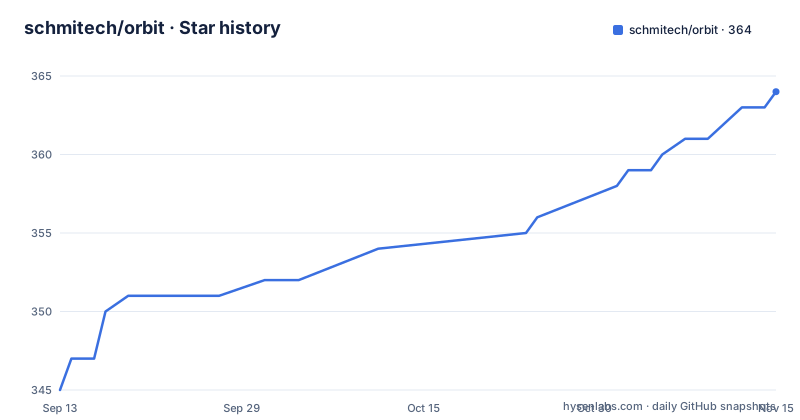
Star history
- schmitech/orbit364 ★ · +19
| Repository | 2026-09-13 | 2026-11-15 |
|---|---|---|
| schmitech/orbit | 345 | 364 |
19 Stars in the last 63 days, measured from the daily GitHub snapshot. Compare with other projects
Editorial analysis
One project covers gateway, retrieval engine and agent host
ORBIT stands for Open Retrieval-Based Inference Toolkit. Its pitch is to connect your data and tools to local or hosted models through one API, deployed on your own infrastructure, under the Apache 2.0 license with no gated features. In its own words it combines an AI gateway, a retrieval engine and an agent host in a single project.
The breadth is the main thing to evaluate. Data access goes through YAML-configured adapters for files, SQL, NoSQL, vector stores and APIs, with hybrid retrieval and reranking. Models are reached through one OpenAI-compatible API, with automatic model selection and provider fallbacks. Agents connect MCP tools, route requests to specialized skills and coordinate through A2A or async messaging. A project this wide gives you one place to configure, but also one large surface to learn.
Five prebuilt Docker flavors, and only Ollama runs inference locally
The fastest trial uses a prebuilt image, which bundles the ORBIT server, the OrbitChat web UI and document chat for PDFs, Word, Excel, images and Markdown. You choose one flavor. The Ollama image needs no API key because Ollama is bundled. The OpenAI, Gemini, OpenRouter and Cohere images need OPENAI_API_KEY, GOOGLE_API_KEY, OPENROUTER_API_KEY or COHERE_API_KEY exported in your shell.
docker pull schmitech/orbit-ollama:latest
docker run -d --name orbit \
  -p 127.0.0.1:5173:5173 -p 127.0.0.1:3000:3000 \
  -v orbit-data:/orbit/data \
  -v orbit-models:/orbit/models \
  schmitech/orbit-ollama:latest
The consequence is about privacy. If your goal is keeping data off third-party servers, the other four flavors send requests to hosted providers, and only the Ollama flavor keeps inference on your machine.
Published ports bind to localhost, and only the Ollama image mounts a models volume
In every run command the two published ports, 5173 and 3000, are bound to 127.0.0.1. Port 5173 serves the web UI and 3000 serves the server API, so by default nothing is reachable from other machines. To let a team use it you must change the mapping deliberately, and that is the moment to put authentication and a reverse proxy in front.
The volumes differ by flavor. All five mount orbit-data at /orbit/data, but only the Ollama command also mounts orbit-models at /orbit/models, which is where downloaded local models would live. If you remove the container without that volume, you pull the models again. The hosted-provider flavors need no models volume because inference happens elsewhere.
docker pull schmitech/orbit-openai:latest
docker run -d --name orbit \
  -p 127.0.0.1:5173:5173 -p 127.0.0.1:3000:3000 \
  -e OPENAI_API_KEY \
  -v orbit-data:/orbit/data \
  schmitech/orbit-openai:latest
The key is passed by name, so it must already be exported
The hosted flavors pass the key with -e and the variable name only, with no value after it. Docker then copies the value from your current shell environment into the container. If the variable is not exported before you run the command, the container starts without a key, and requests to the provider will fail once you try to chat.
That design keeps the secret out of your shell history and out of the command line, which is a sensible choice. The cost is a silent failure mode: the container appears healthy while the provider call cannot authenticate. Export the key first, run the container, then confirm the first chat works before you load documents. The README also notes that each image is published with a version tag, for example schmitech/orbit-ollama:2.21.0, if you want to pin a release instead of following latest.
Adapters and examples show how data gets connected
The adapters are where ORBIT earns or loses its place. They are YAML configurations for each source, and the repository ships an examples directory that shows the range: a customer-orders example, a customer-360 composite, a decision-car-simulation, intent templates, an MCP server and a test MCP server, an A2A protocol example, an OpenAI-compatible API example, prompts, and question and answer pair files for a city assistant.
The list includes demos for chatting with Elasticsearch data through an intent retriever and querying SQL data in a real-time voice conversation. Start from the example nearest your source instead of writing a configuration from nothing. The server, clients, config, install and docker directories at the top level show that the project is a server plus client applications, not a single library.
Real-time decisions, voice and media are listed as features with little detail
Beyond text chat, ORBIT lists document and image processing, voice experiences, and generation of images, audio and video. It also lists real-time decisions: structured choices, yes or no answers, and scores with probabilities for routing, triage and moderation.
These are capability claims, and the README gives no accuracy or latency figures for any of them. A score with a probability is only as good as the model behind it, so test routing and moderation against your own data before trusting it for decisions. The project points to a capability matrix that compares ORBIT with Open WebUI and LiteLLM, but that matrix is written by the project, so read it as a feature list from one side.
Security features are listed, and air-gapped use depends on local models
The security and operations list covers SSO, role-based access, PII detection, moderation, quotas, audit logs and cost estimates, with an admin UI for daily management and a control plane view for resources, API keys, users and MCP tools. The project also says it supports self-hosting on-premises or in a private cloud, including air-gapped deployments with local models.
The qualifier is local models. An air-gapped deployment cannot call OpenAI, Gemini, OpenRouter or Cohere, so the image flavors that depend on those keys do not apply there. The repository contains a SECURITY.md for reporting problems, and the releases are frequent: v2.21.0 on 2026-10-28, v2.20.3 on 2026-10-25 and v2.20.2 on 2026-10-24. The last push was on 2026-10-29. With releases arriving every few days, pin a version tag and read the changelog before each upgrade.
Editorial conclusion
ORBIT suits teams that want one self-hosted gateway to put private files, databases and MCP tools behind a single OpenAI-compatible API, and that can operate a Python service with several moving parts. It is a poor fit if you need a fully offline setup from the quick start, because only the Ollama image runs inference locally, or if you cannot track a project that releases every few days. Pin an image version and decide on a model provider before you evaluate it.
Frequently asked questions
what is orbit
ORBIT, the Open Retrieval-Based Inference Toolkit, is a self-hosted AI gateway, retrieval engine and agent host. It connects data and tools to local or hosted models through one API.
Does orbit still exist?
The schmitech/orbit repository is not archived. Its latest release, v2.21.0, was published on 2026-10-28, and the last push was on 2026-10-29.
How do I try ORBIT with Docker?
Pull one prebuilt flavor image, such as schmitech/orbit-ollama:latest, and run it with ports 5173 and 3000 bound to 127.0.0.1. The OpenAI, Gemini, OpenRouter and Cohere flavors need an exported API key.
Official sources
Add this badge to your README
If you maintain this project, the badge below links readers to this analysis and shows its maintenance status from the daily GitHub snapshot. Paste the markdown into your README; add ?metric=license or ?metric=stars to the image URL for a different field.

[](https://hysenlabs.com/projects/schmitech-orbit)Star history chart for your README
[](https://hysenlabs.com/projects/schmitech-orbit)Was this useful?