SeekStorm: the server container runs as root and listens on port 80
SeekStorm: vector & lexical search - in-process library & multi-tenancy server, in Rust.
At a glance
- What is it?
- A Rust search engine published as three crates in one workspace, with lexical and vector indexes kept as separate native engines behind a query planner. The library profile trades debug checks for speed, and the published container runs as root on every interface.
- Who is it for?
- SeekStorm is worth evaluating if you want vector and lexical search in the same Rust process, or a self-hosted multi-tenancy server, and you care about the index architecture rather than about a hosted service. Four things decide whether it fits.
- Can I use it commercially?
- Yes. Apache-2.0 is a permissive licence: you can use, modify and sell software built on it, as long as you keep its copyright and licence notices.
- Is it still maintained?
- Yes. The repository last received commits 6 days ago.
- What is it written in?
- Mainly Rust, according to GitHub's language statistics.
Answers come from the project's GitHub data, last synced on November 19, 2026, and from our analysis. They are not legal advice.
Star history
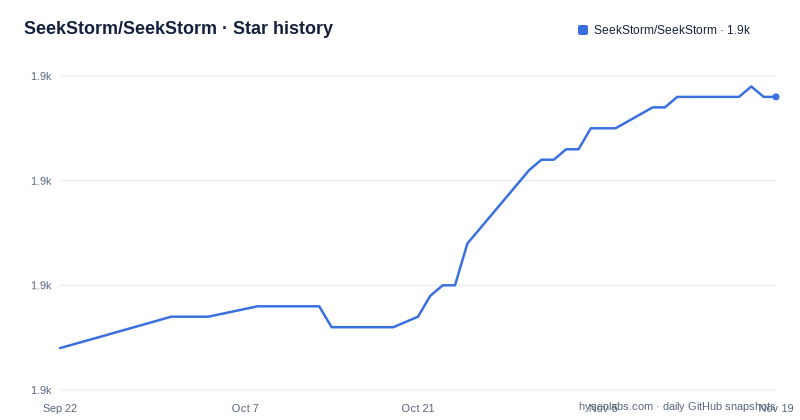
- SeekStorm/SeekStorm1,938 ★ · +24
| Repository | 2026-09-22 | 2026-11-19 |
|---|---|---|
| SeekStorm/SeekStorm | 1.9k | 1.9k |
24 Stars in the last 58 days, measured from the daily GitHub snapshot. Compare with other projects
Editorial analysis
The published server container runs as root and binds every interface
The image is a two-stage build: a Rust slim image with a C++ compiler installed, cargo building the release binary, and then a Debian slim runtime stage that copies the single binary across. That runtime stage is three directives long, and all three matter. It sets the user to root explicitly rather than inheriting a non-root default. It declares no exposed port. And it starts the server with its listen address, port and index path passed as arguments:
./seekstorm_server local_ip=0.0.0.0 local_port=80 index_path=seekstorm_indexSo the multi-tenancy server, the component meant to sit between clients and indexes, ships as root on port 80 of every interface by default, with its index in a relative path inside the container's working directory. There is no volume declared for that path and no health check, and the binary is copied to the filesystem root rather than to a directory on the path. Anyone deploying this image should treat all four as things to change rather than defaults to keep.
The release profile turns off overflow checks and makes panics abort
The workspace profile is tuned for throughput and states every trade explicitly. Link time optimisation is on and the optimisation level is three. Debug info is compiled out, debug assertions are disabled, overflow checks are off, and the binary is stripped of its debuginfo. Panic behaviour is set to abort rather than unwind. The two that matter most for anyone embedding the library are overflow checks and panic. With overflow checks off, an integer that exceeds its range wraps silently in release builds, so a length or offset calculation in your own code will not trap the way it does in a test profile. With panic set to abort, the library cannot be caught by an unwind handler at the process boundary, which changes how a failure inside a search propagates to the caller that embeds it.
The lint rules are warnings, so none of them can fail a build
The workspace declares five lint rules and sets every one of them to warn rather than deny. Missing documentation on public items is a warning, and so are unused import braces, trivial casts, trivial numeric casts and unused qualifications. The effect is that none of these can fail a build or a continuous integration run; they surface as warnings that a developer may or may not address. That is a defensible choice for a library mid-way through its public surface, and it is worth knowing if you are evaluating the quality signals of the codebase. The workspace itself is three members: the search library, the server and the REST client, all built from one Cargo.toml with resolver 3.
Two native index engines, one query planner, one fusion step
The central design decision is that lexical and vector search are separate implementations rather than one index asked to do both. Underneath sit an inverted index optimised for lexical relevance and an approximate nearest neighbour index optimised for vector similarity, each with its own storage layout, its own indexing path, its own search path, its own scoring and its own top-k selection. A query planner sits above both, and the caller chooses per query between lexical, vector or hybrid. Hybrid means fusing the two candidate lists with Reciprocal Rank Fusion, and the page is explicit that the hybrid path is exhaustive rather than a re-ranking of a preliminary candidate set, which is the expensive way to do it and the way that keeps recall. The stated goal is that a user of the library should not have to know any of that.
Field filters run inside the vector search, not after it
One line in the vector feature list is worth isolating, because it is the usual thing approximate search gets wrong. All field filters are directly active during vector search rather than applied afterwards as a post-search filtering step. That distinction decides whether a filtered query returns the right number of results: in an approximate index, applying a filter after the nearest neighbours have already been chosen means the engine returns whatever passed the filter from a candidate set that may never have contained enough matching rows. Filters inside the search let the index account for them while choosing candidates. The rest of the vector surface follows the same pattern of stating the mechanism rather than the outcome, with F32 and I8 precisions, cosine, dot product and Euclidean similarity, TurboQuant and affine scalar quantization, and K-Medoid clustering where the centres are actual data points under Partition Around Medoids.
The per-day indexing figure is the per-second figure multiplied by 86,400
The architecture section gives one indexing number written as an equation: 35K docs per second, which is stated as equal to 3 billion docs per day on a laptop. The second half of that is arithmetic rather than a measurement, since 35,000 multiplied by the seconds in a day is a little over 3.02 billion. That is not a criticism of the figure so much as a note about how to read it, because a daily rate derived from a per-second rate assumes the rate holds for 86,400 uninterrupted seconds, which no laptop indexing run does. The search side of the same section claims 7x faster query latency and 17x faster tail latency at the 99th percentile for lexical search, and here the comparison point is not named in the text, which points to a separate benchmark page rather than stating what it is measured against.
One ecosystem repository is MIT and one image lives under a personal namespace
The main project is Apache 2.0, and the header repeats that. Two details in the surrounding links are worth noting for anyone assembling components from this ecosystem. The InstantSearch adapter, a drop-in shim that redirects an existing Algolia InstantSearch.js frontend at a SeekStorm backend without a UI rewrite, is linked with a different licence tab in its own repository, so that component is MIT while the engine is Apache 2.0. And the published container image is not under the project namespace: the Docker Hub link points at a namespace named after the maintainer rather than at the organisation every other link in the list uses. Neither fact is explained in the visible text, and both affect how you should record provenance for a component you depend on.
Five REST clients, one of them in this repository, with mismatched names for TypeScript
The header advertises six clients, and only one of them is built in this workspace. SeekStorm ships a Rust REST client as a workspace member alongside the library and the server. The Python, TypeScript, C# and Java clients each live in their own repository under the same organisation, published to PyPI, npm and NuGet. The naming is not consistent across those repositories: the TypeScript heading links to a repository whose name ends in a client and ts suffix, while the package published to npm carries a different name and the badge link in that same line points at a third repository name ending in pure ts. Anyone wiring up the JavaScript side has to resolve which of those three names is the package and which is the source before the install will work.
Editorial conclusion
SeekStorm is worth evaluating if you want vector and lexical search in the same Rust process, or a self-hosted multi-tenancy server, and you care about the index architecture rather than about a hosted service. Four things decide whether it fits. Read the release profile before trusting it with data, because overflow checks and debug assertions are off and a panic aborts rather than unwinds, so a logic error in an arithmetic path will corrupt rather than trip. Check your deployment story, because the container the project publishes runs as root and binds port 80 on all interfaces with no non-root user, no exposed port declaration and no health check. Decide which clients you need, since only the Rust one lives in this repository and the Python, TypeScript, C# and Java clients are separate projects with, in one case, mismatched repository and package names. And note the project describes itself as a work in progress that has been open sourced since 2024 while a commercial product built on the same engine has been in production since 2020.
Frequently asked questions
Is SeekStorm open source, and under what licence?
Yes, under the Apache License 2.0. Development started in 2015, the engine has been in production since 2020, the Rust port dates from 2023 and the project was open sourced in 2024, with the page still describing it as work in progress.
What is the difference between the SeekStorm library and the SeekStorm server?
The library is an in-process crate for vector and lexical search inside your own program, published as the seekstorm crate. The server is a separate crate, seekstorm_server, packaged as a multi-tenancy search server with a REST API. Both are members of the same Cargo workspace together with the Rust REST client.
How does hybrid search work in SeekStorm?
Two separate first-class index architectures run underneath, an inverted index for lexical relevance and an approximate nearest neighbour index for vector similarity, each with its own storage layout, indexing, search, scoring and top-k handling. A query planner chooses per query between lexical, vector and hybrid, and hybrid results are fused with Reciprocal Rank Fusion. The hybrid path is exhaustive rather than a re-ranking of preliminary candidates.
Does SeekStorm need a separate service to generate embeddings?
No. It can generate and index embeddings from any text document field using Model2Vec, and it can equally import externally generated embeddings in F32 or I8 precision. It also supports multi-vector indexing from multiple fields and from multiple chunks per field.
Which platforms and architectures does SeekStorm support?
Windows, Linux and MacOS, with SIMD acceleration for x86-64 on both AMD64 and Intel 64 and for AArch64 including Apple Silicon. Indexes can be held in RAM or in memory mapped files, and the page claims single-machine scalability for thousands of concurrent queries without clusters or proprietary accelerators.
Official sources
Where developers are discussing it
Posts on Hacker News, dev.to and Lobsters that link to this repository, found by our scan of those communities. 0 in the last 30 days; newest first.
- Show HN: SeekStorm, sub-millisecond lexical, vector and hybrid search in RustHacker News · Oct 21, 2026 · 2 points · 2 comments
Add this badge to your README
If you maintain this project, the badge below links readers to this analysis and shows its maintenance status from the daily GitHub snapshot. Paste the markdown into your README; add ?metric=license or ?metric=stars to the image URL for a different field.

[](https://hysenlabs.com/projects/seekstorm-seekstorm)Star history chart for your README
[](https://hysenlabs.com/projects/seekstorm-seekstorm)Was this useful?