roapi: four query frontends, and only one of them can join tables
Create full-fledged APIs for slowly moving datasets without writing a single line of code.
At a glance
- What is it?
- A Rust server that turns static datasets into read-only APIs on Apache Arrow and Datafusion, with SQL, FlightSQL, GraphQL and REST frontends plus a key-value lookup and a Postgres wire endpoint, installable through brew, pip or cargo. Only the SQL frontend supports joins, the sample config binds both listeners to all interfaces, and the release image ships the test datasets.
- Who is it for?
- roapi is a good fit when you have a dataset that changes on the order of days and want a queryable endpoint without standing up a database, because the Arrow and Datafusion base means the file formats are the interface. Four things to check before you expose it.
- Can I use it commercially?
- Yes. Apache-2.0 is a permissive licence: you can use, modify and sell software built on it, as long as you keep its copyright and licence notices.
- Is it still maintained?
- Activity is slowing. The repository last received commits 8 months ago.
- What is it written in?
- Mainly Rust, according to GitHub's language statistics.
Answers come from the project's GitHub data, last synced on November 22, 2026, and from our analysis. They are not legal advice.
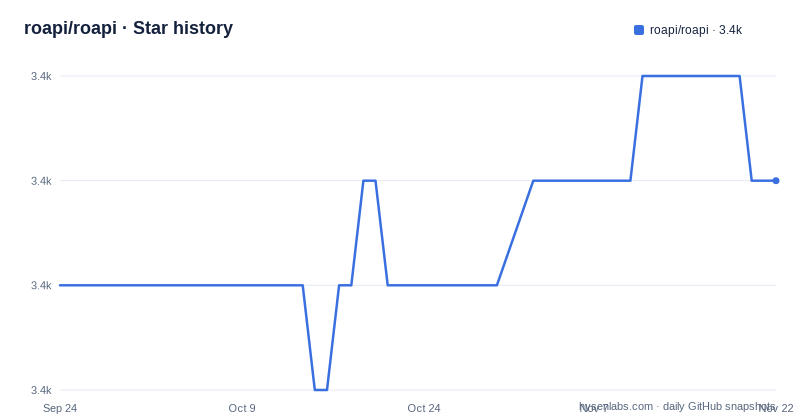
Star history
- roapi/roapi3,435 ★ · +1
| Repository | 2026-09-24 | 2026-11-22 |
|---|---|---|
| roapi/roapi | 3.4k | 3.4k |
1 Stars in the last 59 days, measured from the daily GitHub snapshot. Compare with other projects
Editorial analysis
Both listeners bind outward, and credentials sit inside table URIs
The sample configuration file opens with the two addresses the server listens on, and both are set to all interfaces rather than to localhost:
addr:
  http: 0.0.0.0:8080
  postgres: 0.0.0.0:5433
The second one matters more than it looks, because the Postgres wire protocol endpoint accepts SQL from any Postgres client. A configuration file that is meant to be a starting example therefore opens a database listener on every interface.
The same example shows how a database source is named, and the credentials are in the URI:
--table "table_name=mysql://username:password@localhost:3306/database"
--table "table_name=sqlite://path/to/database"
That form is convenient for a command line and awkward for a config file, since the password ends up wherever the configuration is stored. There is no separate credential field in the example.
The dynamic registration section has the same shape of problem, since the request shown posts to a private network address rather than to the local host the rest of the file uses.
Four frontends translate into plans, and only SQL can join
The architecture is described in four parts. Query frontends translate SQL, FlightSQL, GraphQL and REST queries into Datafusion plans. Datafusion executes those plans. A data layer loads datasets from a variety of sources and formats with automatic schema inference. And a response encoding layer serialises the intermediate Arrow record batch into whatever format the client asked for.
So four query languages reach the same execution engine, and the differences are all in the frontends.
The SQL frontend is described as using a subset of standard SQL, and it is the only query interface that supports table joins. The REST frontend supports exactly four operators: columns, sort, limit and filter, with filters expressed as bracketed parameters for equality and for gte and lt comparisons. The GraphQL frontend supports the same operator set as REST, with the same capabilities expressed as a filter object and a sort list.
That leaves FlightSQL. It is named in the architecture list as one of the four frontends and never appears again in the usage sections, which document SQL, GraphQL, REST, the key-value lookup and the Postgres endpoint. Whether it is implemented, and on what terms, the file does not say.
The release image ships the test datasets
The container build assembles a final image from a slim Debian base, and one of its copy steps brings the repository's test data along:
COPY test_data /test_data
COPY --from=builder /roapi_src/target/release/roapi /usr/local/bin/roapi

EXPOSE 8080
ENTRYPOINT ["roapi"]
So the published image contains the sample CSV and JSON files the quick start queries, mounted at a fixed path. That is convenient for trying the image without mounting anything, and it means every deployment carries a copy of datasets nobody asked for.
The rest of the build is more careful about size. The build argument defaults to a database feature set plus the user interface, the interface is compiled to WebAssembly with an optimisation level chosen for a fast and small binary, and the release binary is built with that interface embedded so there is no separate asset to ship. Dependencies are cooked in an earlier stage with a recipe file so the layer caches, and the only port exposed is the HTTP one.
The query engine is a separate crate from the server
The workspace has four members: the server, the query engine, a command line tool for that engine, and the user interface package.
The split matters because it means the part that turns a query into a plan is not tied to the HTTP surface. The engine is the crate that wraps Datafusion, and the server is a thin layer that adds frontends, the data layer and response encoding on top of it.
The profiles are tuned per package. The release profile uses thin link-time optimisation rather than the full form, the development and test profiles unpack split debug information, and the user interface package is compiled at a raised optimisation level with a comment saying it is for a fast and small WebAssembly binary. That last one is the exception to the usual pattern where the interface is the cheapest thing to build.
There is also a lock file, a flake, and separate directories for continuous integration and for end-to-end tests, so the test suite is split between unit-level and whole-system.
Two dependency patches are present, and both are commented out
The bottom of the manifest contains two patch blocks that are not active.
The first would replace a delta kernel crate from the registry with a version taken from a fork, pinned to a specific revision hash. The second would replace a connector crate with one from a local path outside the repository, in a sibling directory.
Both being commented out means a fresh clone builds against the published versions of both crates. That is the safer default, and it also means the pinned fork and the local connector are opt-in.
The second one deserves a note. Its path is a sibling of the repository rather than something inside it, so enabling it requires a checkout layout that is not the one a clone gives you. A contributor who uncomments that line and has only this repository will not build.
The comments are kept rather than deleted, which at least means the intended sources are written down rather than rediscovered later.
Dynamic registration needs a startup table anyway
Tables can be added while the server runs, and the flag that enables it is a single letter. The instruction is to add that parameter to the command, and it comes with a condition: the table parameter cannot be ignored for now.
So the server will accept tables over HTTP but still insists on at least one being declared at startup. The endpoint takes a JSON array of objects, each with a table name and a URI, and the second entry in the example is a SQLite source, so the same registration path accepts files and databases.
Two smaller platform notes come out of the same section. On Windows the full scheme has to be filled in, either a file scheme or a filesystem scheme, and double quotes are used instead of single quotes to work around the Windows command line length limit.
That is a fair summary of what portability costs here: one path syntax on Unix and another on Windows, with a documented workaround rather than a fix.
Tags are prefixed, clustered, and the branch has been quiet since March
The release names carry a prefix, so a tag is not simply the version. The three most recent are version 0.13.0 from March 2026, version 0.12.7 from two days earlier, and version 0.12.6 from June 2025.
Read as a timeline, that is a nine-month gap followed by two releases inside two days. The last push on the default branch is dated 2026-03-25, one day after the newest tag, so the branch is aligned with the release rather than running ahead of it.
For an adopter that shape argues for pinning a tag rather than tracking the branch, because there is nothing to gain from moving to the branch head and a clustering of releases is often a stabilisation pass rather than new work.
It also means the naming convention matters when you write automation around this. The version alone is not the tag.
Editorial conclusion
roapi is a good fit when you have a dataset that changes on the order of days and want a queryable endpoint without standing up a database, because the Arrow and Datafusion base means the file formats are the interface. Four things to check before you expose it. The SQL endpoint is the only one that joins, so multi-table work has to go through it. The sample configuration binds the HTTP and Postgres listeners to all interfaces and carries database credentials inside table URIs, so tighten both before it leaves a laptop. Dynamic table registration is exposed over HTTP and requires a startup table anyway, so treat it as an administrative endpoint. And the last push on the default branch is dated 2026-03-25, after which the three most recent tags arrived within two days of each other, so pin a release rather than tracking the branch.
Frequently asked questions
What are the 7 most common types of APIs?
That is a general question this repository does not answer. What it builds are read-only query interfaces over static datasets: SQL, FlightSQL, GraphQL and REST frontends that translate into Datafusion plans, plus a key-value lookup and a Postgres wire protocol endpoint.
How do I install roapi?
Three ways: brew install roapi, pip install roapi, or cargo install --locked --git https://github.com/roapi/roapi --branch main --bins roapi. Pre-built binaries are published on the release page for each platform, and container images at ghcr.io/roapi/roapi.
Which roapi query interface supports table joins?
Only the SQL one. The file states it is the only query interface that supports table joins, while the REST and GraphQL frontends support the same four operators: columns, sort, limit and filter.
How do I point roapi at MySQL or SQLite?
Use a URI in the table argument, as table_name=mysql://username:password@localhost:3306/database or table_name=sqlite://path/to/database. The configuration file accepts the same sources with extra format options, such as a JSON pointer and a flag for arrays.
Can roapi return something other than JSON?
Yes. Responses are JSON by default, and a different encoding is requested with the ACCEPT header, for example application/vnd.apache.arrow.stream to receive Arrow record batches instead.
Official sources
Add this badge to your README
If you maintain this project, the badge below links readers to this analysis and shows its maintenance status from the daily GitHub snapshot. Paste the markdown into your README; add ?metric=license or ?metric=stars to the image URL for a different field.

[](https://hysenlabs.com/projects/roapi-roapi)Star history chart for your README
[](https://hysenlabs.com/projects/roapi-roapi)Was this useful?