Goutoujunshi: the Codex Skill that separates facts from guesses before advising
A Codex-based romance strategist that first acknowledges your feelings, then analyzes the relationship and gives actionable advice. Built-in knowledge base covering psychology, law, society, humanities, philosophy, marriage and family, and sexology; supports non-traditional relationships.
At a glance
- What is it?
- Goutoujunshi is a Chinese language Codex Skill for dating, conflict, breakup and reconciliation questions. It answers with one sendable line, an observation window and a stop condition, and it keeps facts apart from guesses and will not open a chat app database.
- Who is it for?
- Use it when you want a structured second opinion that shows which part of your story is fact and which part is guesswork, and when you are willing to answer an intake before getting advice. Do not use it for coercion, stalking, domestic violence or self harm situations, where the project routes to safety and referral flows instead.
- Can I use it commercially?
- Yes. MIT is a permissive licence: you can use, modify and sell software built on it, as long as you keep its copyright and licence notices.
- Is it still maintained?
- Yes. The repository last received commits 56 days ago.
- What is it written in?
- Mainly Python, according to GitHub's language statistics.
Answers come from the project's GitHub data, last synced on November 15, 2026, and from our analysis. They are not legal advice.
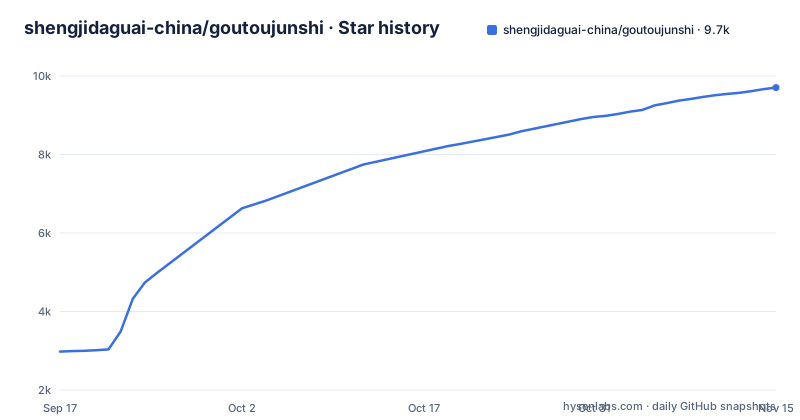
Star history
- shengjidaguai-china/goutoujunshi9,704 ★ · +6,725
| Repository | 2026-09-17 | 2026-11-15 |
|---|---|---|
| shengjidaguai-china/goutoujunshi | 3k | 9.7k |
6,725 Stars in the last 59 days, measured from the daily GitHub snapshot. Compare with other projects
Editorial analysis
Installing means handing one sentence to your AI assistant
There is no pip install line here. The top level of the repository holds `.github/`, `.gitignore`, `CHANGELOG.md`, `CODE_OF_CONDUCT.md`, `CONTRIBUTING.md`, `LICENSE`, `LICENSE.zh-CN.md`, `README.md`, `README_EN.md`, `SECURITY.md`, `SKILL.md`, `agents/`, `assets/`, `documentation/`, `references/` and `scripts/`. No packaging file sits among them, and the project publishes no GitHub releases, so there is no version to pin. Installation is one text instruction you paste into whichever assistant you already use:
请将公开仓库 https://github.com/shengjidaguai-china/goutoujunshi 下载并安装为本地 Skill。That sentence names the repository URL and asks for a local Skill. Your assistant performs the download, so what lands on disk depends on that assistant's install path and on whether it follows the request at all. The 2026-07-23 update row says an installed copy can run its own self-check even without the project's reference material.
The intake asks for seven slots before it advises anything
The opening request is deliberately short:
请使用狗头军师帮我梳理情绪、分析当前关系,并给出下一步建议。The reply it comes back with asks for your MBTI, a composite score from 0 to 100, and your main strengths and weaknesses; then a code name, an MBTI and a 0 to 100 score for person A; the same line again for person B if one exists; how you met, how long it has run, key events, contact and investment; whether the goal is to advance, confirm the relationship, repair it, compare options or exit; and what hurts most right now on a scale of 0 to 10, plus whether a message has to be answered immediately. Blank fields are allowed and a plain story works instead, because the Skill builds the profile from your narration and then asks only for details that would change the advice.
Three buckets: what happened, what you assumed, what nobody knows
The workflow is fixed and short enough to read in one screen:
用户叙述
  → 情绪落地
  → 建立本人及目标对象档案
  → 分离事实/推测/未知
  → 检索当前情境所需知识
  → 比较互惠、现实、风险与机会成本
  → 给出明确首选建议和理由
  → 生成行动、话术、观察窗口与停止条件
Splitting fact, inference and unknown is the step that carries the weight, since screenshots, exported text and your own retelling are each labelled by where they came from. The stated rule is that behaviour counts for more than labels: no MBTI, no gender and no single chat log is treated as proof of what the other person feels. What comes back is one preferred move with its reasoning attached, plus an observation window and a stop condition, not a menu of equal options.
Long-term memory asks once, then writes a condensed profile
Cross task memory is opt in. The Skill asks one time whether a trimmed profile may be kept on your own machine, and states that refusing leaves normal use unaffected. `scripts/memory_store.py` is described as the consent gate, the size limit, revocation and deletion path, so the stored record is meant to be viewable, pausable, revocable or clearable from inside a conversation. The 2026-08-03 changelog row says the point is reuse of a limited profile of both people and key progress, and states plainly that complete chats are not saved. The README does not document a retention window, an encryption step or a file format for that profile, so treat whatever it keeps as whatever your assistant keeps.
ChatLab analysis stops at the export file you already hold
Export analysis depends on ChatLab, described as an optional dependency, and it works on a chat export file you obtained yourself:
请使用狗头军师通过 ChatLab 分析我和对象A最近三个月的聊天。The Skill says it previews the import plan before touching anything, then narrows the query to a session, a person and a time range. It also states that it will not read, decrypt or export a chat application's database, and that without ChatLab you can still paste text or upload screenshots. The consequence for you is concrete: if your chat app cannot hand you an export, this route closes and the fact and guess separation has to carry the whole analysis on whatever you paste.
One to three knowledge files load per question
The library is split on purpose. `references/knowledge/` holds relationship science and cross disciplinary notes, `references/practical/` holds communication, tool adaptation and memory rules, and the 2026-07-23 changelog row says `SKILL.md` was shrunk into a light behaviour and routing kernel so that only 1 to 3 documents load for the question in front of you, with an estimated 48.3 percent cut in daily context cost. The index at `./references/knowledge/19-核心书单与论文索引.md` groups 135 references by evidence strength and usage boundary. Topics run from attachment and social exchange to marriage and family law in China, domestic violence, stalking, fraud, evidence keeping and crisis referral.
Explicit rejection is never a puzzle to solve
Two boundaries matter before you rely on this. The rules say an explicit refusal is not an obstacle to be cracked, and that violence, coercion, stalking, fraud and self harm risk cannot be handled with ordinary dating scripts and move into safety and referral flows instead. The knowledge base covers Blueprint inner state, natural flow, cold reading and Mystery structure, and names belittling, push pull, compliance tests and gaslighting as risks paired with lower risk substitutes. It also refuses to package MBTI, attachment types or internet scripts as a diagnosis, a fate or a formula that always wins. If you are facing coercion or danger, this Skill is the wrong instrument, and the safety and legal sections it points to, or outside help, are the right ones.
No releases, no packaging file, and a validator you run yourself
Maintenance evidence is thin and worth checking yourself. The last push landed on 2026-09-20, the repository is not archived, and it publishes no GitHub releases, so the version history lives in `CHANGELOG.md` and the README's update table, whose rows run from 2026-07-21 through 2026-08-03. The only executables named anywhere are `scripts/validate_skill.py` for project integrity and `scripts/memory_store.py` for the memory consent gate. No requirements file, test directory or packaging metadata appears in the file list, and the README does not list dependencies for either script, so running them means bringing your own Python setup. The July rows say the validator now checks required files, context budget and runtime boundaries and blocks mind reading, manipulation and stage escalation, but it runs only if you run it.
Editorial conclusion
Use it when you want a structured second opinion that shows which part of your story is fact and which part is guesswork, and when you are willing to answer an intake before getting advice. Do not use it for coercion, stalking, domestic violence or self harm situations, where the project routes to safety and referral flows instead. Before your first session, check that your assistant can install a repository as a local Skill, and decide in advance whether you accept a stored profile of the other person.
Frequently asked questions
What does Goutoujunshi ask me before it gives advice?
Your MBTI, a composite score from 0 to 100 and your strengths and weaknesses; the same for a person A, and again for a person B if there is one; how you met, how long it has run, key events, contact and investment; whether you want to advance, confirm, repair, compare or exit; and what hurts most now on a 0 to 10 scale, plus whether a message must be answered immediately. Blank fields are allowed and a plain story works instead.
Can Goutoujunshi read my chat history straight out of the app?
No. It states that it will not read, decrypt or export a chat application's database. With the optional ChatLab dependency it works on an export file you already obtained, after previewing an import plan and narrowing the query to a session, a person and a time range. Without ChatLab you paste text or upload screenshots instead.
Does Goutoujunshi remember my relationship between separate tasks?
Only after you give one separate permission. `scripts/memory_store.py` handles the consent gate, the size limit, revocation and deletion, and the 2026-08-03 changelog row says complete chats are not saved. You can view, pause, revoke or clear the condensed profile from inside a conversation, and refusing changes nothing about normal use.
Is Goutoujunshi a replacement for a therapist or a lawyer?
It says it offers relationship education and decision support and does not replace psychotherapy, medical diagnosis, legal advice, police or emergency services. For violence, coercion, stalking, fraud or self harm risk it moves into safety and referral flows rather than ordinary dating scripts, and an explicit refusal is treated as final rather than as something to work around.
Official sources
Add this badge to your README
If you maintain this project, the badge below links readers to this analysis and shows its maintenance status from the daily GitHub snapshot. Paste the markdown into your README; add ?metric=license or ?metric=stars to the image URL for a different field.

[](https://hysenlabs.com/projects/shengjidaguai-china-goutoujunshi)Star history chart for your README
[](https://hysenlabs.com/projects/shengjidaguai-china-goutoujunshi)Was this useful?