CS146S_CN: A Chinese Course for AI-Assisted Software Development
动手学CS146S中文版课程,包含assignments,vibe coding工具等,本项目将长期持续维护,致力于打造中文最好的vibe coding教程。
At a glance
- What is it?
- ShouZhengAI/CS146S_CN is a Chinese-language course repository centered on Coding Agents, MCP, Agent Skills, context engineering, and software factories. It is best viewed as guided learning material rather than an installable Python framework.
- Who is it for?
- Adopt this repository if you already have the stated programming background and want structured Chinese material on AI-assisted software development. Do not treat it as a production framework or a beginner tutorial for Python.
- Can I use it commercially?
- Yes. MIT is a permissive licence: you can use, modify and sell software built on it, as long as you keep its copyright and licence notices.
- Is it still maintained?
- Yes. The repository last received commits 4 days ago.
- What is it written in?
- Mainly Python, according to GitHub's language statistics.
Answers come from the project's GitHub data, last synced on November 6, 2026, and from our analysis. They are not legal advice.
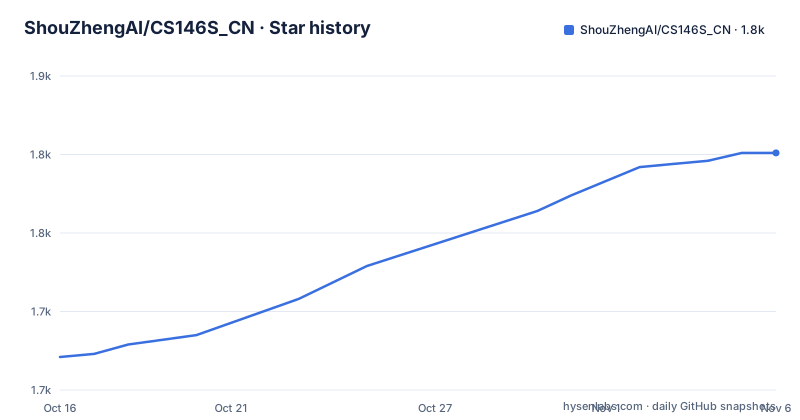
Star history
- ShouZhengAI/CS146S_CN1,801 ★ · +130
| Repository | 2026-10-16 | 2026-11-06 |
|---|---|---|
| ShouZhengAI/CS146S_CN | 1.7k | 1.8k |
130 Stars in the last 21 days, measured from the daily GitHub snapshot. Compare with other projects
Editorial analysis
What CS146S_CN Teaches Beyond AI Code Generation
CS146S_CN addresses a specific gap between knowing how to write code and working effectively with a Coding Agent. Its course description treats software development as a collaboration between developers and increasingly capable agents. Instead of concentrating only on generated source code, the course description examines how developers define intent, organize context, provide tools, and coordinate a larger workflow.
The syllabus names MCP, Agent Skills, spec-driven development, loop engineering, software factories, automated testing, and deployment as central subjects. It also covers context engineering, tool design, repository instructions, code review, security, and background agents. This makes the repository closer to a guided curriculum for modern development practices than a collection of isolated prompting examples.
The intended reader has experience equivalent to CS111. Knowledge comparable to CS221 and CS229 is recommended, although those specific courses are described as recommendations rather than stated prerequisites. The course format combines weekly lectures, hands-on coding sessions, and guest talks. Students are expected to produce a final project that demonstrates modern development practices, so the repository is aimed at people prepared for sustained coursework rather than a quick tool demonstration.
The grading description reinforces that structure. The final project accounts for 50 percent of the grade, weekly assignments account for 15 percent, open-source contributions account for 5 percent, and class participation accounts for 5 percent. That omission is a documentation gap worth checking before treating the grading table as complete.
Agent Workflows, Context, and Repository Instructions
The course syllabus provides a concrete progression through the agent development stack. Early material examines the internal operation of an LLM agent, including the agent loop and core tools such as read, write, edit, and bash. Later material moves toward context engineering, RePPIT, specification-driven work, MCP, and tool ergonomics. This sequence moves from execution mechanics to the systems used to control and evaluate that execution.
RePPIT is identified as Research, Propose, Plan, Implement, and Test. The README does not provide an executable implementation of this loop, but its naming makes the intended workflow explicit: investigate the problem, propose an approach, plan the changes, implement them, and test the result. The course also discusses spec-driven development, which places an executable or reviewable specification ahead of implementation work.
Repository configuration receives its own syllabus section. The documentation names CLAUDE.md and AGENTS.md as files for customizing agent behavior, and it plans to explain what each file should contain. Hooks are assigned a gatekeeping role for lint checks, tests, and guardrails. Subagent modes such as planner, implementer, and reviewer are also listed, indicating that the course considers role separation within an agentic workflow rather than relying on one undifferentiated session.
A later section asks what makes a repository agent-ready. Its proposed measures include structure, documentation, tests, and explicit checking mechanisms. That is a demanding definition: an agent-friendly repository is not merely one containing source code, but one in which an agent can discover instructions, run checks, and understand how changes should be evaluated. The README names audits and readiness scoring, although it does not include the scoring rubric itself.
MCP, Agent Skills, and CLI-Based Control
MCP and Agent Skills are separate layers in the curriculum. MCP is introduced through servers, clients, tools, and transports. The syllabus places this material beside advanced prompting, RePPIT, and design practices intended to make tools easier for an agent to use. That distinction matters because an agent does not receive useful capability merely because an API exists. The available operations, their descriptions, arguments, and surrounding workflow all affect how the agent can apply them.
Agent Skills receive separate treatment. The README describes a skill as a workflow encoded through SKILL.md and scripts, then extends the idea to Web Skills that can operate beyond a repository. The repository links examples of skill collections and a browsing tool, but it does not present CS146S_CN itself as a packaged skill library. Its role here is instructional: it points to external examples while explaining how skills structure agent behavior.
CLI use is also treated as a course topic rather than an installation feature. Combining command-line tools with scripts and skills reflects the course emphasis on tool composition. However, the visible documentation does not establish whether learners should use a particular operating system, shell, Coding Agent, or Python version. That makes the course portable in principle, but also less turnkey.
This portion is most relevant to developers who want to understand the plumbing behind an agent system. It is less suitable for someone looking for a single command that installs MCP servers, registers skills, and configures hooks. No such unified installer or configuration file is identified in the repository entries or README.
Using the Course Repository for a First Session
The README does not document a local installation command, Python package setup, virtual environment, or dependency installation procedure. Based on the repository layout, the intended starting point is to obtain the course from its repository and follow the README links to course material. Python is the repository's primary language, but the top-level structure shown here contains README.md, Resource, and _assignments rather than a conventional Python package manifest or importable module.
For a first real session, start with the Fall 2026 syllabus and select the current week's lectures, transcript, assignments, and linked readings. The first listed week covers Coding Agent internals, including read, write, edit, and bash, along with system prompts and tool definitions. The second week introduces RePPIT, specification-driven development, MCP, and tool design. Following that order preserves the README's progression from agent mechanics to higher-level workflow design.
The first listed practical activity is a session titled “用 200 行代码构建 Claude Code,” with separate links for slides and code. The repository does not explain in the visible README how learners should run that code, what dependencies it needs, or what output to expect. It would therefore be misleading to invent an installation command or execution sequence. A learner should open the provided code resource and inspect its own requirements before attempting to run it.
After the lecture material, the learner should move to the matching entry in _assignments and compare its required work with the grading structure. If the assignment depends on an external agent or model service, the README does not identify a required account, API key, supported provider, or cost. Those operational requirements need verification before the exercise is treated as reproducible.
Security, Code Review, and Agent Failure Boundaries
The syllabus treats security as a subject that agents must help address rather than a property assumed to follow from faster generation. Planned material covers SAST, SCA, dependency vulnerabilities, secret leakage, prompt injection, agent-specific attack surfaces, and agent-assisted triage. This is educational coverage of software security. The repository is not presented as a vulnerability scanner or an autonomous penetration-testing framework.
Prompt injection is the clearest agent-specific limitation named by the course. An agent that consumes repository content, external documents, tool output, or other untrusted context may encounter instructions unrelated to the user's task. The README does not prescribe a complete sandboxing policy, permission model, or secret-handling procedure, so learners should not infer that the listed topics provide ready-made defenses.
Agentic code review has a similar boundary. The course proposes examining what AI review can find and what it may miss, then integrating review rules into a pull request workflow. The visible README does not identify a review tool, rule format, CI provider, or approval policy. It also does not claim that an agent can replace human review. The responsible reading is that agents can participate in review while leaving architectural judgment and repository-specific checks to the development process.
Several linked resources are external, including presentations, transcripts, tools, and guest-related materials. The repository layout does not guarantee that every external resource remains available or that its content has the same licensing terms as the course repository. This is another reason to avoid treating the course as a self-contained software distribution.
Maintenance, Licensing, and Course Currency
The repository is not archived, and its last push was on 2026-10-08. That date supports describing the repository as recently updated at the time of this review. This status applies to CS146S_CN itself. The README separately states that the original Fall 2025 course is archived and that Fall 2026 is being tracked, which are statements about the upstream course rather than this repository's GitHub status.
The repository has no GitHub releases. Readers therefore cannot expect release notes, formal version tags, or packaged migration notes from that mechanism. The repository describes itself as long-term maintained, but this is a project statement rather than a guarantee about every assignment or external dependency. Course currency also depends on linked tools and services that can evolve independently of the README.
The repository is licensed under MIT. That permits use and modification under the license's conditions, while the README notes that content originates from and belongs to the original course party. The repository also identifies itself as unofficial. Because educational text, images, assignments, and third-party materials may have separate provenance, anyone planning to redistribute or adapt portions should inspect the LICENSE file and the rights applicable to each included resource. This is a documentation and licensing check, not legal advice.
There are no release-based upgrade instructions in the visible README. The maintenance cost for a learner is therefore mostly the cost of checking weekly course pages, assignment changes, and external tool behavior. There is no documented dependency migration path for an installed Python environment.
CS146S_CN Versus a Production Agent Framework
A production agent framework is a different kind of project. Such a framework normally packages an agent runtime, exposes an API or CLI, declares dependencies, and provides configuration for tools, model access, persistence, or evaluation. CS146S_CN does not claim those package-level features in the visible documentation. It contains course material, resources, and assignments, and its listed entry points are lecture notes, transcripts, external readings, and examples.
The practical alternative is to use the conceptual material in CS146S_CN while implementing the agent workflow in a separate development environment. A learner could study context design and RePPIT in the course, then apply those ideas within an existing coding tool, repository configuration, and test suite. The README does not name one mandatory runtime for this process, so the course does not force a single vendor or framework choice.
This approach is slower than consuming a ready-made framework if the goal is immediate deployment, but it exposes more of the design decisions that matter in agent-assisted development. It also lets a team connect the ideas to its own repository instructions, checks, and review process. The trade-off is that learners must assemble those pieces themselves. CS146S_CN teaches what to consider, while it does not document a complete production installation.
Editorial conclusion
Adopt this repository if you already have the stated programming background and want structured Chinese material on AI-assisted software development. Do not treat it as a production framework or a beginner tutorial for Python. Before enrolling, verify that the Fall 2026 materials contain the assignments and schedules you need, then confirm whether the linked external tools and services are accessible in your environment.
Frequently asked questions
Who is the CS146S_CN course intended for?
The course is intended for learners who already have programming experience equivalent to CS111. It recommends prior knowledge comparable to CS221 or CS229 and expects participation in lectures, coding practice, assignments, and a final project.
Does CS146S_CN provide installation instructions?
The visible README does not provide a local installation command, dependency setup, or Python environment procedure. The repository is presented as course material whose linked lectures, code examples, readings, and assignments should be accessed from the README.
What topics does CS146S_CN cover?
The syllabus covers Coding Agent internals, context engineering, RePPIT, specification-driven development, MCP, Agent Skills, CLI use, repository customization, code review, security, and background agents. It also addresses testing, deployment, and software factory practices.
Is CS146S_CN an official release of the original course?
No. The README explicitly identifies the project as unofficial, states that Fall 2025 has been archived, and says that Fall 2026 is being tracked.
Can I use CS146S_CN as a Python package?
The visible documentation does not present CS146S_CN as an importable Python package or define package installation. Its listed repository structure is centered on README.md, Resource, and _assignments.
Official sources
Add this badge to your README
If you maintain this project, the badge below links readers to this analysis and shows its maintenance status from the daily GitHub snapshot. Paste the markdown into your README; add ?metric=license or ?metric=stars to the image URL for a different field.

[](https://hysenlabs.com/projects/shouzhengai-cs146s-cn)Star history chart for your README
[](https://hysenlabs.com/projects/shouzhengai-cs146s-cn)Was this useful?