shsarv/Machine-Learning-Projects: A Portfolio of Practical ML Projects
This repository showcases a selection of machine learning projects undertaken to understand and master various ML concepts. Each project reflects commitment to applying theoretical knowledge to practical scenarios, demonstrating proficiency in machine learning techniques and tools.
At a glance
- What is it?
- shsarv/Machine-Learning-Projects is a collection of 26 machine learning, computer vision, NLP, healthcare, and analytics projects presented through notebooks and several web or GUI applications. It is best treated as a learning portfolio, not as a unified library with one installation path or a production platform.
- Who is it for?
- Adopt this repository when you need readable examples across common machine learning domains, especially for learning, notebook experiments, or portfolio work. Do not treat it as a production framework, a single deployable application, or a dependency with a stable API.
- Can I use it commercially?
- Not without permission. GitHub finds no licence file in the repository, and without a licence all rights are reserved by default: you may read the code but not reuse it. Check the README, or ask the authors, before using it.
- Is it still maintained?
- Yes. The repository last received commits 26 days ago.
- What is it written in?
- Mainly Jupyter Notebook, according to GitHub's language statistics.
Answers come from the project's GitHub data, last synced on November 6, 2026, and from our analysis. They are not legal advice.
Star history
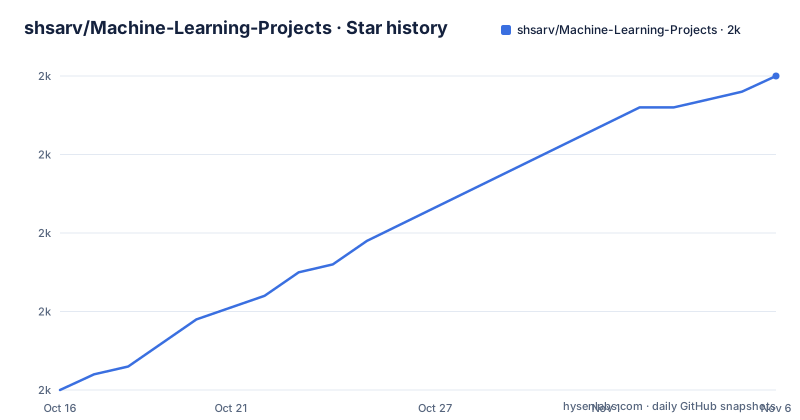
- shsarv/Machine-Learning-Projects2,030 ★ · +40
| Repository | 2026-10-16 | 2026-11-06 |
|---|---|---|
| shsarv/Machine-Learning-Projects | 2k | 2k |
40 Stars in the last 21 days, measured from the daily GitHub snapshot. Compare with other projects
Editorial analysis
What the Machine-Learning-Projects Repository Contains
The repository addresses a broad practical need: showing how machine learning concepts can be applied across separate problems rather than within one specialized product. The README describes 26 end-to-end projects across healthcare AI, real-time computer vision, NLP chatbots, time series forecasting, classical machine learning, geospatial analysis, and data science. The intended audience appears to be students, beginners, and developers who want examples that connect algorithms with recognizable data and application scenarios.
The collection is not limited to a single algorithmic style. Healthcare examples include brain tumor detection, diabetes prediction, heart disease prediction, arrhythmia classification, a medical chatbot, and drug mechanism-of-action prediction. Computer vision examples cover driver monitoring, distracted behavior detection, lane detection, human counting, age and gender estimation, image colorization, and a selfie capture project. Other directories cover admissions, IPL scores, employee turnover, property maintenance fines, research topics, retail sales, and the Coursera neighborhood capstone.
The repository is therefore a portfolio rather than a single application. Each project may have its own notebook, dataset, model artifact, web interface, or GUI component. The README identifies several technologies, including Flask, TensorFlow, Keras, PyTorch, OpenCV, Dlib, NLTK, scikit-learn, XGBoost, TabNet, Random Forest, SVM, Logistic Regression, and Hough transforms. That breadth is useful for comparison, but it also means that there is no single interface or shared runtime that can be assumed across all 26 projects.
How the ML Projects Are Organized
The repository layout uses separate top-level directories for individual projects. The visible names include BRAIN TUMOR DETECTION [END 2 END], Classification of Arrhythmia [ECG DATA], Diabetes Prediction [END 2 END], Drowsiness detection [OPEN CV], Gender and age detection using deep learning, Lane Line Detection [OPEN CV], Mechanisms Of Action (MoA) Prediction, Medical Chatbot [END 2 END] [NLP], and TimeSeries Multi StoreSales prediction. This structure gives each example a clear boundary, but it does not imply that every directory follows the same file convention.
The README classifies projects by domain and also assigns levels such as beginner, intermediate, and advanced. It marks project types as web app, GUI app, or notebook. Those labels are useful for choosing a starting point, although the repository overview does not establish a shared dependency lockfile, common Python environment, or common training command. The primary language is Jupyter Notebook, so the most reproducible starting point for many projects is likely to be the notebook associated with the selected directory.
The repository also includes Resources, docs, .github, contribution files, and a project description document. Those support files suggest that the collection is organized as a GitHub portfolio rather than packaged software. The live website is listed as a way to view the projects, while the README links to each project directory for source access. The directory names and project descriptions indicate a mixture of research exercises, demonstrations, and small applications rather than a coherent API surface.
Healthcare and Vision Workflows
The healthcare projects use several distinct prediction mechanisms. Brain Tumor Detection is described as a CNN system that accepts an MRI scan and returns a prediction with a confidence score. The same project category is identified as a Flask web app, which means the expected usage involves an application interface rather than only notebook inspection. Diabetes Prediction is a tabular classification example using eight health markers and models such as Random Forest, SVM, and Logistic Regression. Heart Disease Prediction uses 13 clinical features with ensemble models. Arrhythmia Classification uses 279 ECG features to classify 16 arrhythmia types. MoA Prediction is described as a deep learning project using gene expression and cell viability data with TabNet and PyTorch.
The computer vision directories follow different processing paths. Lane Line Detection uses OpenCV, Canny edge detection, and the Hough transform to draw road lanes on images or video. Human Detection and Counting uses live video with a HOG descriptor and NMS. Drowsiness Detection tracks eye state through Eye Aspect Ratio and triggers an alert through a Flask application. Distracted Driver Detection uses a TensorFlow or Keras CNN to classify ten behaviors from images. The README also lists face-based gender and age estimation with OpenCV, DNN, and Caffe models, plus black-and-white image colorization using deep learning.
This variety makes the collection useful for studying input modalities, but it also exposes a practical constraint. A notebook that loads a local dataset and a Flask app that expects a webcam, uploaded image, or trained weight file have different setup and failure conditions. The repository overview does not provide a universal input contract or model-serving API.
NLP, Time Series, and Prediction Workflows
The NLP and predictive projects broaden the collection beyond image classification. Medical Chatbot [END 2 END] [NLP] maps symptoms described by a user to diagnosis suggestions using NLTK, machine learning models, and Flask. The README frames this as an advanced project, but it does not document the training corpus, response policy, confidence handling, or safeguards for medical advice. It should therefore be understood as a demonstration interface unless its individual project files provide stronger controls.
The time series example is TimeSeries Multi StoreSales prediction. Its name indicates a forecasting task across multiple stores, but the repository overview does not state the forecasting algorithm, forecast horizon, data format, or deployment process. The IPL Score Prediction project follows a similar pattern for a sports prediction task. These examples can show how tabular or sequential data is prepared and modeled, but the top-level documentation does not allow a reviewer to confirm whether they share a common feature pipeline.
Other prediction directories focus on business or classification problems. Getting Admission in College Prediction, Predict Employee Turnover with scikitlearn, Predicting Property Maintenance Fines, Research topic Prediction, and Wine Quality prediction use datasets and classification or prediction workflows that may be more approachable than the CNN, ECG, and chatbot projects. Iris Flower Classification is another likely entry point for learning basic supervised learning. The repository does not claim consistent train, validation, and test procedures across these directories, so those details need to be checked in the notebook or source files.
Running a First Project
The README links to project directories and includes a Getting Started section, but the README excerpt does not show the commands in that section. It also does not specify a repository-wide installation command, Python version, environment file, or shared package list. A first user should open the selected project directory, inspect its notebook or source files, and use the dependency instructions there if present.
The README’s live website is the documented way to browse the collection:
https://shsarv.github.io/Machine-Learning-Projects/
For a notebook-based project, the concrete first action is to open the relevant Jupyter Notebook after installing the dependencies declared by that project. The README does not state whether `jupyter` is already installed, so it would be unsafe to present an installation command as repository documentation. Likewise, the overview does not document whether datasets are committed, downloaded automatically, or supplied through external services.
For a Flask project such as Brain Tumor Detection or Medical Chatbot, the source directory must be checked for the application entry point, expected model files, template files, and port configuration. Those details are not included in the visible README excerpt. The portfolio is best explored project by project rather than installed as one application.
Limitations and a Practical Alternative
The main limitation is structural. A collection of independently authored notebooks and apps does not provide the consistency expected from a library, framework, or managed service. Dependency versions, dataset locations, preprocessing conventions, model formats, and launch commands may differ between directories. The README also does not document rollback procedures, a release process, a centralized test suite, or a supported compatibility matrix. There are no GitHub releases, so there is no release artifact or versioned upgrade path in the documented repository history.
The project descriptions also need careful interpretation. A confidence score in Brain Tumor Detection does not establish clinical validity. A symptom-to-diagnosis suggestion in Medical Chatbot is not equivalent to medical advice or diagnostic approval. A drowsiness alert based on eye state is not a complete driver-monitoring system. These examples can teach implementation patterns, but production use would require domain-specific evaluation, safety requirements, privacy review, and monitoring that the repository overview does not document.
A real alternative is to use a single task-focused machine learning project or a domain-specific library when you need a reproducible deployment. For example, a notebook can be evaluated with its own dataset, preprocessing code, and model metrics, while a maintained application framework can provide explicit configuration and deployment conventions. The difference is not that this repository lacks useful algorithms. The difference is scope: this repository offers many independent examples, whereas a focused project offers a narrower, more inspectable path from data to a defined application outcome.
Maintenance, Licensing, and Adoption Boundaries
The repository is not marked as archived. Its last push was on 2026-10-13. That fact indicates repository activity, but the project has no GitHub releases, and the README does not define a release cadence, supported Python versions, or compatibility policy. Maintenance status should therefore be judged per project directory rather than assumed from the parent repository.
The repository links to `LICENSE.md`, but repository metadata identifies the license as unknown. No license text or grant is available to establish whether notebooks, model weights, datasets, web assets, or documentation can be reused in a commercial or redistributed project. This matters because a collection can combine code with external datasets and pre-trained models that have separate terms. Review the license file and each asset’s provenance before copying code or models.
For study and portfolio use, the strongest fit is a learner who wants to compare several ML domains and can inspect each project independently. For an organization, the repository is a candidate source of examples, not an adoptable platform. The first verification should be the selected project’s dependency declarations, dataset source, license, entry point, and documented evaluation method.
Editorial conclusion
Adopt this repository when you need readable examples across common machine learning domains, especially for learning, notebook experiments, or portfolio work. Do not treat it as a production framework, a single deployable application, or a dependency with a stable API. Before using a project, inspect its notebook, dataset requirements, application entry point, model files, and dependency instructions. The repository was last pushed on 2026-10-13, but it has no GitHub releases and its license is identified as unknown, so upgrade and redistribution terms must be checked from the repository contents before adoption.
Frequently asked questions
What is shsarv/Machine-Learning-Projects used for?
It is a portfolio of 26 machine learning projects covering healthcare AI, computer vision, NLP, time series, classical prediction, geospatial analysis, and data science. The repository is intended as a collection of practical examples rather than one unified ML product.
How do I get started with shsarv/Machine-Learning-Projects?
The README links to individual project directories and a live website. The visible documentation does not include a verified repository-wide installation command, Python version, or environment setup, so the selected project’s notebook and source files should determine the setup.
Does shsarv/Machine-Learning-Projects contain Flask applications and notebooks?
Yes. The README identifies Flask for projects such as Brain Tumor Detection and Medical Chatbot, while many other projects are marked as notebooks. It also lists web apps, GUI apps, and notebook-based projects in its project type labels.
Is shsarv/Machine-Learning-Projects suitable for production deployment?
The repository documents learning-oriented projects and several web or GUI applications, but it does not provide a common production API, release series, centralized deployment guide, or documented compatibility policy. Individual projects may require additional engineering before production use.
What license applies to shsarv/Machine-Learning-Projects?
The repository links to `LICENSE.md`, but repository metadata identifies the license as unknown. The license and the terms for any external datasets or model files should be checked directly before redistribution or commercial use.
Official sources
Add this badge to your README
If you maintain this project, the badge below links readers to this analysis and shows its maintenance status from the daily GitHub snapshot. Paste the markdown into your README; add ?metric=license or ?metric=stars to the image URL for a different field.

[](https://hysenlabs.com/projects/shsarv-machine-learning-projects)Star history chart for your README
[](https://hysenlabs.com/projects/shsarv-machine-learning-projects)Was this useful?