sidex claims it is 96% smaller, publishes no benchmark and ships no prebuilt binary, and carries an SSH server and a Docker client
VS Code rebuilt on Tauri. Same architecture, 96% smaller. Early release.
At a glance
- What is it?
- sidex is a port of VS Code from Electron to Tauri with a built-in coding agent, honestly marked as an early release. What makes it interesting is the gap between the claims and the measurements: a size figure in the repository description that appears nowhere else, three different version numbers for one project, extensions you can install but not run, and two network-facing Rust dependencies that no feature list mentions.
- Who is it for?
- sidex suits someone who wants the VS Code editing, terminal and Git experience without the bundled browser runtime and is willing to build it from source, since there are no prebuilt binaries. Read the agent section before enabling it, because the credential chain can reuse a subscription login you already have and the escape hatch for network exposure turns the server into remote code execution for anyone who can reach the port.
- Can I use it commercially?
- Yes. MIT is a permissive licence: you can use, modify and sell software built on it, as long as you keep its copyright and licence notices.
- Is it still maintained?
- Yes. The repository last received commits 81 days ago.
- What is it written in?
- Mainly TypeScript, according to GitHub's language statistics.
Answers come from the project's GitHub data, last synced on November 15, 2026, and from our analysis. They are not legal advice.
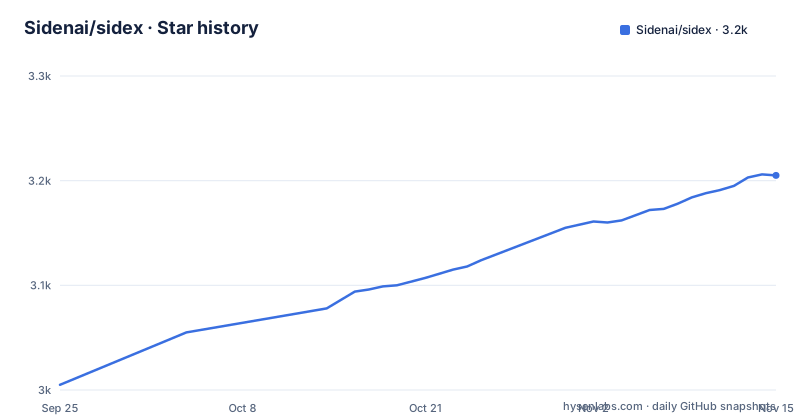
Star history
- Sidenai/sidex3,205 ★ · +200
| Repository | 2026-09-25 | 2026-11-15 |
|---|---|---|
| Sidenai/sidex | 3k | 3.2k |
200 Stars in the last 51 days, measured from the daily GitHub snapshot. Compare with other projects
Editorial analysis
The size claim is in the description and the measurement is deferred
The repository description leads with a number: rebuilt on a different runtime, same architecture, ninety-six percent smaller. Nothing in the file supports it. The section arguing the case for the rewrite makes a different argument entirely, that the other editor's memory use is almost entirely the bundled browser rather than the editor, and then qualifies it three ways. The saving is most tested on one operating system, where the system webview is shared with the platform browser. On the other desktop the picture is described as more nuanced, with the webview's memory looking higher depending on how it is measured, and that is linked as an open issue in the upstream runtime project. The only figure given is a target of under 200 megabytes idle on that one platform, and real benchmarks are promised once the application is stable enough for them to be meaningful.
There is no prebuilt binary to check any of it against
The build section says the first build takes five to ten minutes of compile time and states plainly that pre-built binaries are not distributed yet. That single line removes the only way a reader could settle the size question, because there is nothing published to measure and nothing to compare. It also reframes the ninety-six percent figure as a projection about an artefact nobody can download. The two remaining paths are a development run from a clone and a source build, and both require the reader to have the toolchain already in place. What the file does commit to is behaviour rather than size: the editor and terminal are described as solid, and the extension host and debugger as still in progress.
Three version numbers for one project
The JavaScript manifest says the application is at 0.1.3. The newest published release is v0.1.2, and there have only ever been two releases, both from the same week in April 2026. The Rust workspace manifest says 0.2.0. So the desktop application, the published artefacts and the native crates are on three different version lines, with the native side already a whole minor version ahead of the application it ships inside. The default branch has moved since those releases, so the branch is ahead of the newest tag as well. The repository field in the native manifest also spells the owner in lower case, which is harmless on a case-insensitive lookup and wrong on a case-sensitive one.
You can install extensions that cannot run
The status section has one heading, Solid, and eleven bullets under it. Extension installation from an open extension registry is one of them. The opening note, though, says the extension host and the debugger are still in progress. So the file lists as working a path that installs extensions into an application with no working host to execute them, and marks the shortfall in the preamble rather than in the list. The native side tells the same story from the other direction: twenty-one internal crates are declared as workspace members, including ones for extensions, the extension API, the debug adapter protocol, authentication, profiles and updates. The scaffolding is several features ahead of the surface.
An SSH server library and a Docker client ship inside an editor
The workspace dependency table includes a Rust implementation of an SSH server, a Docker API client, and a WebSocket library, alongside the more expected pieces: an async runtime, a rope-based text buffer, a terminal emulator with pseudo-terminal support, a bundled SQLite with backup support, tree-sitter for syntax, a file watcher, and an HTTP client with TLS. None of the remote or container dependencies appears anywhere in the file's feature list, and the eleven solid bullets cover editing, files, terminal, Git, themes, menus, extensions, search, storage and the agent. That is a large amount of network-facing surface area arriving with no documented feature and no stated threat model. The one explicit safety rail in the whole manifest is a lints table denying unsafe code across the workspace.
The JavaScript side tells a parallel story. Two Microsoft first-party telemetry packages are still direct dependencies of a project whose file insists there is no hosted service in the agent's path, and neither appears in the prose anywhere. Syntax highlighting arrives as a WebAssembly build of the same parser the native side uses natively. The terminal is assembled from ten separate add-on packages covering everything from ligatures to WebGL rendering, which is the cost of reimplementing an existing feature rather than shipping someone else's. What the file does commit to is the shape of the port: a mapping table from the original architecture onto the new one, layer by layer, beginning with the main process becoming a native backend and the browser window object becoming a webview window.
The agent is a Go binary the application spawns and supervises
The coding agent is not part of the editor process. On launch the application starts a separate server binary, written in Go and living in its own directory, as a child process bound to the loopback interface on a random free port. It is supervised from the native side and stopped when the application exits. The design degrades deliberately: if the binary has not been built, everything except the chat panel keeps working, and the panel simply reports itself as disconnected. Building it is a separate, optional step, and the file gives the exact commands:
cd sidexai/sidex-server
go build -tags fts5 -o sidex-server ./cmd/server
The build tag turns on SQLite full-text search in that server, and the application looks for the resulting binary automatically when running from a source checkout.
Credentials resolve from four sources and the third one is a CLI login you already have
There are no built-in model presets; you add a provider and a model identifier yourself. Keys are then resolved in a stated order, first match winning. The first source is a key typed into settings. The second is an environment variable already exported in your shell. The third is an existing login from another coding agent on the same machine, which is opt-in per provider. The fourth is a keyless local model server on loopback, detected automatically across four named local runtimes on their default ports. The note attached to the third source is the one to read: the application presents the same first-party client identity those command-line tools use, so a connected login can run models, and usage still counts against that subscription. The file names a billed key in settings as the path that does not depend on a login or on a provider's consumer terms.
One environment variable turns the agent into remote code execution
The file is explicit that the agent server executes shell commands and edits files on your behalf, and that binding it to loopback only is a deliberate boundary rather than an accident. Two environment variables govern that boundary. One can widen the bind address if you need it. The other is an explicit opt-in that the server requires before it will start on a non-loopback address at all, and the warning attached to it says not to set it unless you understand the exposure and have your own authentication in front of it, because an open port on this server means arbitrary code execution for whoever can reach it. Credentials, separately, reach the server only through its process environment, are set fresh on each start, and are never written to a config file or sent to the webview. The credential list itself is worth reading as an inventory. A committed example file enumerates twelve provider keys by name, from the two largest model providers through gateway and regional ones, and it explains that none of them is required because the application reads whatever credentials already exist on the machine. The same file notes that the four local runtimes are probed on their default ports, and that setting a base URL for one in that file would be pointless because the application resolves it fresh from settings on every start of the server.
Editorial conclusion
sidex suits someone who wants the VS Code editing, terminal and Git experience without the bundled browser runtime and is willing to build it from source, since there are no prebuilt binaries. Read the agent section before enabling it, because the credential chain can reuse a subscription login you already have and the escape hatch for network exposure turns the server into remote code execution for anyone who can reach the port. Treat the size and memory figures as unmeasured, and check the language toolchain requirements first: the frontend build asks for a 12 GB Node heap and the optional agent server needs Go.
Frequently asked questions
What is Sidex?
It is a port of Visual Studio Code that replaces Electron with Tauri, a Rust backend plus the operating system's native webview, keeping the same TypeScript workbench, editor, terminal and Git integration without a bundled browser. It is marked as an early release.
How do I run sidex from source?
Clone the repository, change into it, install the JavaScript dependencies, then run the Tauri development command. For a distributable build, install the dependencies and run the Tauri build command, which triggers the frontend build. The first build takes five to ten minutes of Rust compile time.
Does sidex need an account?
No. The file states it needs no SideX account of any kind, no sign-in, no identity provider and no hosted service in the path for the coding agent. Requests go from the editor to a server on your own machine and on to whichever model provider you configure.
What works in sidex today?
The file marks eleven things as solid: the editor with highlighting and basic completion, the file explorer, the terminal with a full pseudo-terminal, Git, themes, native menus, extension installation from an open registry, file watching and search, SQLite storage with document management, and the built-in agent. The extension host and the debugger are still in progress.
Can sidex reach the agent server from another machine?
Not by default. It binds to loopback only on a random free port. A variable can widen the bind address, but the server refuses to start on a non-loopback address without a second explicit opt-in, and the file warns that an open port there means arbitrary code execution for anyone who can reach it.
Official sources
Add this badge to your README
If you maintain this project, the badge below links readers to this analysis and shows its maintenance status from the daily GitHub snapshot. Paste the markdown into your README; add ?metric=license or ?metric=stars to the image URL for a different field.

[](https://hysenlabs.com/projects/sidenai-sidex)Star history chart for your README
[](https://hysenlabs.com/projects/sidenai-sidex)Was this useful?