signtools: a signing service that cannot do the signing, and two dependencies forked minutes before release
✒ A free, self-hosted platform to sideload iOS apps without a computer
At a glance
- What is it?
- SignTools is a self-hosted web service, written in Go, that signs iOS, iPadOS and macOS apps using a separate macOS builder running Apple's own tooling. That split is the whole design, and it is the reason the service can be hosted anywhere. The build is also unusual in ways worth knowing: two of its dependencies are replaced by forks hosted under the same organisation, and the pseudo-versions for those forks carry timestamps two minutes before the release they shipped in.
- Who is it for?
- The scope statement is the first thing to read and the most important thing here. The project says it does not constitute a public service, does not offer an alternative catalogue of applications, does not endorse piracy, and exists to let users run homebrew apps or tweaks on their own devices.
- Can I use it commercially?
- Yes, with strict conditions. AGPL-3.0 is a network copyleft licence: if people use a modified version over a network, for example as a hosted service, you must offer them its source code under the same licence.
- Is it still maintained?
- Yes. The repository last received commits 2 days ago.
- What is it written in?
- Mainly Go, according to GitHub's language statistics.
Answers come from the project's GitHub data, last synced on November 25, 2026, and from our analysis. They are not legal advice.
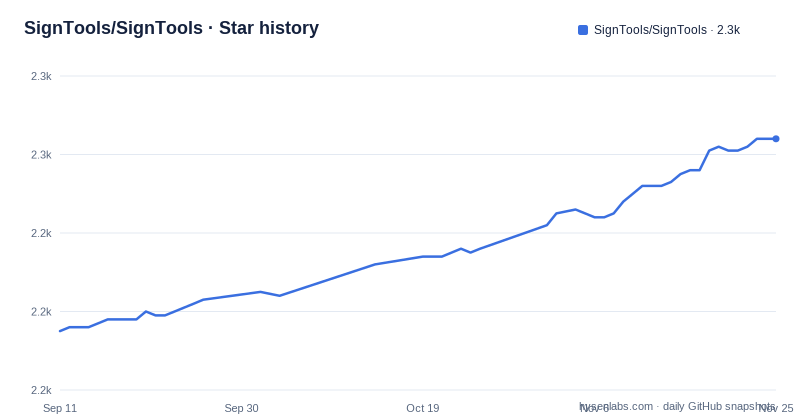
Star history
- SignTools/SignTools2,264 ★ · +49
| Repository | 2026-09-11 | 2026-11-25 |
|---|---|---|
| SignTools/SignTools | 2.2k | 2.3k |
49 Stars in the last 75 days, measured from the daily GitHub snapshot. Compare with other projects
Editorial analysis
The disclaimer defines the scope in one sentence
The page states its own limits before it states its features, and the sentence doing the work is specific.
It says the project is self-hosted and does not constitute a public service, that it does not offer any alternative catalogue of applications, and that it does not endorse or support any form of piracy. The sole purpose given is to enable users to run homebrew apps or tweaks on their own devices.
Two clauses of that are load bearing. The absence of an alternative catalogue means the project ships no content, so there is nothing to pirate through it; the artefacts come from whoever operates the instance. And the scope is homebrew apps and tweaks on your own devices, which is a much narrower claim than the technology would allow and is the claim the feature list stays inside.
There is then a liability acknowledgement, in the standard form: the developers and collaborators cannot be held responsible for damages, losses or consequences, and users should comply with applicable law. That is boilerplate, and it is worth reading as boilerplate rather than as a substitute for the sentence above it.
The reason the framing matters is that the underlying capability is general. A tool that signs an arbitrary unsigned application, injects a library into it and hands back an installable artefact can be pointed at anything. What constrains it is not a technical limit but the operator's intent plus the requirement that signing uses your own identity. Read the scope statement as part of the design, not as decoration.
Signing needs a Mac, so the project is split in two
The architecture section explains the split before anything else, and it is the most interesting decision in the project.
There are two components: a service and a builder. The builder is a macOS machine that performs signing using Apple's official software, and the stated reason is reliability and compatibility. The service, which is what this repository contains, can be hosted anywhere, and provides a web interface for uploading, signing and downloading apps, using the builder where necessary.
So the hard part cannot be containerised. Code signing on Apple platforms goes through tooling that exists only on macOS, and a Linux server cannot do it. Rather than pretending otherwise or emulating it, the project puts the macOS requirement in one box and everything else in another.
The benefit is stated as a consequence rather than a feature: having the web service means nothing has to be installed on your phone, and you can still sideload without a computer.
That last phrase needs unpacking, because the feature list says no computer is required after an initial setup. The initial setup is the builder. So the sequence is that you stand up a macOS machine once, and from then on the phone needs nothing beyond a browser. The feature that says no jailbreak is required belongs to the same list: the result is a conventionally signed application that installs through the normal path under your own identity.
One detail worth noting about scope. The supported targets include iOS, iPadOS and macOS, with macOS covered in both native and packaged form. So this is not only a phone tool, and a self-hosted instance is as much a macOS signing service as an iOS one.
AGPL-3.0 extended to the organisation's unlicensed forks
The README states that SignTools and its unlicensed dependencies under the SignTools organization are licensed under AGPL-3.0, and links to a copy of the license. It also asks readers interested in exclusive licensing to open an issue.
AGPL-3.0 includes a network-use provision: an operator who modifies the program and lets users interact with that modified version over a network must offer those users the corresponding source under the license terms. This is distinct from a restriction on commercial use.
For each dependency or fork, inspect the applicable license and the rights available from its authors; the README statement alone does not establish rights in every upstream project. Read the full license and seek advice for a specific distribution or deployment.
Two dependencies replaced by forks, timestamped minutes before the release
The module file contains a replace directive for two dependencies, and both point at forks under the project's own organisation:
replace (
	github.com/tus/tusd/v2 v2.10.0 => github.com/SignTools/tusd/v2 v2.0.0-20260716144328-8379fca867cb
	software.sslmate.com/src/go-pkcs12 v0.7.3 => github.com/SignTools/go-pkcs12 v0.0.0-20260716144310-901ab8d8d132
)
Both replacements target untagged commits, which is what the version format with a date and a hash means. So the pinned state of both libraries is a specific commit on a branch, not a release, and there is no upstream version to compare it against.
The timestamps are the detail. They read 14:43:28 and 14:43:10 on 16 July 2026, and the newest published release of the project is tagged for 14:49:12 the same day. Both forks were branched roughly two minutes before the release that shipped with them. That is consistent with someone needing a change, forking, patching, pointing the build at the fork and cutting a patch release in the same sitting.
Which two libraries, and why, tells you what this project actually needed. One is a resumable upload server, and the other is a reader and writer for PKCS#12 certificate files, which is the format Apple signing identities ship in. So one fork is about moving large application archives reliably, and the other is about reading the signing certificate itself.
Neither is a gratuitous patch. Both are load bearing. What it costs you is that a reproducible build of this project now depends on two commits on branches you cannot diff against a release, hosted by the project rather than upstream.
A resumable upload server and a resumable upload client in the same binary
The dependency list contains both halves of the same protocol, which is unusual enough to notice.
There is a resumable upload server, the one that was forked, and there is a separate resumable upload client library, plus a general purpose HTTP client library. So this binary can receive a large upload, and it can also perform one.
The coherent reading is that the service accepts application archives from a browser over a resumable protocol, and then forwards them to the macOS builder over the same kind of protocol, so an interrupted transfer does not have to start again. Given that application bundles are large and the two halves of the system are different machines on different networks, resumability on the leg that crosses the network is the part that matters.
There is also a structural cost to shipping a server and a client of the same protocol in one process: two implementations of the same wire format, from two projects, one of which is a fork.
The rest of the list describes the shape of the service. A web framework, a configuration library with a YAML backend, a GitHub API client at an old major version, an OAuth2 library, a UUID library, an ordered map, an atomic file writer, and a test framework. Two entries are worth flagging as abandoned by their maintainers: a pre-standard-library errors package, and the GitHub client at major version 33, which is from the previous generation of that library's numbering.
Logging is where the list is heaviest. Five packages are involved, including two community wrappers, one for the web framework's logger and one to bridge the standard library interface, plus a colour package and a standard library bridge pulled in indirectly. For a single service that is a lot of logging surface, and it is the clearest sign of which parts of this stack have been assembled incrementally rather than chosen once.
The runtime image installs nothing at all
The container recipe is short enough to read in full, and the final stage is where the attention goes:
FROM alpine:3.24.1

WORKDIR /

COPY --from=builder "/src/SignTools" "/"

ENTRYPOINT ["/SignTools"]
EXPOSE 8080
One binary, copied to the root of a minimal Alpine image, with one port exposed. The build stage disables the C compiler, strips the symbol table and debug data, and turns off automatic version control stamping, which is required because the source is copied into the build without a repository directory.
The build image is a Go release newer than the version the module file declares, which is ordinary and harmless, and it is the second place the Go version appears.
What the final stage does not do is install a certificate authority. The build stage adds one package, the version control client, and only because the build needs to fetch modules. The runtime stage adds nothing. The base image does not ship a trust store, so any outbound TLS from the service itself depends on something outside this file.
That matters here more than it would in a typical Go service, because the dependency list contains an OAuth2 library and a GitHub API client, both of which make outbound HTTPS calls in the ordinary case. So either the operational path avoids them, or the certificate store comes from a base image, a bind mount, or a layer this recipe does not show. It is a small thing to check and an awkward one to discover in production.
One exposed port and a single entry point means the whole surface is the HTTP interface, which is worth keeping in mind against the feature list.
The readme is a stub, and one details file is never linked
This page is about a hundred and twenty words of prose and two links, and the links are the entire documentation.
Installation is a link to a separate file. The frequently asked questions are a link to a separate file. The screenshots section is an HTML table containing one empty cell, so the images exist and none of them is described in text.
There is also a details file at the top level of the repository that the page never mentions. So the documentation is split three ways, and the reader has to find the third piece by listing the repository rather than by reading the readme.
The repository layout is otherwise sensible for a Go service with a web frontend: a main entry point and its test, a source directory, a module definition with its checksums, a container recipe, a release configuration for Go, and an images directory. There is also a shell script and a certificate file at the top level whose names suggest they are for generating a test signing identity rather than being part of the service.
Two release tools sit side by side, which is a genuine oddity: a GoReleaser configuration for the binaries, and a semantic release configuration for something else, with commit hooks installed through the JavaScript toolchain. So the project publishes through two pipelines, one for each ecosystem it spans.
The small JavaScript manifest is worth a look because it is doing two jobs. It installs the hook runner, a staged-file formatter and a source formatter, and it configures the formatter to treat one file extension as HTML rather than as whatever the extension suggests, at a print width of 119. That extension corresponds to Go HTML templates, which is how this service renders its pages, so the web templates are formatted by the same tool as everything else.
Entitlements are the configurable part, and that is the real security surface
The feature list is short, and one item in it carries almost all of the risk.
Most of the list is unremarkable and each item maps to a step in the workflow. No jailbreak is required. Three operating systems are supported, iOS, iPadOS and macOS. Nothing needs to be installed on the phone. The web interface is described as minimal and mobile friendly. You upload an unsigned application and download a signed one. You can install a signed application from the website straight to your device, over the air. Provisioning profiles and developer accounts are supported. You choose between multiple signing profiles for each application.
Then there is configurable signing including entitlements, and that is where the security decisions live.
An entitlement is the list of capabilities a signed application claims: keychain sharing, push notification delivery, application groups, associated domains, and so on. A signature tells the system who vouched for the binary. Entitlements tell it what the binary is allowed to ask for. So a service that lets an operator choose entitlements per application is handing out capability grants, and those grants are the difference between a re-signed application that behaves like itself and one that can reach into other applications' data.
Which is why multiple signing profiles per application is a feature and not just a convenience. Different applications need different entitlements, and a service that keeps them separate is better organised than one that applies one set everywhere.
The other item that deserves a plain reading is tweak injection during signing. That is the capability that lets a modified application load an additional library, and it is the specific mechanism behind the homebrew and tweak use the disclaimer describes. Nothing else in the list has that reach, and it is the one capability an operator should think hardest about before exposing the interface.
Editorial conclusion
The scope statement is the first thing to read and the most important thing here. The project says it does not constitute a public service, does not offer an alternative catalogue of applications, does not endorse piracy, and exists to let users run homebrew apps or tweaks on their own devices. Every signing identity is the operator's own, which is the fact that keeps this in infrastructure territory rather than entitlement bypass territory: nothing here unlocks somebody else's paid software, it re-signs a binary under your own developer account. Four things to verify before running it. First, you need both halves. This repository is the service; the builder is a separate macOS machine, so a Linux server alone will not sign anything, and the page says no computer is needed only after that initial setup. Second, you need real Apple developer credentials, and the entitlements you can configure are the security-relevant surface, since entitlements are what grant capabilities beyond a plain signature. Third, the dependency situation is unusual: two upstream libraries are replaced by forks under the same organisation, those forks are untagged pseudo-versions, and the project declares them AGPL-3.0 by policy precisely because they carry no licence of their own. Check that before you redistribute a build. And fourth, the readme is a stub. It points at an installation guide and a frequently asked questions file, and there is a details file in the repository that it never links, so budget time to read the repository rather than the readme.
Frequently asked questions
Is SignTools the Microsoft SignTool for Windows?
No. That is a Windows SDK utility for signing Windows binaries and is unrelated to this project. This repository is a self-hosted web service written in Go that signs iOS, iPadOS and macOS applications, with the signing itself performed on a separate macOS builder using Apple's own software.
What does SignTools need in order to sign an application?
A separate builder, which is a macOS machine that performs the signing with Apple's official software. The service in this repository can be hosted anywhere and supplies the web interface. Provisioning profiles, developer accounts, configurable entitlements and multiple signing profiles per application are all supported.
Which license is SignTools under?
AGPL-3.0, and the page extends that licence to all unlicensed dependencies hosted under the SignTools organisation, which matters because two of its dependencies are replaced by forks living there. The page also says to raise an issue if you are interested in exclusive licensing.
How do SignTools installations reach a phone?
Through the web interface, with nothing installed on the phone, and signed applications can be installed over the air from the site. The page states that no jailbreak is required and that no computer is needed after the initial setup, which is the macOS builder.
Official sources
Add this badge to your README
If you maintain this project, the badge below links readers to this analysis and shows its maintenance status from the daily GitHub snapshot. Paste the markdown into your README; add ?metric=license or ?metric=stars to the image URL for a different field.

[](https://hysenlabs.com/projects/signtools-signtools)Star history chart for your README
[](https://hysenlabs.com/projects/signtools-signtools)Was this useful?