Harp: the help text binds -h to both --host and --help, and the release page stopped at 0.40.3
Static Web Server/Generator/Bundler
At a glance
- What is it?
- sintaxi/harp is a zero-configuration static web server that renders templates on the fly and can also compile a site to flat files. Its package, its help sample and its release page carry three different version numbers, and its licence text exists only in the README.
- Who is it for?
- Harp fits a front-end that wants layouts, partials and metadata without a build step, and that can ship flat files to any HTTP server when it wants to stop running a server at all. Two things to settle first.
- Can I use it commercially?
- Not without permission. GitHub finds no licence file in the repository, and without a licence all rights are reserved by default: you may read the code but not reuse it. Check the README, or ask the authors, before using it.
- Is it still maintained?
- Yes. The repository last received commits 132 days ago.
- What is it written in?
- Mainly JavaScript, according to GitHub's language statistics.
Answers come from the project's GitHub data, last synced on November 15, 2026, and from our analysis. They are not legal advice.
Star history
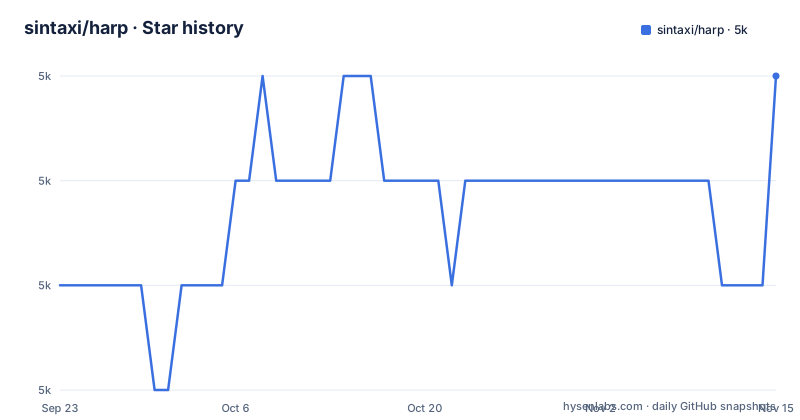
- sintaxi/harp4,997 ★ · +2
| Repository | 2026-09-23 | 2026-11-15 |
|---|---|---|
| sintaxi/harp | 5k | 5k |
2 Stars in the last 53 days, measured from the daily GitHub snapshot. Compare with other projects
Editorial analysis
Two domains, and the package still points at the older one
The repository's homepage is recorded as `https://harp.sh`, while the package metadata points somewhere else entirely:
  "name": "harp",
  "version": "0.50.1",
  "description": "Static Web Server/Generator/Bundler",
  "homepage": "http://harp.rip",
  "main": "./lib/index.js",
That homepage value is plain HTTP, and the README's resources section points its server documentation at `harp.rip/docs/` for the same reason. So the project moved domains and the published package did not follow, which matters if you follow the metadata rather than the repository page. The bug tracker URL in the same file points at the issue tracker on GitHub, and the README credits the work to a single maintainer handle while the package lists an author plus twenty-one contributors, several of them at the same company domain. Small inconsistencies, but they are the kind that tell you which parts of the documentation are written by hand and which are generated.
Three version numbers, and no release since June 2021
The clearest example of the drift is versioning. `package.json` declares 0.50.1. The help sample printed in the README says `Harp 〜 Static Web Server v0.46.0`. The release page lists v0.40.3, published on 2021-06-07 with the title security upgrade --deny-symlinks, and before it v0.40.2 from 2021-06-02, titled security patch [Unauthorized File Access]. Those two security releases are five days apart, and then nothing: the next entry down is v0.24.0 from 2017. So the newest artefact you can pull from the releases page is older than the newest artefact you can install from npm, and the branch itself moved on with a last push on 2026-07-06. Nothing in the repository explains the relationship, and there is no changelog file at the root to arbitrate it. Treat the npm version as the current one and read the source when you need to know what changed.
The option list binds -h to both --host and --help
The CLI help block is short enough to read in full, and it contains a collision:
  Harp 〜 Static Web Server v0.46.0

  USAGE
    harp <source>                                   serves project locally
    harp <source> <build>                           compiles for static host

  OPTIONS
    -p, --port                      9000            server port to listen on
    -h, --host                      0.0.0.0         server host to answer to
    -s, --silent                    false           supresses logs
    -h, --help                                      outputs this help message
    -v, --version                                   outputs version of harp
`-h` is documented twice, once for `--host` and once for `--help`, so the short flag cannot mean both at runtime and one of the two lines is aspirational. The defaults are worth reading too. The host defaults to 0.0.0.0, so a plain `harp ./public` answers on every interface of the machine rather than only the loopback, while the port defaults to 9000 and logging is on unless you pass `--silent`. The block also ends partway through a box drawing line, so whatever the rest of the help output looked like is not in the file.
The overview names seven pre-processors and the list names five
The description says Harp serves Jade, Markdown, EJS, Less, Stylus, Sass and CoffeeScript as HTML, CSS and JavaScript without configuration. The section titled Supported Pre-Processors then names five: EJS, Jade, Markdown, Sass (SCSS) and Sass. Less, Stylus and CoffeeScript appear in the prose and not in the list, and the package keywords go a different direction again, adding cjs and jsx. So the set of languages you can rely on is the shorter one unless you test it. That list has one more annotation that matters more than the missing entries: Markdown is marked Unsanitized, with no option alongside it to change that. Raw HTML written into a Markdown page is therefore served as written, which is the right behaviour for a documentation site and the wrong one for anything that renders content from another person.
CommonJS throughout, and one middleware fence is empty
Harp works as a library as well as a command. The documented surface is small:
var harp = require("harp")
harp.server(projectPath [,args])
server.listen(port, host)
Compilation takes an optional output path and an optional callback, `harp.compile(projectPath [,outputPath] [, callback])`, and the Express example mounts it behind a static handler:
// Express
var express = require("express");
var harp = require("harp");
var app = express();

app.use(express.static(__dirname + "/public"));
app.use(harp.mount(__dirname + "/public"));

app.listen(port, host)
Everything is `var` and `require`, so this is CommonJS with no ES module entry described. Note that the README introduces the Connect and Express middleware section with a fenced block that contains nothing at all, and the working example follows it, so the middleware story is one empty fence away from being absent. The example puts static files first and mounted Harp second.
Installation is one global npm command and two invocations
The whole quick start is four commands:
sudo npm install -g harp
mkdir ./public
harp  ./public
harp ./public ./build
The first runs npm as root to install globally, which is the convention of the era rather than something the project requires, and it means the package lands in a directory owned by root on most systems. The second creates a project directory, the third serves it, and the fourth compiles the same directory into a build folder whose contents can be published at a static host such as Surge.sh. The README describes what you can put in that directory as ejs, jade, md, sass and scss files, processed automatically. Three sentences in this section carry typos, including an instruction that begins Start Harp server by pointing oit and a closing line that reads Yor dist folder is now ready, which is consistent with a document that stopped being edited and a release page that stopped in 2021.
The licence text lives in the README, and the metadata reports none
Licensing here takes one read and one check. The README carries the MIT permission notice in full, with a copyright line for Chloi Inc running from 2012 to 2021 and All rights reserved above it. The repository metadata reports no licence, and the root listing has no LICENSE file: what is there is `.gitignore`, `.npmignore`, `CONTRIBUTING.md`, `README.md`, `SECURITY.md`, `bin/`, `hooks/`, `lib/`, `package-lock.json`, `package.json`, `scripts/` and `test/`. The MIT text in the README is unambiguous about what permission it grants, but a licence that exists only inside a readme is not what a package manager or a compliance tool will find. The tree also holds a `hooks/` directory whose purpose the README never explains, and the package's `main` points at `./lib/index.js` while `bin/` holds the command line entry.
Editorial conclusion
Harp fits a front-end that wants layouts, partials and metadata without a build step, and that can ship flat files to any HTTP server when it wants to stop running a server at all. Two things to settle first. Markdown is listed as unsanitized, so raw HTML in a page passes through to whatever renders it, which matters for any project that accepts content from someone else. And the version numbers do not agree: the npm package declares 0.50.1, the help sample in the README prints v0.46.0, the newest release is v0.40.3 from 2021-06-07, and the last push to the branch was on 2026-07-06, so pin what you install and expect to read source rather than release notes. On licensing, the README carries the MIT permission notice with a Chloi Inc copyright running to 2021 while the repository metadata reports no licence and there is no LICENSE file at the root, so confirm the terms for your use before shipping it in a product.
Frequently asked questions
What is Harp, the static site server?
Harp is a zero-configuration static web server with built in pre-processing. It serves Jade, Markdown, EJS, Less, Stylus, Sass and CoffeeScript as HTML, CSS and JavaScript, supports layouts and partials plus metadata for traversing the file system, and can compile a project down to static assets for any valid HTTP server.
How do I install and run Harp?
Install it globally with `sudo npm install -g harp`, create a project directory with `mkdir ./public`, then run `harp ./public` to serve it at http://localhost:9000. Running `harp ./public ./build` compiles the same project into a build folder that a static host can serve.
What is the current version of Harp?
The npm package declares 0.50.1 and the help sample in the README prints v0.46.0, while the newest release on the repository's releases page is v0.40.3 from 2021-06-07. The branch's last push was on 2026-07-06, so the published release is older than the current source.
Which license does Harp use?
The README carries the MIT permission notice with a copyright line for Chloi Inc running from 2012 to 2021, while the repository metadata reports no license and there is no LICENSE file at the repository root. Anyone shipping it should confirm the terms rather than rely on the readme text.
Can Harp be used as a Node library or Express middleware?
Yes. `require("harp")` gives `harp.server(projectPath [,args])` and `harp.compile(projectPath [,outputPath] [, callback])`, and the Express example serves static files first and then mounts Harp with `app.use(harp.mount(__dirname + "/public"))`.
Official sources
Add this badge to your README
If you maintain this project, the badge below links readers to this analysis and shows its maintenance status from the daily GitHub snapshot. Paste the markdown into your README; add ?metric=license or ?metric=stars to the image URL for a different field.

[](https://hysenlabs.com/projects/sintaxi-harp)Star history chart for your README
[](https://hysenlabs.com/projects/sintaxi-harp)Was this useful?