Secure Code Game pitches two minutes and then asks for a Codespace
Learn to code securely while having fun through our popular open source in-editor experience, designed for developers, students, and anyone curious about security. Get started for free in under 2 minutes, playing right from your browser.
At a glance
- What is it?
- This is a template repository holding four self-contained security seasons that run in a Codespace, from Python and C fundamentals through CodeQL to a season set inside an AI coding assistant. The pitch says you can start in the browser in under two minutes. The instructions say to fork the template, open a Codespace, wait for background installs, and spend part of your sixty free hours doing it.
- Who is it for?
- Secure Code Game fits a teacher, a bootcamp or a team training day who wants security practice that runs in a browser tab instead of on a lab machine, and the per-season split means you can hand someone Season 4 without the twelve hours of the earlier ones. Two things to sort out first.
- Can I use it commercially?
- Yes. MIT is a permissive licence: you can use, modify and sell software built on it, as long as you keep its copyright and licence notices.
- Is it still maintained?
- Yes. The repository last received commits 22 days ago.
- What is it written in?
- Mainly JavaScript, according to GitHub's language statistics.
Answers come from the project's GitHub data, last synced on November 22, 2026, and from our analysis. They are not legal advice.
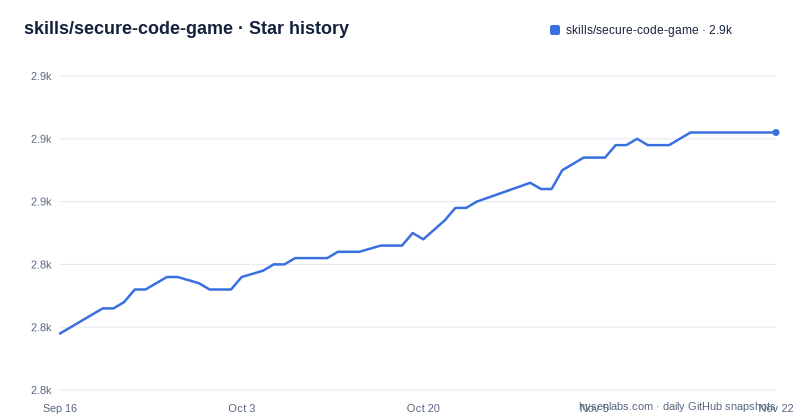
Star history
- skills/secure-code-game2,861 ★ · +32
| Repository | 2026-09-16 | 2026-11-22 |
|---|---|---|
| skills/secure-code-game | 2.8k | 2.9k |
32 Stars in the last 67 days, measured from the daily GitHub snapshot. Compare with other projects
Editorial analysis
Two minutes in a browser, then a Codespace against your allowance
The opening pitch is a single sentence with a number in it: get started for free in under two minutes, playing right from your browser.
The getting started section then describes a different amount of time and a different machine. You click Use this template, create your own repository, pick an owner, and then create a Codespace on main. It warns that this counts towards sixty hours of monthly free allowance, and that extensions and background installations take less than three minutes to finish. There is also a note to dismiss a banner offering to create a virtual environment, because none is needed.
So the browser promise describes the game interface, and the setup cost describes the environment around it. Neither is wrong, but a reader who stops at the pitch will not know that a code space is part of the deal.
The template's own instructions are still in the file
The file opens and closes with scaffolding meant for whoever forks it, not for whoever plays it. Inside a comment at the top is a block of author notes pointing at the courses quick start documentation and listing the steps a repository owner is expected to take: enable the template flag, add a social image of a stated size, turn on automatic deletion of head branches, add a description and tags next to About, disable releases, packages and environments, and add an open source licence.
Around those notes sit a header block and a footer block with nothing in them, holding the notes in place. The footer that renders, further down, is the visible one with support links, a status page link, a code of conduct and a licence line reading 2026 GitHub.
The practical effect is that a rendered README shows a large gap where a banner should be, and a reader who switches on raw HTML finds the fork instructions addressed to the owner rather than to the player.
The newest seasons are a quarter of the length of the oldest
Four seasons are laid out in two tables, newest first inside each. The two under artificial intelligence are Season 4 on agentic AI at about two hours and Season 3 on large language model security at about an hour and a half. The two under secure coding are Season 2 across a multi stack at about six hours and Season 1 on foundations at about six hours.
That is roughly three and a half hours of AI material against twelve hours of conventional material, and the file presents the four as parallel pathways rather than one ladder. Each season is described as self-contained, so you can start at Season 3 or 4 without covering what came before.
The durations are estimates rather than measurements, since nothing in the file counts how long a level takes. What the two hours buys is the newest content: five progressively harder levels, and no requirement for AI or coding experience beyond curiosity.
Season four puts you inside an assistant that runs shell commands
The newest season's premise is that you are not fixing an assistant, you are inside one. The description has you stepping into a fully interactive AI coding assistant that turns natural language into shell commands, browses the web, connects to live data sources, runs organisation-approved skills, stores persistent memory and orchestrates multi-agent workflows.
What you practise is securing agentic workflows and multi-agent communications, across five levels of rising difficulty.
That framing matters for how the season is used. A browser assistant that issues shell commands, fetches pages and calls other agents is a system with several trust boundaries in it at once, and a level that asks you to spot the missing control is a different exercise from finding a bug in a web form. The file does not list the five levels, so what exactly each one asks of you is not visible here.
Only the first two seasons need Python, and none of it is pinned
The repository carries one dependency file, and its header says it holds the Python dependencies for Seasons 1 and 2 and that they are installed automatically by a Codespace post-create command in the devcontainer configuration.
Six packages are listed, none of them with a version: a TLS wrapper, a password hashing library, a web framework, its testing companion, a signalling library and an HTTP client.
Two observations. First, the absence of that file for Seasons 3 and 4 matches the tables, since those two run in the browser with no local toolchain, while Seasons 1 and 2 need Python and, for one of them, C, Go and JavaScript alongside it. Second, for a security course, leaving the cryptography and hashing packages unpinned means every learner gets whatever the index serves that week. That is convenient for maintenance and it makes two lessons non-reproducible.
A public copy is recommended, and the reason is billing
The first getting started step ends with advice that is about cost rather than setup: choose the owner, and make the repository public so that it does not use Actions minutes.
That single clause explains why the whole flow is Codespaces based. A private copy runs its automation against a monthly allowance, while a public one does not, and the sixty free hours quoted in the next step belong to the Codespace rather than to Actions.
For a training audience it is a workable arrangement. For anyone who needs to add private material to a season, the same advice stops applying, and the file offers no alternative environment. The devcontainer directory is the only local setup described, and it is described as automatic rather than documented.
Four season folders, no releases, and a self reported player count
The top level is exactly what the four seasons need: a directory per season, a devcontainer configuration, GitHub workflow configuration, a dependency file, a contribution guide, a licence and the readme. There is no build system, no package manifest and no release history, because nothing here is published as a package. The repository has no GitHub releases at all, and the last push to main is dated 2026-10-01.
The player count is the one number in the file that carries weight and no support. It says over ten thousand players across industry and academia have already played, and points at a short link for testimonials and frequently asked questions.
The stated audience is developers, students and anyone curious about security, and the promise is that no AI or coding experience is needed for the two newer seasons. That claim sits next to the twelve hours of Python, C, Go and JavaScript waiting in the older two, which is the clearest statement in the file about who each season is for.
Editorial conclusion
Secure Code Game fits a teacher, a bootcamp or a team training day who wants security practice that runs in a browser tab instead of on a lab machine, and the per-season split means you can hand someone Season 4 without the twelve hours of the earlier ones. Two things to sort out first. Decide which season you are actually assigning, because the two AI seasons total about three and a half hours while the two coding seasons total about twelve, and the difficulty ramp between them is not smooth. And read the environment step before promising anyone a free setup, because a Codespace draws on a monthly allowance, while a public copy of the repository does not consume Actions minutes.
Frequently asked questions
What game can I play to learn about cybersecurity?
This repository is one, and it runs in the browser rather than as a download. It holds four self-contained seasons: Season 1 on foundations using Python and C at about six hours, Season 2 across CI/CD, backend and web with CodeQL using GitHub Actions, Go, Python and JavaScript at about six hours, Season 3 on large language model security at about an hour and a half, and Season 4 on agentic AI at about two hours.
What does "secure coding" mean?
The file does not define the term. It demonstrates it across four seasons, moving from web apps, systems programming and data handling through CodeQL on CI/CD pipelines and backend services, then into prompt design and input and output handling for language model applications, and finally into agentic workflows and multi-agent communications.
What is the code game?
The project here is called Secure Code Game, an open source in-editor experience for practising security. It is a GitHub template repository holding four season folders plus a devcontainer configuration, and it has no releases and no package to install.
Which is the best coding game?
This repository does not compare itself to other games, and it makes no claim about being the best. What it states is a player count of over ten thousand across industry and academia, and four seasons with stated durations of roughly six, six, one and a half and two hours.
Do I need a Codespace to play Secure Code Game?
The documented path is one. The instructions say to create a Codespace on main after copying the template, note that this counts towards sixty hours of monthly free allowance, and say extensions and background installations take less than three minutes. A banner offering to create a virtual environment should be dismissed.
Official sources
Add this badge to your README
If you maintain this project, the badge below links readers to this analysis and shows its maintenance status from the daily GitHub snapshot. Paste the markdown into your README; add ?metric=license or ?metric=stars to the image URL for a different field.

[](https://hysenlabs.com/projects/skills-secure-code-game)Star history chart for your README
[](https://hysenlabs.com/projects/skills-secure-code-game)Was this useful?