Snabb's tarball is still named after the old project, and make docker replaces the built binary with a symlink
Snabb: Simple and fast packet networking
At a glance
- What is it?
- A packet networking toolkit written in Lua on a just-in-time compiler, reaching the NIC without going through the kernel, and shipping as one stand-alone binary for Linux. Three vendored libraries are compiled from the tree, the container base is an eight-year-old Alpine, and one of its applications is developed in somebody else's fork.
- Who is it for?
- Snabb fits a network engineer who needs line-rate packet work without a kernel bypass stack of their own, particularly in the two documented roles of making virtualised networking practical at high packet rates and providing an ISP address-transition component. Three things to check before you build on it.
- Can I use it commercially?
- Yes. Apache-2.0 is a permissive licence: you can use, modify and sell software built on it, as long as you keep its copyright and licence notices.
- Is it still maintained?
- Yes. The repository last received commits 6 days ago.
- What is it written in?
- Mainly Lua, according to GitHub's language statistics.
Answers come from the project's GitHub data, last synced on November 23, 2026, and from our analysis. They are not legal advice.
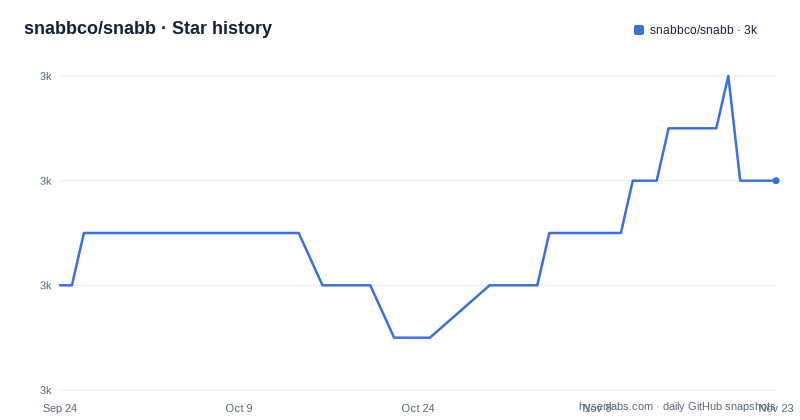
Star history
- snabbco/snabb3,034 ★ · +2
| Repository | 2026-09-24 | 2026-11-23 |
|---|---|---|
| snabbco/snabb | 3k | 3k |
2 Stars in the last 60 days, measured from the daily GitHub snapshot. Compare with other projects
Editorial analysis
Three techniques, and the third one bypasses the kernel
The README names three techniques and they are worth taking in order, because the third changes what the tool can do.
The first is Lua, described as a high-level language that is easy to learn, which is the argument for why a network engineer could pick this up.
The second is a just-in-time compiler described as competitive with C. That is the performance argument, and it is the reason the first point is acceptable: the language is slow and the compiler is not.
The third is Ethernet input and output with no kernel overhead, which the README names as a kernel bypass mode. That is the one that matters for a packet toolkit, because it means the data path does not run through the kernel's network stack.
The output is a single stand-alone executable containing every application, which the README compares to a BusyBox for networking, and which runs on any modern Linux distribution on x86-64. Nothing in the document mentions another operating system or another processor architecture.
So the design in three lines is: a language chosen for learnability, a compiler chosen to make that language fast, and a driver path chosen to remove the kernel from the per-packet cost. Everything else in the repository is one of those three.
The project renamed itself and the tarball did not
The first line of the README says the project was formerly known as Snabb Switch. The rename is complete in the prose and incomplete in the packaging.
The build file sets a package name variable to the old name, and the distribution target uses it to build the output directory name, appending the tag description to it. It then clones the working tree into that directory under the old name again, removes the version control directory from the copy, copies the built binary in, and produces a compressed archive whose name is derived from the directory. So the artefact a distributor receives is named after a project name that no longer exists, while the binary inside it is named after the current one.
The build file does keep the two apart deliberately. It has separate variables for the package name and for the distribution binary name, and the distribution target contains a conditional that creates a symbolic link from the old binary name to the new one only when the two differ. That is a compatibility shim for anyone who scripted the old name, and it is the same instinct as keeping the old directory name in the tarball.
The install target is unaffected: it installs the binary to a bin directory under a prefix variable, honouring a staging directory variable, so a system install does not carry the old name with it.
The documented first command runs the binary through sudo
The quick start is three commands and the third one elevates.
Clone the repository, change into it, run make with a parallel flag, and then run the built binary with a help flag through sudo:
$ git clone https://github.com/SnabbCo/snabb
$ cd snabb
$ make -j
$ sudo src/snabb --help
The README claims a development environment takes about a minute, which is a claim about the make rather than about the rest.
The load-generator example repeats the pattern. Copy the built binary into a local binary directory, which needs no privileges, and then run a packet replay command through sudo, naming a capture file and an interface.
Nothing in the README connects that to the kernel bypass described earlier, so the connection has to be made by the reader: reaching the network hardware without the kernel normally means privileged access to the device. That is a reasonable inference and it is not stated.
The interface named in the example, in the form of a bus address and a device index, is the naming a ten-gigabit adapter carries on a server, which is consistent with the hardware the toolkit expects. The practical note for anyone trying this is that the build output is invoked as root on the first run, so a mistake in an application reaches the driver as root.
make docker overwrites the built binary with a wrapper script
The container route is documented as basic support, built by one make target, and that target does something worth knowing about.
The target runs a container build, then creates a symbolic link, pointing a path inside the source tree at a wrapper script under the scripts directory, and prints two usage lines. The path it replaces is the same one the install target copies to the binary directory, which is where the build leaves the executable.
So running the container target after a build replaces your local binary with a script, and the README then tells you that you can simply run that path as you would on Linux, which is what the wrapper arranges. The convenience is real, and it comes at the cost of the artefact you just built.
There is no documented way to undo it short of rebuilding, since the build output lands in the same path. The README presents the two approaches as alternatives, one containerised and one as if on Linux, and does not mention that choosing the first changes what the second one points at.
The size claim for the resulting image is eight megabytes, which the README gives directly.
Both container stages are built on an Alpine release from 2018
The container definition has two stages and both name the same base image, pinned by tag rather than by digest, at a version of Alpine that predates most of the current toolchain by years.
The build stage installs a C toolchain package, the compiler, the packet capture development headers, kernel headers and the find utilities, then copies the tree and runs a clean, a parallel make, and a second parallel make inside the source subdirectory. That second make is the same two-stage structure the top level uses.
The runtime stage installs one package, a runtime library for the compiler, and copies only the built binary across. There is no shared library directory copied, no shell, and no configuration, which is consistent with the eight megabyte claim and with the single binary design.
Two things stand out in the runtime half. A volume is declared at a directory that is also the working directory, so the container's working directory is a volume rather than a layer, and the entry point is the binary with no arguments, which means the arguments a user passes after the image name become the program's arguments.
The build stage needing a full C toolchain is the cost of compiling the vendored runtime from source, which is the next section's subject.
Three vendored libraries are compiled from submodules, one with a non-default target
The top level of the repository holds a lib directory, and the build file treats it as three separate projects.
The first is a just-in-time compiler, and the build does not use its default target. It changes into the vendored copy, changes into its own source directory and asks it to reuse an existing virtual machine image, then builds it with flags passed on the command line.
The second is a syscall binding library. The build copies its Lua source and its syscall modules into the source tree, creating a platform directory and copying architecture-specific and shared subdirectories into it.
The third is a packet inspection library, whose Lua and native sources are copied the same way into a directory of their own.
The compiler flags are worth a second look. The build force-includes a header from the repository root into every compilation, using the compiler's include flag rather than the source's own declarations, and it enables a compatibility option that presents Lua 5.2 semantics on top of the just-in-time compiler. So the runtime language version is a build decision made in the top level makefile, not a property of the vendored library.
Three native dependencies compiled from submodules, one with a non-default target and a force-included header, is why a clean source build is more than one command.
The load generator targets one family of Intel adapters
The packet load generator is the application with the most specific hardware requirement, and it is worth separating from the rest.
It generates load in two ways: by replaying a capture file in the standard trace format, or by synthesising packets with customisable contents. Either way it writes to any number of Intel ten-gigabit network interfaces, naming one adapter family by its part number. The README's community links point at a high-level device driver for the same vendor's adapter family, which is the other half of that dependency.
The efficiency claim is specific and large: a small percentage of one core per CPU is said to be enough even for hundreds of gigabits per second, which is why the README says you can run it on a small server or directly on the device under test.
That claim is also the reason the hardware list is short. Kernel bypass is not vendor-neutral; it needs a driver the toolkit knows how to drive, and the toolkit names one. Anyone on a different adapter family is outside what is documented here, whatever the kernel-bypass architecture would suggest.
The example command's interface naming is consistent with that: a ten-gigabit server port address, which is how those adapters present themselves.
One application is developed in an external fork, and the version is generated
Two structural notes close out the picture.
The first is about where development happens for one of the applications. The Layer-2 VPN application is described as being developed by a named engineer at a named research network, and the README says his branch in his own repository is the master line of development for it. So part of this project's roadmap lives outside this repository, in a personal account, and the README says so plainly rather than implying it is tracked here.
The other applications are described differently. The virtualisation networking application was originally developed to support a named national carrier's network and targets up to a stated rate of traffic per server, deployable with QEMU or integrated with a named cloud platform. The address transition component is an ISP-facing piece that lets users reach IPv4 while the internal network stays IPv6-only, and can share one IPv4 address across multiple customers.
The version handling is the last piece. The root holds a dot-prefixed version file and a shell script whose name says it generates a Lua version file. Together with the release names, which are calendar versions carrying a code name in quotes, that explains how a Lua toolkit publishes versioned releases: the number is stamped into a generated file rather than edited by hand.
The recent releases stop in August 2024 while the last commit is from July 2026, so the branch is well ahead of the last named release.
Editorial conclusion
Snabb fits a network engineer who needs line-rate packet work without a kernel bypass stack of their own, particularly in the two documented roles of making virtualised networking practical at high packet rates and providing an ISP address-transition component. Three things to check before you build on it. It is Linux on x86-64 only, and the load generator is written against one family of Intel ten-gigabit adapters, so hardware support is narrower than the kernel-bypass description suggests. The build compiles three vendored libraries from submodules, one of which is built with a non-default target, so a source build is not a single make in a clean tree. And the documented run commands all invoke the binary through sudo, which is the visible consequence of the kernel-bypass design rather than an accident.
Frequently asked questions
What is Snabb?
A simple and fast packet networking toolkit, formerly called Snabb Switch. It is written in Lua on a just-in-time compiler described as competitive with C, and its Ethernet input and output runs with no kernel overhead in a kernel bypass mode. It compiles into one stand-alone binary that includes every application and runs on modern Linux on x86-64.
What is Snabb used for?
The documented applications include making QEMU and KVM networking practical at high packet rates for ISP core routers, an ISP-facing IPv6 transition component that can share one IPv4 address between customers, a Layer-2 VPN application under development in an external fork, a packet load generator, and a Lua shell for experimenting with the APIs.
How do I build Snabb?
Clone the repository, change into it and run make with a parallel flag, then run the built binary. The README claims that takes about a minute, and the binary is stand-alone and can be copied between machines. A container route exists through a docker make target, which also replaces the local binary with a wrapper script.
Does Snabb run on macOS, Windows or ARM?
The README states that the single binary runs on any modern Linux distribution on x86-64 and names no other platform. Hardware support is also narrow in a documented way: the load generator writes to one family of Intel ten-gigabit adapters by part number, and the community links point at a device driver for the same vendor.
Official sources
Add this badge to your README
If you maintain this project, the badge below links readers to this analysis and shows its maintenance status from the daily GitHub snapshot. Paste the markdown into your README; add ?metric=license or ?metric=stars to the image URL for a different field.

[](https://hysenlabs.com/projects/snabbco-snabb)Star history chart for your README
[](https://hysenlabs.com/projects/snabbco-snabb)Was this useful?