SOFARPC is nineteen Maven modules around a point-to-point Java call
SOFARPC is a high-performance, high-extensibility, production-level Java RPC framework.
At a glance
- What is it?
- SOFARPC is a Java RPC framework whose readme is 250 words long and points at a documentation site for everything else. What the readme does fix is the shape of the tree: core next to core-impl, then codec, remoting, registry, fault, tracer, metrics, and a bootstrap. The extension points it names are filter, routing and load balancing.
- Who is it for?
- Take SOFARPC if you run Java services, want point-to-point remote calls, and intend to add policy through the three extension points it names: filter, routing and load balancing. Its own summary also claims a microservice governance solution around the framework and its surrounding components, and the history it gives is ten years of use inside Ant Financial across five generations of development.
- Can I use it commercially?
- Yes. Apache-2.0 is a permissive licence: you can use, modify and sell software built on it, as long as you keep its copyright and licence notices.
- Is it still maintained?
- Yes. The repository last received commits 13 days ago.
- What is it written in?
- Mainly Java, according to GitHub's language statistics.
Answers come from the project's GitHub data, last synced on November 15, 2026, and from our analysis. They are not legal advice.
Star history
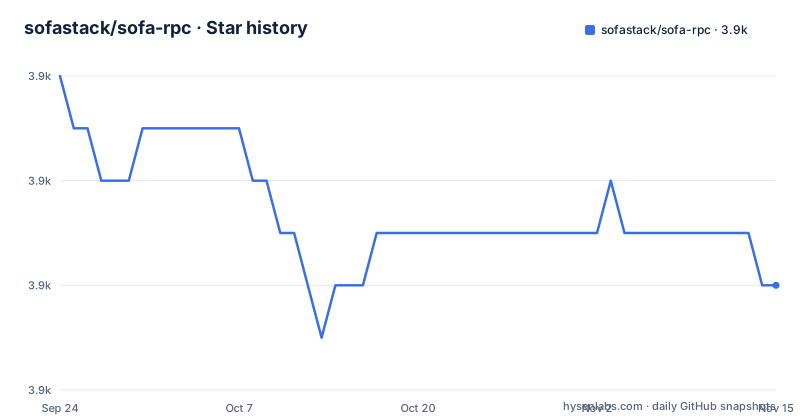
- sofastack/sofa-rpc3,918 ★ · -4
| Repository | 2026-09-24 | 2026-11-15 |
|---|---|---|
| sofastack/sofa-rpc | 3.9k | 3.9k |
-4 Stars in the last 52 days, measured from the daily GitHub snapshot. Compare with other projects
Editorial analysis
Nineteen module directories, one per seam in the stack
The repository root is a Maven multi-module project: a parent pom.xml sits next to nineteen module directories. The names follow the parts of an RPC stack rather than feature areas, which is the fastest way to read the design. Two of them sit side by side, core/ and core-impl/, and keeping them apart is itself a fact about the shape: one is the surface, the other is what sits behind it. Around that pair sit codec/, remoting/, registry/, fault/, tracer/, metrics/, config/, bootstrap/ and compiler/, then the supporting directories resource/, log-common-tools/, tools/, doc-swagger/, test/ and example/. Two more sit at the front of the alphabetical listing with packaging-sounding names, all/ and bom/. Which artifact each directory publishes is not explained anywhere in the readme.
Invoke types are named, protocols are not
The feature list names the invoke types it covers: synchronous, oneway, callback, generalized and more. Protocols are handled in the opposite way. One line claims support for multiple protocols and no line names a single one of them. The same is true of service registries, where the claim is that multiple registries are supported without any of them appearing. So the invocation modes are the part of the surface you can read off the page, and they are also the part you choose at the call site, while the protocol and registry choices are exactly what you will have to look up elsewhere. That asymmetry is worth knowing before you start: the choice you make in application code is documented, the choices you make in configuration are not.
Filter, routing and load balancing are the extension points
The overview promises a wealth of model abstraction and extensible interfaces, and then names three: filter, routing and load balancing. That is the whole extension story the readme gives, and it maps onto the module names, since fault/ and registry/ exist for the concerns a filter or a routing rule would reach into. No code intrusion is claimed twice, once in the overview and once as the first item in the feature list, which reads as a promise that policies attach without editing the call path. What is not given anywhere is an interface name, a base class or a registration point, so the shape of a custom filter, and the order several of them run in, are questions for the developer guide rather than for this page.
Failover, warm-up and fault tolerance arrive as one line
Cluster behaviour is compressed into a single item: support cluster failover, service warm-up, automatic fault tolerance. Three separate behaviours, one line, none of them explained. Failover is the one you would want defined, because the difference between moving to the next provider and failing the call is a decision about duplicate work on your side, and nothing in the readme says which of the two this framework does. Service warm-up implies a window after start-up during which traffic is held back from a new instance, and automatic fault tolerance implies decisions taken on your behalf rather than reported back to you. All three are named as supported features. None come with a configuration key, a timeout or a stated default, so the only honest summary is that you have to read the guide to learn what they do.
JDK 8 at both ends, Maven 3.2.5 at build time
The requirement block is short and specific. The build needs JDK 8 or above and Maven 3.2.5 or above; the runtime needs JDK 8 or above. Nothing above that floor is named, so there is no stated ceiling and no stated preference between distributions. The repository root carries mvnw and mvnw.cmd next to a .mvn/ directory, which is the Maven wrapper, so the 3.2.5 floor can be satisfied from the checkout rather than from a machine-wide install. There is also an example/ module with its own pom.xml and a src/ directory, which is what a first build has to exercise, and a bom/ directory for the dependency versions the modules share.
Ten years at Ant Financial, with the tutorial on a docs site
The overview gives the history as more than ten years of use inside Ant Financial and five generations of development, and that is the only statement of scale the readme makes. Everything procedural points outward to the documentation site: a getting started page, a user guide, a developer guide, release notes and a road map, all hosted under sofastack.tech. The getting started link is written for SOFA Boot, and the related project named at the top is sofa-rpc-boot-project, which its own description says holds the starters and the samples. So the quick start is a Spring Boot story told in a different repository, and this one supplies the framework underneath it. Two readmes sit at the root, the English one and README_zh_CN.md, and the docs links all carry a language parameter.
Contact is a DingTalk group heading with nothing under it
The contact section is the shortest thing in the readme: a Contact Us heading with a single bullet reading DingTalk Group, and no identifier, no link and no instructions attached to it. For a project that claims ten years of internal production use, that is the entire stated external support surface. The contribution route is a link to a how-to-contributing page on the documentation site, and the repository root also carries CONTRIBUTING.md and SECURITY.md, so a written process exists even though the contact section does not point at it. Worth knowing before you adopt the framework: you are expected to read the guide rather than to ask, and the group is named without a way to find it from the page.
Apache 2.0, with third-party terms on a separate page
The licence line does two things. It puts SOFARPC under the Apache License 2.0, and it acknowledges that the framework uses some third-party components whose open source licences are collected on a separate NOTICE page in the documentation site. The LICENSE file sits in the repository root; the NOTICE page does not, it is hosted with the docs. So a scan of the checkout finds the Apache text and not the third-party list, which matters if your build has a licence allowlist that expects everything in one place. Coverage reporting has the same split, with codecov.yml in the root and the badge in the readme pointing at the service. Governance files are thin too: no code of conduct document appears at the root of this repository.
Editorial conclusion
Take SOFARPC if you run Java services, want point-to-point remote calls, and intend to add policy through the three extension points it names: filter, routing and load balancing. Its own summary also claims a microservice governance solution around the framework and its surrounding components, and the history it gives is ten years of use inside Ant Financial across five generations of development. Check three things before you commit. The protocol and registry names are not in the readme, only the claim that several of each are supported, so plan a trip to the developer guide. Cluster failover, service warm-up and automatic fault tolerance arrive as one line of the feature list with no behaviour described, and the failover part decides whether a retried call can duplicate work. The build floor is JDK 8 with Maven 3.2.5 or above, although the wrapper scripts in the repository root can satisfy that locally. Finally, if you wanted a Spring Boot quick start, that page lives under SOFA-Boot and the sofa-rpc-boot-project repository rather than here, and the only support address given is a DingTalk group heading with no link under it.
Frequently asked questions
What is SOFARPC used for?
It is a Java RPC framework for point-to-point remote service invocation between applications, with interfaces for filter, routing and load balancing so policies can be added without editing the call path. The readme says it has been used inside Ant Financial for more than ten years across five generations of development.
What does SOFARPC need to build and run?
The build needs JDK 8 or above and Maven 3.2.5 or above. The runtime needs only JDK 8 or above. The repository root also carries mvnw and mvnw.cmd next to a .mvn/ directory, so the Maven wrapper can satisfy the build tool requirement from the checkout.
Which RPC invoke types and protocols does SOFARPC support?
The readme names the invoke types: synchronous, oneway, callback, generalized and more. For protocols and service registries it claims support for multiple ones without naming any, so those lists have to come from the developer guide.
How do I start a SOFARPC project?
The readme has no installation snippet. It points at a getting started page written for SOFA Boot on the sofastack.tech documentation site, and at the related repository sofa-rpc-boot-project, which holds the starters and samples.
How does SOFARPC handle a failing or starting service?
The feature list names cluster failover, service warm-up and automatic fault tolerance as supported. It does not describe what any of them do, and gives no configuration key, timeout or default for them.
What licence is SOFARPC released under?
The Apache License 2.0, with the licences of the third-party components it uses collected on a separate NOTICE page in the documentation site. The LICENSE file is in the repository root, the NOTICE page is hosted with the docs.
Official sources
Add this badge to your README
If you maintain this project, the badge below links readers to this analysis and shows its maintenance status from the daily GitHub snapshot. Paste the markdown into your README; add ?metric=license or ?metric=stars to the image URL for a different field.

[](https://hysenlabs.com/projects/sofastack-sofa-rpc)Star history chart for your README
[](https://hysenlabs.com/projects/sofastack-sofa-rpc)Was this useful?