SOLO Builders is one README with a community attached, not a repository with code
A curated resource collection for independent developers, AI builders, and one-person companies.
At a glance
- What is it?
- The GitHub side of SOLO Builders is a single markdown file that describes a community for independent developers, with the actual site at solo.xin. Everything a visitor can evaluate lives in that file, and the file is short. Its two most concrete lines are a keyword list and a link.
- Who is it for?
- This fits someone looking for the name and a first impression of what the community claims to value, and it costs a minute to read. It does not fit anyone trying to evaluate a tool, a licence or an installation, because none of those exist in the repository.
- Can I use it commercially?
- Not without permission. GitHub finds no licence file in the repository, and without a licence all rights are reserved by default: you may read the code but not reuse it. Check the README, or ask the authors, before using it.
- Is it still maintained?
- Activity is slowing. The repository last received commits 6 months ago.
- What is it written in?
- GitHub does not report a main language for this repository.
Answers come from the project's GitHub data, last synced on November 7, 2026, and from our analysis. They are not legal advice.
Star history
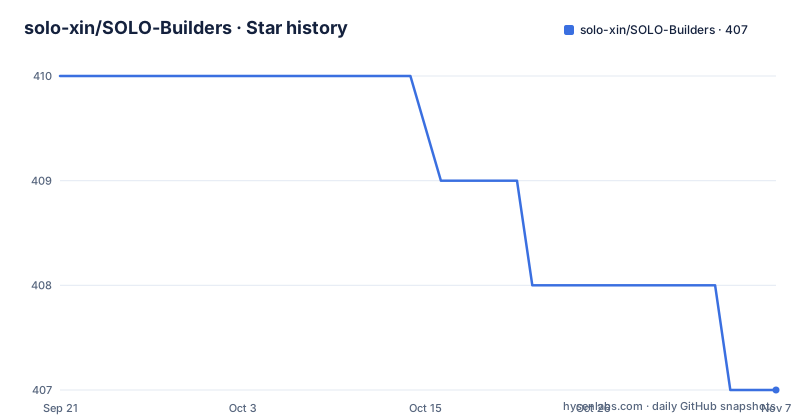
- solo-xin/SOLO-Builders407 ★ · -3
| Repository | 2026-09-21 | 2026-11-07 |
|---|---|---|
| solo-xin/SOLO-Builders | 410 | 407 |
-3 Stars in the last 47 days, measured from the daily GitHub snapshot. Compare with other projects
Editorial analysis
The repository holds one file and the product lives at a domain
The entire GitHub side of SOLO Builders is README.md. There is no source directory, no package manifest, no lockfile, no CI configuration and no licence file, and GitHub reports no releases for the project. No primary language is detected, which is consistent with a repository that contains prose rather than code.
What it points to is a site. The only outbound link in the file is the community URL https://solo.xin, listed once under a Links heading and again as the homepage. The opening line sets the tone in the form of a three-part motto: build independently, ship continuously, grow together.
So the correct way to read this repository is as a landing page stored in version control. That is a legitimate choice for a community project, and it also means there is nothing here to clone, build or install. The site is where the discussions, directories and showcases live, if they exist at all.
Two value lists and not a single capability
The file states its focus as seven items: independent development, AI-native products, solo business building, one-person companies, build in public, automation and AI workflows, and sustainable internet businesses. Under a Why section it argues that AI is lowering the barrier to building products and that more developers are turning into solo founders and one-person companies.
What it wants from members is a second list of five repetitions of the word real: real products, real builders, real launches, real revenue, real experiences.
Both lists are positioning rather than description. Nothing in them is checkable, and no threshold is attached to any of them. A philosophy section reinforces the same register with lines such as shipping matters more than talking and consistency beats hype.
The vision closes with three refusals: not just content, not just traffic, but a real place where builders connect, build, launch and grow together. That is a statement of intent, and the repository contains no mechanism that would let anyone hold it to account.
The keyword line is the most precise content in the file
Near the bottom, under a Keywords heading, the file lists nine terms separated by a middle dot: independent developer, solo founder, indie hacker, AI builder, one-person company, AI native, build in public, SaaS and automation.
It is the only line in the repository that does specific work. The About and Philosophy sections describe an attitude; the keyword line describes an audience, and it is written in the compressed form that search engines reward rather than the form a person would read.
Notice which terms do not appear: no language, no framework, no stack, no tool. This is not a repository that builds anything, so there is nothing technical to name, and the keyword line reflects that honestly.
For a visitor deciding whether to follow the link, that omission is the most useful signal in the file. A curated list and a community site can both be worth an afternoon. A promise to describe developer tooling without naming a single tool is a different kind of project.
The name collides with an existing trade term
Solo builders is already a working phrase in residential construction, and it is used that way by general contractors rather than by software founders. Anyone typing the brand string is therefore reaching for two unrelated sets of results, and the second set is a crowded one.
The file partly anticipates this. The keyword line widens the name toward indie hacker and one-person company, and the About section spends several lines separating the community from traditional startup communities. The argument is about execution rather than fundraising, which is a real distinction, but it is an argument made in the repository rather than a name that carries the distinction by itself.
The practical consequence is distribution. A generic two-word phrase cannot be ranked reliably on its own, so a project with this name has to earn its position through the writing and the members rather than through the title.
An MIT licence claimed in text but not shipped as a file
The README ends with a single line: MIT License © SOLO Builders. There is no LICENSE file in the repository, so the licence exists as a statement rather than as a text anyone can verify.
For a repository containing only one markdown file the practical difference is small, since there is no code to reuse and nothing to redistribute. The MIT grant also carries no patent clause and no contributor licensing, which matters more once there are multiple authors.
The wording is what makes it worth reading carefully. The line names an organisation that is a community rather than a legal entity, so there is no identifiable party to hold the grant, and no notice or copyright year beyond the typographic symbol.
Anyone planning to reuse material from the community site rather than the repository should treat that as an open question and ask, rather than assume the MIT line extends to it.
An ecosystem list with no way to check which parts are live
Three groups of content are promised. Community covers discussions, product sharing, build logs, AI workflows, launch experiences and growth experiments. Resources covers indie product cases, monetization ideas, SaaS workflows, prompt engineering and automation systems. Ecosystem covers SOLO Plans, builder directories, product showcases, communities and groups, and future AI-native tools.
Each of these reads as a page or a feed that would exist on solo.xin. The repository gives no way to tell which are running, because a landing page describes intent rather than inventory, and a link to the site is the only evidence offered.
The word future appears in the last ecosystem item and is doing honest work there. Nothing in the file claims a schedule, a backlog or a launch date for any of it.
Last pushed on 2026-05-07, which is the only date to judge it by
The repository is not archived and has no releases. The last push is dated 2026-05-07, which is the only dated fact in the file, and a markdown landing page rarely changes once it is written.
That makes the absence of a release history unremarkable rather than suspicious. There is no versioning scheme for a page of prose, and no changelog to read. The risk is different, and it is about whether the site matches the description.
So the way to evaluate this project is to open the link rather than to read further here. Check whether the discussions are open to non-members, whether the builder directories list anyone, and whether SOLO Plans is something you can join or a name for a page that does not exist yet.
Editorial conclusion
This fits someone looking for the name and a first impression of what the community claims to value, and it costs a minute to read. It does not fit anyone trying to evaluate a tool, a licence or an installation, because none of those exist in the repository. Two things to check before drawing a conclusion. First, the README states an MIT licence while the repository contains only that one file, so the licence claim is asserted rather than shipped. Second, the last push is dated 2026-05-07 with no releases, so treat the ecosystem section as a wish list rather than a set of running services until solo.xin confirms which parts are live.
Frequently asked questions
What is SOLO Builders?
A community and ecosystem for independent developers, solo founders, AI builders and one-person companies, reached at https://solo.xin. The GitHub repository holds the README that describes it rather than any software.
Does the SOLO Builders repository contain code?
No. It contains a single file, README.md, GitHub reports no releases, and no primary language is detected. There is nothing to clone, build or install.
What licence is SOLO Builders under?
The README states MIT License © SOLO Builders. The repository holds only that one file, so no separate LICENSE file ships with it.
What does SOLO Builders list under its ecosystem?
SOLO Plans, builder directories, product showcases, communities and groups, and future AI-native tools. The README does not say which of these are live.
When was SOLO Builders last updated?
The last push to the repository is dated 2026-05-07 and there are no GitHub releases. The repository is not archived.
What focus areas does SOLO Builders claim?
Independent development, AI-native products, solo business building, one-person companies, build in public, automation and AI workflows, and sustainable internet businesses.
Official sources
Add this badge to your README
If you maintain this project, the badge below links readers to this analysis and shows its maintenance status from the daily GitHub snapshot. Paste the markdown into your README; add ?metric=license or ?metric=stars to the image URL for a different field.

[](https://hysenlabs.com/projects/solo-xin-solo-builders)Star history chart for your README
[](https://hysenlabs.com/projects/solo-xin-solo-builders)Was this useful?