dlpython_course, ten numbered notebook folders and not one pinned dependency
Примеры для курса "Основы нейронных сетей"
At a glance
- What is it?
- This repository is the assignment half of a Russian-language deep learning course: eight numbered notebook directories, one unnumbered directory on callbacks, and one called archive. That is the whole tree, plus a readme and a gitignore. There is no requirements file, no environment specification, no licence, no dataset download step, and no expected output for any exercise, so the first thing a student has to solve is which version of two deep learning frameworks the notebooks were written against.
- Who is it for?
- Work through this repository if you want the exercises for a deep learning course and you are already comfortable installing a framework yourself. Check four things before the first notebook.
- Can I use it commercially?
- Not without permission. GitHub finds no licence file in the repository, and without a licence all rights are reserved by default: you may read the code but not reuse it. Check the README, or ask the authors, before using it.
- Is it still maintained?
- Yes. The repository last received commits 154 days ago.
- What is it written in?
- Mainly Jupyter Notebook, according to GitHub's language statistics.
Answers come from the project's GitHub data, last synced on October 20, 2026, and from our analysis. They are not legal advice.
Star history
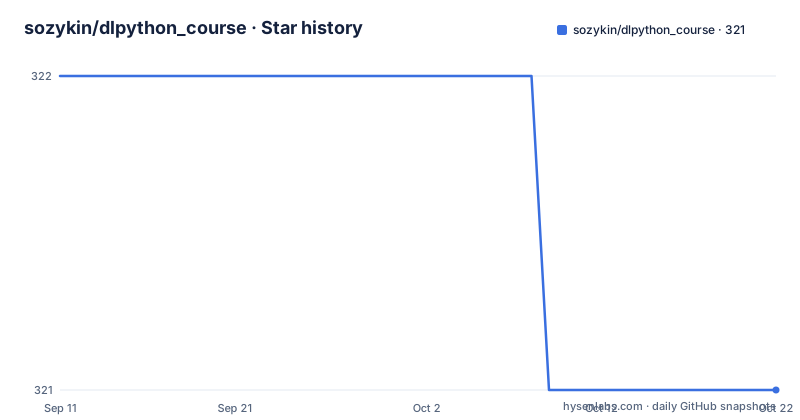
- sozykin/dlpython_course321 ★ · -1
| Repository | 2026-09-11 | 2026-10-20 |
|---|---|---|
| sozykin/dlpython_course | 322 | 321 |
-1 Stars in the last 39 days, measured from the daily GitHub snapshot. Compare with other projects
Editorial analysis
The repository and the course page have two different names
The readme's own heading names one course, and the repository's description names another. The heading calls it a course on programming deep neural networks in Python. The description calls it a course on the fundamentals of neural networks, which is a broader thing and a different title.
The two are separated by a slash rather than a version number, so neither is presented as the old name for the other. A reader arriving from a search result sees the description, and a reader arriving from the repository page sees the heading, and there is no sentence in the file connecting them.
The course page itself is linked with a subdomain and recorded without one. The link in the readme carries a www prefix; the repository's homepage field does not. Both point at the same path on the same site, and the difference is small enough that only someone comparing the two strings would notice it, which is exactly the kind of thing that gets one of them fixed and the other left.
The link is also the only route to the lectures. Its text says the page carries video lectures and practical assignments, so the repository is the code half of a course whose teaching half is somewhere else.
Two frameworks are required and the syllabus names a different set
The required software section is two items. The first is Python 3, with no minor version and no floor. The second names two deep learning frameworks, one of them built on the other, plus a third-party framework from a different vendor.
Now look at what the ten directories actually contain, as described. The first one is the foundations module and it names two frameworks, and they are not the same two. Across the other nine directories the readme names task types and never names a framework again. So the one module that describes its own stack contradicts the requirement list, and the requirement list's third entry is never claimed by anything.
That third entry is not incidental. The recommended reading includes an interactive textbook whose code is available in four frameworks, and only two of those four are in the requirement list. So the file contains three framework sets that do not agree: what you must install, what the first exercise uses, and what the suggested textbook covers.
Eight numbers, ten directories, and one of them is an archive
The list of examples runs from one to eight and then stops numbering. Two further directories are named without a number: one for callbacks in the framework's training loop, and one described as an archive of outdated examples.
The unnumbered callbacks directory sits where a ninth would go, which suggests it was added after the sequence was finished. That is a reasonable way to grow a syllabus, and it is also the only clue the file gives about it, because neither unnumbered directory has a sentence explaining when it was added or what it replaced.
The archive is the sharper problem. It is item nine or ten on a list the readme presents as the course's examples, and it is described in the same list as the rest. A student working top to bottom arrives at obsolete material as the final exercise, with no marker beyond the word archive and no statement of which of the eight numbered modules superseded it.
Neither unnumbered directory is documented from the inside either. The tree shows ten folders and no per-folder readme, so the only description any of them has is the single line in the root file.
The tree is ten folders, a readme, and a gitignore
There is no requirements file. There is no environment file, no lockfile, no container definition, and no continuous integration configuration. There is no licence file, and none is detected. There is no data directory and no script that fetches one, so the two datasets the exercises use have to be obtained by whatever mechanism the framework offers at the time you run the notebook.
That is the entire practical surface of the repository, and for a course whose stated prerequisite is installing two deep learning frameworks it is thin. Nothing records a version, so nothing tells a student whether the code they are reading was written against a current release of either framework or one from several years ago. Nothing records a Python minor version either, beyond the phrase Python 3 in the requirements section.
The default branch is still called master, and there are no releases, so there is no tag to install and nothing to compare against. The last push to that branch is 21 May 2026. The primary language GitHub detects for the repository is Jupyter Notebook, which is at least an accurate description of what the deliverable is, and it also means the repository page shows no dominant language and no indication of how many notebooks there are.
Two datasets are named with no source and no expected result
The first module is the only one whose description names its data, and it names two datasets for two different task types. One is an image classification set of clothing models. The other is a regression set for estimating property prices from tabular features. Both are the canonical tutorial dataset for the framework the module is built on, which is convenient, because it means a reader who has seen the framework's own tutorial has seen the data before.
What the description does not include is anything that would let a student tell a working notebook from a broken one. There is no download instruction, no mirror, no expected accuracy, no loss curve, no count of examples, and no statement of which split is used. Every other module is described only by task type, so the other eight are worse documented than the first.
For notebooks whose whole purpose is to be run and inspected, that is the gap that matters. A regression notebook that trains and prints a number is doing its job whether the number is right or wrong, and nothing in the repository tells you which you have.
The readme is in one language and the repository has no second one
Every line of the file is in Russian, including the section headings, the framework names in the requirements list, and the acknowledgements. The course page it links is on the same site. There is no translated readme in the tree.
That is a normal choice for a course, and mentioning it matters only because of what the repository page shows an English reader: a directory listing of ten folders whose names are numbered but uninformative, and a description in a language they cannot read. The folder names are the only English in the project, and they are abbreviations, with one exception that is a proper noun.
The readme also does not map the ten directories to anything on the course page. The page is described as carrying video lectures and practical assignments; the repository enumerates example programs. Nothing states which lecture goes with which folder, or whether the assignments and the folders are the same material under two names, which is the question a student arriving at the end of the syllabus will have.
The funding note is scoped to the first version and carries no date
The last section of the file is an acknowledgement, and it is specific. It says that the first version of the course was implemented using support funds awarded as a grant, allocated through a competition run by a national civic educational organisation, and it names that organisation.
Two things follow from the wording. The funding is attached to the first version, so it describes work done at a point in the past rather than the current state of the tree. And the file gives no date for that first version, no version number, and no statement of what the current version added.
That is the whole of the version history for a repository that has been pushed to as recently as 21 May 2026. There are no releases, no tags, no changelog, and no commit convention visible from the outside. So a reader cannot tell whether the eight numbered modules are the current syllabus, whether the unnumbered callbacks directory belongs to the funded version or a later one, or what is in the archive that was once current.
For a teaching repository, that is a documentation gap rather than a defect. It is also the reason the numbered folders are worth trusting more than the enumeration order, since the numbers are the only part of the list with an implied order.
Both recommended books are free and both have versioned code, this one does not
The reading list has two entries and both are free, which is stated for each. The first is a book by the creator of the framework the first module is built on, with a GitHub repository holding the code from the book. The second is an interactive textbook whose implementations exist in four frameworks, with its sources on GitHub as well.
Both links are to a maintained repository, and both are to code that is versioned, reviewed, and pinned to a framework release. This repository is neither. That contrast is the practical shape of the whole file: the suggested references have infrastructure and the course material does not.
The framework mismatch matters most here. A reader who works through the interactive textbook alongside the exercises will meet implementations for two frameworks this course never uses, and will meet a different set of conventions from the ones the notebooks follow. A reader who works through the book will meet the same framework the first module uses and a deeper treatment of it than eight folders of exercises provide.
Neither reference is required, and the readme does not say which to choose. It lists them, notes that both are free, and stops.
Editorial conclusion
Work through this repository if you want the exercises for a deep learning course and you are already comfortable installing a framework yourself. Check four things before the first notebook. Which version of the two required frameworks you install, because nothing in the repository records one and the framework APIs these examples call have moved. Whether the archive directory is worth opening, because it is enumerated as the tenth item on a list of ten while being described as obsolete. Whether the course page is reachable, since the lectures and assignments live there and this repository is only the code half. And whether you want to rely on a repository with no licence file, which matters if you plan to reuse any of the notebooks rather than only run them.
Frequently asked questions
What is in the sozykin/dlpython_course repository?
Ten directories of example programs for a deep learning course: eight numbered modules covering neural network basics, convolutional networks, pretrained networks, transfer learning, text processing, recurrent networks, one-dimensional convolutions, and time series, plus an unnumbered directory on framework callbacks and one described as an archive of outdated examples. The only other entries in the tree are a readme and a gitignore.
What do I need to install to run the dlpython_course notebooks?
The readme states two requirements: Python 3, with no version specified, and two deep learning frameworks, naming TensorFlow and PyTorch. No requirements file, environment file, or lockfile exists in the repository, and no version of either framework is recorded anywhere.
Which datasets do the dlpython_course exercises use?
Only the first module names its data: an image classification set of clothing models and a property price regression set. No download instruction, dataset version, or expected accuracy is given, and the other nine directories are described only by task type.
Where are the lectures and assignments for the dlpython_course course?
On the course page linked from the readme, which the link text says carries video lectures and practical assignments. The repository supplies the example programs only, and it does not map its ten directories to any lecture or assignment numbering. The readme also states that the first version of the course was funded by a grant awarded through a competition run by a national civic educational organisation.
Official sources
Add this badge to your README
If you maintain this project, the badge below links readers to this analysis and shows its maintenance status from the daily GitHub snapshot. Paste the markdown into your README; add ?metric=license or ?metric=stars to the image URL for a different field.

[](https://hysenlabs.com/projects/sozykin-dlpython-course)Star history chart for your README
[](https://hysenlabs.com/projects/sozykin-dlpython-course)