The Spring Data JPA Maven snippet has a version placeholder and never fills it in
Simplifies the development of creating a JPA-based data access layer.
At a glance
- What is it?
- Spring Data JPA generates repository implementations from your interfaces. Its README is an AsciiDoc page that shows a full application wiring an in-memory H2 database and generating its schema, points at a snapshot repository, and carries a module the page never mentions.
- Who is it for?
- Spring Data JPA is worth reaching for when you want repository interfaces and query methods derived from their names rather than hand written DAO code, and the sample configuration shows the whole shape of that arrangement in one page. Before you start, settle the version yourself, since the README's dependency block is a placeholder and the snapshot repository block will hand you a moving target if you are not careful.
- Can I use it commercially?
- Yes. Apache-2.0 is a permissive licence: you can use, modify and sell software built on it, as long as you keep its copyright and licence notices.
- Is it still maintained?
- Yes. The repository last received commits 2 days ago.
- What is it written in?
- Mainly Java, according to GitHub's language statistics.
Answers come from the project's GitHub data, last synced on November 15, 2026, and from our analysis. They are not legal advice.
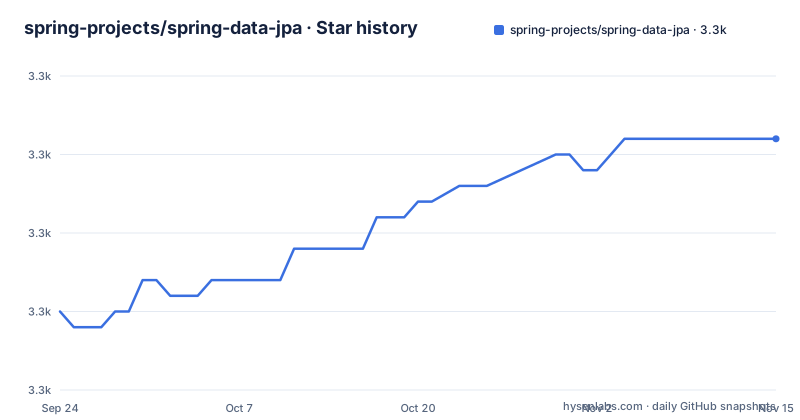
Star history
- spring-projects/spring-data-jpa3,296 ★ · +11
| Repository | 2026-09-24 | 2026-11-15 |
|---|---|---|
| spring-projects/spring-data-jpa | 3.3k | 3.3k |
11 Stars in the last 52 days, measured from the daily GitHub snapshot. Compare with other projects
Editorial analysis
The dependency block ships a placeholder instead of a version
The Maven configuration section gives you a dependency with three real lines and one that is not a version at all. The groupId is org.springframework.data, the artifactId is spring-data-jpa, and the version element is a literal ${version} property. Nothing in the page sets that property, so the snippet is a template rather than something you can paste into a pom. A second block repeats the same three coordinates with ${version}-SNAPSHOT and adds a repository entry pointing at https://repo.spring.io/snapshot for the case where you want the snapshots of an upcoming major version. Between them the two blocks cover the stable case and the pre-release case, and both leave the actual number to you. Binaries for released versions are hosted at repo.spring.io, which the build section also names as the place you do not need to build from.
The teaser deletes everything before it saves anything
The code sample is a complete little application rather than a fragment, and reading it end to end is more useful than copying it. A PersonRepository extends CrudRepository<Person, Long> and declares two finder methods, findByLastname and findByFirstnameLike. A service takes the repository through its constructor and its only method starts with repository.deleteAll() before creating a Person named Oliver Gierke, saving it, and reading it back twice, once by last name and once by a first-name pattern. The configuration class enables repository scanning for a package, wires an embedded H2 database through EmbeddedDatabaseBuilder, a JpaTransactionManager, and a HibernateJpaVendorAdapter configured for H2 with schema generation switched on, then a LocalContainerEntityManagerFactoryBean scanning another package. So the sample creates its tables from the entities at startup rather than shipping a schema.
Method names become queries, and named queries join in
The feature list is short and each line is a mechanism. Implementation of CRUD methods for JPA entities is the baseline. Dynamic query generation from query method names is what makes findByFirstnameLike work without a query written anywhere. Transparent triggering of JPA named queries by query methods is the less obvious one: a method name can resolve to a named query you already declared in the persistence unit instead of to a generated query, without any annotation on the interface. The remaining items are the supporting layer, domain base classes providing basic properties, transparent auditing for created and last changed values, the possibility to integrate custom repository code, and easy Spring integration with a custom namespace. Read together, they describe a module that gets out of the way once the interface is written.
Auditing is a listed feature, and the Envers module is not mentioned
Transparent auditing, recording when an entity was created and when it last changed, appears in the feature list as a capability of the module. The repository, however, carries a second module directory called spring-data-envers alongside the main one, named after Envers, which is the auditing library it integrates with. Nothing on the README page mentions it, describes it or tells you how the two relate. The same is true of the rest of the layout: three module directories sit at the top level, spring-data-jpa, spring-data-envers and spring-data-jpa-distribution, plus a src directory and one called org, and the page explains none of them. The name of the main module matches the artifactId in the Maven block, which is the only mapping between the tree and the page.
Building needs JDK 17, and the plain command needs Maven 3.8
The build section says you do not need to build from source to use Spring Data, because binaries are at repo.spring.io. If you do want the latest code, it says the project can be built with the Maven wrapper and that you also need JDK 17 or above, with the command given as ./mvnw clean install. The wrapper is present in the repository as mvnw and mvnw.cmd alongside a .mvn directory. If you would rather use a regular mvn command, the requirement is Maven v3.8.0 or above, which is a floor rather than a suggestion. Two procedural details sit next to the commands: pull requests are governed by CONTRIBUTING.adoc, and every commit has to carry a Signed-off-by trailer at the end.
The build is instrumented, under a parent project name
The first line of the page is a build badge, and it is about the build rather than the library. It reads Revved up by Develocity and links to a scans page filtered by a root project name of Spring Data JPA Parent. So the Maven build of this repository is instrumented for Develocity, and the aggregator that owns it is named Spring Data JPA Parent, which is a name that does not appear anywhere else in the README. The repository has a CI.adoc next to CONTRIBUTING.adoc, a SECURITY.adoc, an .github directory and a LICENSE.txt, and the README itself is README.adoc, an AsciiDoc file rather than the Markdown that most repositories on GitHub now carry.
Issue reports are expected to carry a version, a JVM and a reproducer
The reporting section sets out what an issue should contain before you file one, and the bar is specific. Search the issue tracker first, since the first recommendation is to check whether the problem is already reported. Then provide as much information as possible, and the page names the items it wants: the version of Spring Data you are using, the JVM version, complete stack traces and any relevant configuration. Code and stack traces are to be pasted inside triple backticks. Where you can, build a test case or project that reproduces the issue, attach a link or a compressed file, and set the database up in memory if possible, or with Testcontainers if it cannot be. A security policy sits alongside the README as SECURITY.adoc, and the code of conduct it points to is the Spring one, whose reporting address sits on a different company's domain rather than on a spring.io one.
Editorial conclusion
Spring Data JPA is worth reaching for when you want repository interfaces and query methods derived from their names rather than hand written DAO code, and the sample configuration shows the whole shape of that arrangement in one page. Before you start, settle the version yourself, since the README's dependency block is a placeholder and the snapshot repository block will hand you a moving target if you are not careful. Build from source only if you need to, and expect JDK 17 plus the wrapper to be the requirement. And when something breaks, note that the issue tracker expects a Spring Data version, a JVM version, complete stack traces and a reproducer, with an in-memory database or Testcontainers suggested, which is a higher bar than most bug reports meet.
Frequently asked questions
what is spring data jpa
A module of the Spring Data family that makes JPA-based repositories easy to implement. You write repository interfaces, including custom finder methods, and Spring provides the implementations, reducing the boilerplate needed for queries, pagination and auditing.
how to add spring data jpa dependency
The README gives a Maven dependency with groupId org.springframework.data, artifactId spring-data-jpa and a ${version} placeholder you have to fill in. For snapshots of the upcoming major version, use ${version}-SNAPSHOT together with the repository at https://repo.spring.io/snapshot.
how to use spring data jpa
Declare an interface extending CrudRepository with finder methods such as findByLastname, inject it into a service, and enable scanning with @EnableJpaRepositories. The README's sample also wires an embedded H2 datasource and a Hibernate vendor adapter with schema generation on.
Official sources
Add this badge to your README
If you maintain this project, the badge below links readers to this analysis and shows its maintenance status from the daily GitHub snapshot. Paste the markdown into your README; add ?metric=license or ?metric=stars to the image URL for a different field.

[](https://hysenlabs.com/projects/spring-projects-spring-data-jpa)Star history chart for your README
[](https://hysenlabs.com/projects/spring-projects-spring-data-jpa)Was this useful?