alien-signals keeps a reactivity core small on purpose, and Vue 3.6 took it back
👾 The lightest signal library
At a glance
- What is it?
- Stackblitz/alien-signals is a TypeScript signal library whose algorithmic core bans Array, Set, Map and recursion. Its manifest reads 3.2.1 while the newest tag is v3.2.0, its format subpaths each serve the other format, and the benchmark on the front page measures against Vue 3.4 while the same algorithm now ships inside Vue 3.6.
- Who is it for?
- alien-signals is a small deliberate reactivity core rather than a general state manager, and the two things worth checking before depending on it both sit in package.json rather than in the prose. The manifest reads 3.2.1 while the newest tag is v3.2.0, so pin a version deliberately instead of trusting the string in the file.
- Can I use it commercially?
- Yes. MIT is a permissive licence: you can use, modify and sell software built on it, as long as you keep its copyright and licence notices.
- Is it still maintained?
- Yes. The repository last received commits 10 days ago.
- What is it written in?
- Mainly TypeScript, according to GitHub's language statistics.
Answers come from the project's GitHub data, last synced on November 22, 2026, and from our analysis. They are not legal advice.
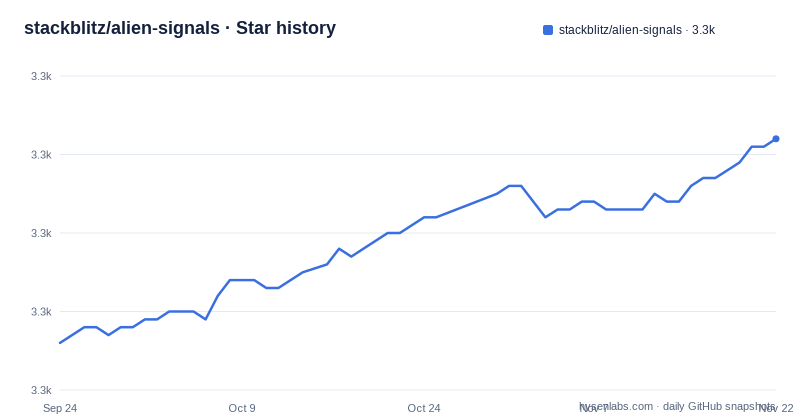
Star history
- stackblitz/alien-signals3,282 ★ · +26
| Repository | 2026-09-24 | 2026-11-22 |
|---|---|---|
| stackblitz/alien-signals | 3.3k | 3.3k |
26 Stars in the last 59 days, measured from the daily GitHub snapshot. Compare with other projects
Editorial analysis
The benchmark on the front page measures against Vue 3.4
The benchmark comparison sits near the top of the README and it names the version it compares against: Vue 3.4. That reference point is historical rather than current, and the background section says why. The author spent considerable time optimizing the reactivity system of Vue 3.4. When Vue 3.5 switched to a pull-based algorithm similar to Preact, the push-pull line moved out into this repository to keep being worked on. So the chart a reader sees by cloning the repo describes a contest between two designs at one point in time, and one of the contestants has since changed. The same paragraph resolves the ending: the core algorithm has since been ported back to Vue 3.6, at pull request 12349. The number worth carrying out of this section is not a benchmark figure but a version: the fastest implementation in the comparison is now the implementation the compared framework ships.
src/system.ts is where the unusual rules live
One sentence in the README explains the constraint that shapes everything else. The algorithmic core, at src/system.ts, does not use Array, Set or Map, and function recursion is disallowed there too. Both bans target the same cost. A library that calls itself the lightest signal library is making a claim about how the relationships between a signal, the computed values reading it and the effects subscribed to those are stored and walked, and both a hash container and a call stack add cost to that walk. The stated conclusion is that under these conditions, maintaining algorithmic simplicity buys more than complex scheduling strategies would. The constraint is visible only in the source, though. The repository layout lists src/ without itemising it, the published documentation does not restate the ban anywhere else, and the benchmark numbers live in a separate repository rather than here. If you plan to extend the system, you are extending a core whose author chose these rules on purpose.
The manifest is one patch ahead of any tag
package.json declares version 3.2.1. The newest release is v3.2.0, published on 2026-05-12, behind it sit v2.0.0 from April 2025 and v1.0.0 from January 2025, and the repository history runs past that release as well, since the last push to the default branch master is dated 2026-06-10. Read plainly, the version in the manifest does not name a published tag. Two readings fit: the file carries work that has not been released, or the 3.2.1 release was cut without a tag. Either way a reader deciding what to depend on should pin on purpose rather than copy the version string out of the repository. The publish path itself is guarded, at least on paper: prepublishOnly runs check and test before anything ships, and test rebuilds from source first. That hook governs the next release, not the gap visible today.
The format subpaths are named for the format they do not serve
The exports map carries six entries. The bare package resolves import to esm/index.mjs and require to cjs/index.cjs, which is conventional. The next two invert that. ./cjs sends import to ./cjs/index.cjs, so an ES module import through that subpath receives a CommonJS file. ./esm sends require to ./esm/index.mjs, so a require call through that subpath receives an ES module file. The last three repeat the pattern for the algorithmic core, with ./system, ./cjs/system and ./esm/system and their types resolved from types/system.d.ts. Read as opt-in format hints for tooling that cannot follow conditional exports, those two names are backwards. Read as an oversight, they are a concrete thing to check before blaming a bundler, because the symptom will look like your own code being wrong. Every entry ships types, so the entry point you choose is also the entry point your editor reads.
trigger() covers the one mutation a signal cannot see
A signal holds a value and its getter returns that value itself rather than a copy, so an array or object kept inside a signal stays mutable. Changing it in place is invisible to the dependency graph, and the README demonstrates that consequence instead of hiding it.
import { signal, computed, trigger } from 'alien-signals';

const arr = signal<number[]>([]);
const length = computed(() => arr().length);

console.log(length()); // 0

// Direct mutation doesn't automatically trigger updates
arr().push(1);
console.log(length()); // Still 0

// Manually trigger updates
trigger(arr);
console.log(length()); // 1
The push above changes the array the computed reads, and the computed still reports zero because nothing announced the change. trigger() settles the subscribers of that signal by hand, and a second form takes a callback so several signals can be settled in one pass after both have been mutated. The rule that falls out of this is simple: any write that goes through the setter, count(2), is tracked, and any write that reaches into the value is not.
Six of seven devDependencies float on latest
Seven devDependencies are declared and six of them are the string latest, among them the TypeScript compiler, the test runner vitest, the bundler rolldown and both halves of the linter, @tsslint/cli and @tsslint/config. The only entry with a real version is reactive-framework-test-suite at 0.0.2. A pnpm-lock.yaml is committed, so the lockfile is what keeps a checkout reproducible; the package manager field pins pnpm to 9.12.0. The linter is not a stock tool either, since check runs tsslint against tsconfig.json and reads tsslint.config.ts, and tsslint is published by this same maintainer as a separate CLI and config package. The build has no bundler configuration file at all: build is node ./build.js and size is node ./size.js, both hand written. Benchmarks live in a directory spelled benchs, and they run under node --jitless with --expose-gc so the optimizing compiler cannot flatter one side of the comparison.
The lightest signal library ships a size script and no number
The package description calls this the lightest signal library, and the constraint list in the README is what makes the adjective arguable. Nothing in the documentation prints the result. There is no figure in prose, no table of bundle weight next to the frameworks the benchmark covers, and no badge carrying a byte count. The benchmark itself lives in a separate repository at transitive-bullshit/js-reactivity-benchmark, so the propagation numbers are not in this tree either, which lists assets/ and no results file. The size claim is therefore checkable only by running the command yourself, and the command is wired into the scripts as npm run size. That is a gap in the evidence rather than a claim that is wrong, and it is also the reason npm run size is worth running before adopting the library on the strength of the adjective.
Ten ports, nine derived libraries, two pull requests
The README keeps three separate inventories: other language implementations, derived projects and adoption. The ports cover Dart twice, Lua twice, Luau, Java, C#, Go and Rust twice, so eight languages from one TypeScript core, with the Java and C# versions coming from the same CTRL-Neo-Studios account. One Rust port does not carry the name at all and ships as samara-signals inside a larger workspace. The derived column is the more informative one, because each entry changes the API surface rather than the algorithm: React bindings, a plain object interface, a class based API shaped after Preact signals, an islands architecture UI library, async signals layered on LazyPromise. The adoption column is shorter, and the two entries with pull request numbers attached are the ones carrying weight: vuejs/core took the algorithm into 3.6, and statelyai/xstate took it for the atom architecture. A third entry claims use inside the language-core package of the Vue language tools for incremental AST parsing and virtual code generation, and the background section repeats that claim.
Editorial conclusion
alien-signals is a small deliberate reactivity core rather than a general state manager, and the two things worth checking before depending on it both sit in package.json rather than in the prose. The manifest reads 3.2.1 while the newest tag is v3.2.0, so pin a version deliberately instead of trusting the string in the file. The subpaths ./cjs and ./esm each serve the opposite format, so a bundler that cannot follow conditional exports hands you the wrong file and the symptom reads like your own bug. The API is short enough to read in a minute, but trigger() has to be reached for whenever a signal holds a mutable collection, because nothing else will notice that change. And the claim that this is the lightest signal library comes with a size script and no published figure, so npm run size is the way to settle it.
Frequently asked questions
Is alien-signals about radio signals from space?
No. It is a TypeScript library for signal based reactivity in the browser, and the name refers to signals in the reactive programming sense, the same idea Vue and Preact use. The algorithm inside it was ported into Vue 3.6 and into the atom architecture of xstate.
What is the shortest way to see the algorithm work?
Create a signal with an initial number, derive a computed from it, and register an effect that reads it. Write through the signal and the effect reruns while the computed returns the new value. The basic example in the README does exactly this in about ten lines.
Why does my computed value stay stale after I push to an array held in a signal?
The getter returns the stored value itself, so in place changes never pass through the setter and nothing announces them. Write through the signal, or call trigger() on that signal after mutating it. trigger also accepts a callback for settling several signals at once.
Should I import alien-signals or alien-signals/system?
The bare package exposes the public API of signal, computed, effect, effectScope and trigger. The /system subpath exposes the algorithmic core on its own, and each format has a matching /cjs and /esm variant. Every entry also resolves a types file, so the choice decides which declarations your editor loads.
Is the version in package.json the version available on npm?
Not by tag. The manifest declares 3.2.1 while the newest release is v3.2.0 from 2026-05-12, with v2.0.0 and v1.0.0 before it. Publishing is gated by a prepublishOnly hook that runs check and test first.
Official sources
Where developers are discussing it
Posts on Hacker News, dev.to and Lobsters that link to this repository, found by our scan of those communities. 0 in the last 30 days; newest first.
- Vue 3.6: When a Watcher Throws, Your Other Watchers Stalldev.to · Oct 19, 2026 · 7 points · 0 comments
Add this badge to your README
If you maintain this project, the badge below links readers to this analysis and shows its maintenance status from the daily GitHub snapshot. Paste the markdown into your README; add ?metric=license or ?metric=stars to the image URL for a different field.

[](https://hysenlabs.com/projects/stackblitz-alien-signals)Star history chart for your README
[](https://hysenlabs.com/projects/stackblitz-alien-signals)Was this useful?