rtp2httpd turns multicast IPTV into HTTP streams, and fast channel change needs your ISP's FCC server
Multicast RTP/RTSP to Unicast HTTP stream converter, with built-in web player, status dashboard, fast channel change support, and more!
At a glance
- What is it?
- rtp2httpd is a C server that converts multicast RTP/UDP and RTSP into HTTP, proxies HLS from an IPTV network, and speaks the operator FCC protocol for quick channel switching. It is built for mainland China IPTV setups and works as a replacement for udpxy and msd_lite.
- Who is it for?
- Run rtp2httpd on a router, NAS or small server inside an IPTV network if you want to watch multicast channels over HTTP. An operator FCC server is needed for the optional fast-channel-change feature, not basic forwarding.
- Can I use it commercially?
- Yes, with conditions. GPL-2.0 is a copyleft licence: if you distribute software that includes it, you must release that software's source code under the same licence. Running it internally without distributing it does not trigger that obligation.
- Is it still maintained?
- Yes. The repository last received commits 25 days ago.
- What is it written in?
- Mainly C, according to GitHub's language statistics.
Answers come from the project's GitHub data, last synced on November 25, 2026, and from our analysis. They are not legal advice.
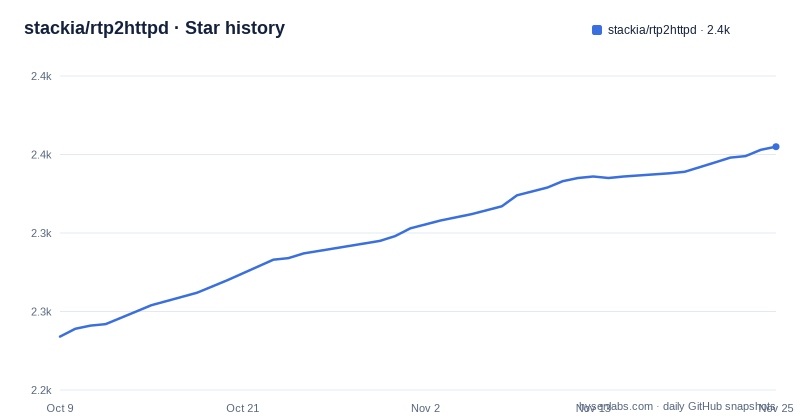
Star history
- stackia/rtp2httpd2,355 ★ · +121
| Repository | 2026-10-09 | 2026-11-25 |
|---|---|---|
| stackia/rtp2httpd | 2.2k | 2.4k |
121 Stars in the last 47 days, measured from the daily GitHub snapshot. Compare with other projects
Editorial analysis
Fast channel change only works with an FCC server and a tuned player
FCC stands for Fast Channel Change, and rtp2httpd implements the operator-grade protocol. With an operator FCC server in place, the project promises millisecond channel switching close to a native set-top box, because FCC hands over an IDR frame immediately so the player can start decoding.
Two conditions apply. The first is the server: the feature is paired with the operator's FCC server, so a network without one gets nothing from it. The second is the client. The README says fast switching needs an IPTV-optimised player such as mytv-android, TiviMate or Cloud Stream, and the demo video uses mytv-android. Common players like PotPlayer and IINA are not tuned for start-up speed, and the FCC effect there is not obvious. The consequence is that a working FCC setup can still feel slow if the player is wrong.
One server, four ways in: RTP, RTSP, HLS and udpxy URLs
rtp2httpd converts multicast RTP/UDP into a standard HTTP stream. It converts RTSP to HTTP, with the full RTSP/RTP stack and UDP NAT traversal through STUN, and the RTSP path also covers playback of IPTV time-shift sources. A third mode is a complete reverse proxy for HTTP to HTTP, so an HLS source on the IPTV internal network can be reached from the LAN or the public internet.
The udpxy URL format is supported in full. That is what lets rtp2httpd stand in for udpxy and msd_lite without changing existing playlists. The README positions it as a seamless replacement for both, and links a benchmark page at rtp2httpd.com/reference/benchmark comparing it with msd_lite, udpxy and tvgate. The numbers sit on that site, so check them there.
The M3U endpoint rewrites RTP and RTSP addresses to HTTP ones
Feed rtp2httpd an M3U or M3U8 playlist, including an external M3U URL, and it identifies RTP and RTSP URLs and rewrites them into HTTP proxy form. It also handles catchup-source addresses used for time-shifted playback. The rewritten list is served at http://<server:port>/playlist.m3u, which any player can load.
This matters for a household setup. Instead of editing each channel entry by hand, you point the server at the operator's list once and give players a single URL. The README does not say how often an external list is refreshed, so after the operator changes channels, confirm the output list reflects it.
Reorder recovery and FEC cover light loss, not a bad link
RTP packets that arrive out of order are corrected automatically, which removes the corrupted-picture effect that network jitter causes. The server also supports Reed-Solomon FEC redundancy recovery. The README limits the claim: it resists mild packet loss, and it needs the multicast upstream to support FEC.
That last condition is the one to check. If the stream you receive carries no FEC data, only the reordering helps. A link that drops many packets will still show artefacts, and nothing in the README promises otherwise. Channel snapshots are a separate feature: an HTTP request returns a snapshot image of a channel, which reduces decoding work on the player side.
The status page can disconnect clients, and the built-in player depends on the browser
http://<server:port>/status shows live state: each connection's IP, status, bandwidth and data transferred, plus the server log with a log level you can change on the fly. From the same interface you can force-disconnect a client.
The built-in player opens at http://<server:port>/player and needs an M3U playlist configured first. Its interface adapts to desktop and mobile. It supports EPG, time shift and playback, but playback needs an RTSP source. It also offers automatic deinterlacing and AMD FSR 1 upscaling, aimed at making 576i and 1080i material look better on 2K and 4K screens. Decoding happens in the browser, so some channels may show no audio or a black picture, as the README warns.
A 509KB binary with epoll workers and a shared buffer pool
The README states the program is 509KB on x86_64, written in pure C with zero dependencies, with all web player frontend resources built in. It uses a non-blocking epoll event loop, supports multiple worker processes to use several CPU cores, and preallocates a buffer pool shared between clients by load so that one slow client cannot consume everything. Clients on the same worker share multicast subscriptions, RTP processing and batch buffers.
One published figure: 25 simultaneous 1080p multicast streams at 8 Mbps each used 25 percent of a single core on an i3-N305 and 4MB of memory. It is the author's number and comes from one machine. The target devices named are routers, optical modems and NAS boxes.
The Docker image needs host networking and NET_ADMIN for large buffers
The Dockerfile builds with cmake on Alpine 3.24 in Release mode and copies the binary and rtp2httpd.conf into a second Alpine stage. It exposes port 5140. The comments give the recommended invocation:
docker run --network=host --cap-add=NET_ADMIN --rm \
  ghcr.io/stackia/rtp2httpd:latest
--cap-add=NET_ADMIN lets the process set larger UDP receive buffers, bypassing rmem_max through SO_RCVBUFFORCE. The same comment block shows --network=host in the usage line, so copy both flags together. Documentation covers other platforms, with an OpenWrt quick start at rtp2httpd.com/guide/quick-start, and the repository includes openwrt-support, ikuai-support and wireshark-support directories.
GPL-2.0, mainland China focus, and a fork of oskar456/rtp2httpd
The project is optimised for mainland China IPTV and thanks the developers of the original oskar456/rtp2httpd. The licence is GPL-2.0. The README lists what that allows, including commercial internal use, paid IPTV transcoding services and selling hardware that includes the software, and what it requires: publish source for modified code, provide source with distributed binaries, and no closed-source resale.
Releases are recent: v3.17.0 on 2026-09-09, v3.17.1 on 2026-09-11 and v3.17.2 on 2026-10-02, with the last push on 2026-10-11. Official documentation is Chinese first, with an English edition at rtp2httpd.com/en/. Anyone new to DHCP authentication, routing, multicast and firewalls is pointed to a separate setup tutorial before starting.
Editorial conclusion
Run rtp2httpd on a router, NAS or small server inside an IPTV network if you want to watch multicast channels over HTTP. An operator FCC server is needed for the optional fast-channel-change feature, not basic forwarding. Skip it if your IPTV is delivered some other way, since the project is tuned for mainland China operators. Before relying on fast channel change, test with mytv-android, TiviMate or Cloud Stream, because PotPlayer and IINA show little benefit.
Frequently asked questions
What is rtp2httpd used for?
It converts multicast RTP/UDP and RTSP IPTV streams into HTTP, proxies HLS sources from an IPTV network to the LAN or internet, and supports operator FCC fast channel change.
Can rtp2httpd replace udpxy?
The README says it is a seamless replacement for udpxy and msd_lite, and it is fully compatible with the udpxy URL format.
Which players work best with rtp2httpd fast channel change?
IPTV-optimised players such as mytv-android, TiviMate and Cloud Stream. PotPlayer and IINA are not optimised for start-up speed, so FCC has little visible effect there.
How do I run rtp2httpd in Docker?
Use docker run --network=host --cap-add=NET_ADMIN --rm ghcr.io/stackia/rtp2httpd:latest. NET_ADMIN allows larger UDP receive buffers, and the image exposes port 5140.
Official sources
Add this badge to your README
If you maintain this project, the badge below links readers to this analysis and shows its maintenance status from the daily GitHub snapshot. Paste the markdown into your README; add ?metric=license or ?metric=stars to the image URL for a different field.

[](https://hysenlabs.com/projects/stackia-rtp2httpd)Star history chart for your README
[](https://hysenlabs.com/projects/stackia-rtp2httpd)Was this useful?