GELab-Zero's requirements file does not contain the thing that runs the model
STEP-GUI: The top GUI agent solution in the galaxy. Developed by the StepFun-GELab team and powered by StepFun’s cutting-edge research capabilities.
At a glance
- What is it?
- A mobile interface agent distributed as two parts, a local inference stack for driving Android devices and a small model that runs on your own machine. The manifest pins one dependency out of sixteen and lists no deep learning framework, because the model runtime lives outside it, and four of the components are still named after a commercial assistant.
- Who is it for?
- GELab-Zero fits a team working on mobile interface agents that wants the device plumbing, trajectory recording and task distribution handled for it, and that will run its own inference rather than send screen contents to a service. Three things to know before you plan an evaluation.
- Can I use it commercially?
- Yes. MIT is a permissive licence: you can use, modify and sell software built on it, as long as you keep its copyright and licence notices.
- Is it still maintained?
- Activity is slowing. The repository last received commits 6 months ago.
- What is it written in?
- Mainly Python, according to GitHub's language statistics.
Answers come from the project's GitHub data, last synced on November 22, 2026, and from our analysis. They are not legal advice.
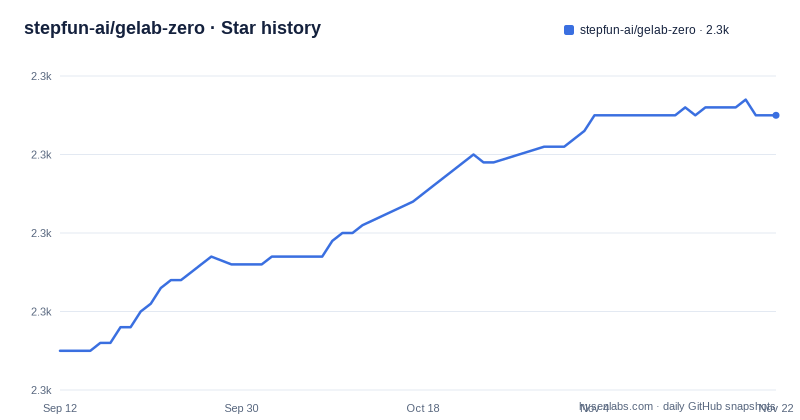
Star history
- stepfun-ai/gelab-zero2,295 ★ · +30
| Repository | 2026-09-12 | 2026-11-22 |
|---|---|---|
| stepfun-ai/gelab-zero | 2.3k | 2.3k |
30 Stars in the last 71 days, measured from the daily GitHub snapshot. Compare with other projects
Editorial analysis
The news list opens with a placeholder and stops five months early
The first item in the news section is a heading that says something is coming soon, with no content under it. Under that, the entries are dated, and the newest is the twelfth of December 2025, describing the MCP server becoming available. The last recorded commit on the main branch is dated 2026-05-11, so roughly five months of work went in without a single news entry, and the repository publishes no releases at all. That means the news section is not a reliable index of what the project has done, and the top of it is a slot waiting for content rather than a record. It is worth noting against the rest of the page, which is unusually well written about the engineering problems it is solving, because the two halves have drifted apart in how carefully they are maintained.
Sixteen dependencies, one pinned, and no framework for the model
The requirements file is short and almost entirely unpinned.
megfile
opencv-python
jsonlines
pydantic
fastapi
uvicorn
pymongo
openai==2.28.0
pandas
Pillow
openpyxl
streamlit
tqdm
requests
fastmcp
uiautomator2
Exactly one entry carries a version. More interesting is what is absent: there is no deep learning framework and no transformer library anywhere in the list, in a project whose headline artefact is a four billion parameter model. That is consistent rather than careless, because the file is the agent side and the model is served by the inference infrastructure this project also open-sources, launched as a separate service by the deployment scripts. Still, it means a reader cannot install the requirements and expect to run the model. The rest of the list tells you what the agent does: drives an Android device through a UI automation library, stores interaction trajectories in a document database, exposes itself as an MCP server, and serves a small interface with a dashboard library.
Four components are named after a commercial assistant
The top level listing is where the internal structure shows through.
copilot_agent_client/  copilot_agent_server/  copilot_front_end/  copilot_tools/
mcp_server/  tools/  visualization/  report/  examples/  images/
Four of the component directories are named after a commercial coding assistant rather than after this project, which is either a leftover from an earlier internal name or a deliberate avoidance of the project's own naming during a rebrand. Either way, the split they describe is the real architecture: a client, a server, a front end and a tool layer. Alongside them sit a server configuration file and a model configuration file at the root, a separate MCP server directory with its own entry point, a committed reports directory, and one top level entry with no extension and no trailing slash, which is a script rather than a folder. There is also a file whose name is in Chinese at the repository root, described as a minimal running guide, and a macOS metadata file committed by accident.
The paper for this work lives under somebody else's account
The news section links a research paper about the engineering system, accepted at a 2025 machine learning conference, and the link does not point at this organisation's repository. It points at a personal account's fork of the project with a different name entirely. The engineering paper is therefore separated from the code it describes, which is a common pattern when a paper predates an open-source release and the authors keep the artefact and the manuscript apart. The consequence for a reader is that the deep dive into how the inference stack works is not in this repository, and the readme says as much: it sends anyone who wants the internals to a generated wiki and to a separate design document. The page is therefore a landing page with a strong argument and a thin technical record.
The model is a preview and the community made the usable formats
The released model is four billion parameters and carries the word preview in its name on both hosting platforms it appears on. It is deliberately small: the page argues for running it on consumer hardware with low latency and no cloud round trip. What is notable is who did the packaging. The news section thanks three outside contributors for quantization tools and two more for tutorials, and the three are third party conversions of this very model sitting in other people's accounts: two in one interchange format from two different people, and one in another format from a third. A project shipping a model that its own community immediately has to re-quantize in three formats is telling you something about what the official release includes. The benchmark is separate again: the task set was released a month after the model, as tasks rather than as a scoring harness.
Enabling the protocol is one command, then a chat client
The integration section is two steps and one of them is a Python invocation.
# enable mcp server
python mcp_server/detailed_gelab_mcp_server.py
Start that, then import the exposed tools into a chat application, and the agent becomes callable from a chat window. That is the whole integration story, and it is a sensible one for a project whose stated audience is both agent developers testing interaction strategies and enterprises that want protocol capabilities inside a product. The four example scripts in the examples directory map to the four ways you would drive it: run one task directly, run one task with state compression enabled, run a task through the protocol server, and hit a test API. The presence of a separate state compression variant next to the plain one suggests the optimisation is still experimental rather than the default path.
Every demonstration is a Chinese consumer app task
The demo section is where the intended environment becomes concrete, and it is worth reading as a list of target applications. There is a recommendation task for recent science fiction films, one for a weekend trip with children, one for claiming meal vouchers on an enterprise welfare platform, one for checking whether a metro line is running and navigating to its nearest entrance, a search on a question and answer site, and a grocery order with eleven items. That last one is the most informative: it names a specific fresh food retailer, specifies weights and a diameter, distinguishes two products by brand and specification, and includes a spicy noodle product described by its scent. A task list like that is a benchmark of fine-grained instruction following inside one app's checkout flow, not a general browsing demo. It also tells you the agent's home turf, which matters for anyone wondering whether their own apps are in scope.
Editorial conclusion
GELab-Zero fits a team working on mobile interface agents that wants the device plumbing, trajectory recording and task distribution handled for it, and that will run its own inference rather than send screen contents to a service. Three things to know before you plan an evaluation. The Python manifest is the agent side only, so installing it does not give you a working model and you have to bring the serving stack yourself. The model is published as a preview and the formats people actually run were produced by outside contributors, which is a signal about the maturity of the release. And every demonstration targets a specific set of Chinese consumer applications with very fine-grained instructions, so if your own app is not in that family you should expect to write your own task set rather than reuse the benchmark.
Frequently asked questions
What is GELab-Zero?
An open-source stack for mobile interface agents, released in two parts: inference engineering infrastructure that handles device connections, dependencies and trajectory recording, and a four billion parameter model that runs on a local machine. The page presents it as having no cloud dependency and no data leaving the machine.
What does GELab-Zero need before it can run a task?
The Python dependencies in the requirements file, including a UI automation library for driving the device, a document database library for trajectories, and an MCP library for the server. A deep learning framework is not in that list, because the model is served by the separately launched inference service rather than by this manifest.
How do I use GELab-Zero through MCP?
Start the server with the single Python command the readme gives, then import the exposed tools into a chat application. One of the example scripts drives a task through that server, alongside scripts for a direct single task, a variant with state compression, and a test API.
What is AndroidDaily in this project?
A benchmark task set that the project released separately from its model, in November 2025, and describes as close to daily life. The demonstrations on the page are drawn from that kind of everyday consumer application rather than from synthetic tasks.
What are the three GELab-Zero agent modes?
Reason and act loops, multi-agent collaboration, and scheduled tasks. Alongside them the infrastructure distributes tasks across several phones at once while recording the interaction trajectories, which the page says is for observability and reproducibility.
Official sources
Add this badge to your README
If you maintain this project, the badge below links readers to this analysis and shows its maintenance status from the daily GitHub snapshot. Paste the markdown into your README; add ?metric=license or ?metric=stars to the image URL for a different field.

[](https://hysenlabs.com/projects/stepfun-ai-gelab-zero)Star history chart for your README
[](https://hysenlabs.com/projects/stepfun-ai-gelab-zero)Was this useful?