The Accidental CTO ships a book, not the code its language label points at
How I Scaled from Zero to a Million Store on Dukaan, Without a CS Degree. .. A System Design Handbook by Subhash Choudhary
At a glance
- What is it?
- Subhash Choudhary's system design handbook lives here as a PDF, a Markdown file and a plain text file at the repository root, with no license file, no releases and a TypeScript label that nothing at the top level explains.
- Who is it for?
- Treat The Accidental CTO as a book that happens to be hosted on GitHub, not as a system design reference you can check or quote. Engineers looking for runnable patterns, decision criteria they can apply or a maintained component will find nothing runnable at the top level, and no way to tell which of the three manuscript files is current.
- Can I use it commercially?
- Not without permission. GitHub finds no licence file in the repository, and without a licence all rights are reserved by default: you may read the code but not reuse it. Check the README, or ask the authors, before using it.
- Is it still maintained?
- Activity is slowing. The repository last received commits 7 months ago.
- What is it written in?
- Mainly TypeScript, according to GitHub's language statistics.
Answers come from the project's GitHub data, last synced on November 7, 2026, and from our analysis. They are not legal advice.
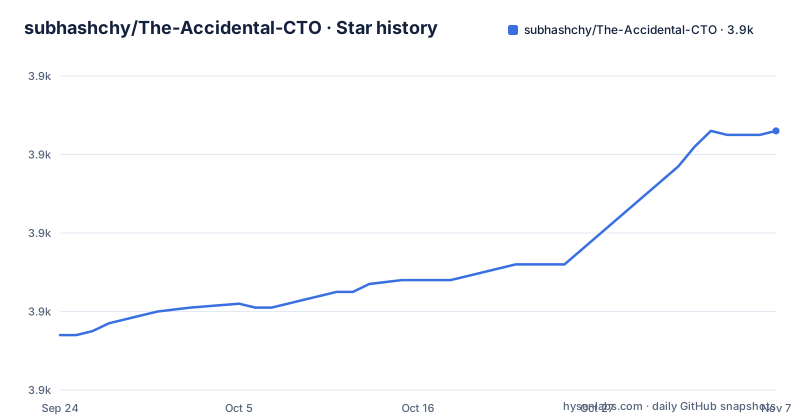
Star history
- subhashchy/The-Accidental-CTO3,926 ★ · +52
| Repository | 2026-09-24 | 2026-11-07 |
|---|---|---|
| subhashchy/The-Accidental-CTO | 3.9k | 3.9k |
52 Stars in the last 44 days, measured from the daily GitHub snapshot. Compare with other projects
Editorial analysis
The book's only edition is a PDF sitting at the repository root
Everything a reader needs is a single committed file: `The Accidental CTO Book.pdf`, sitting beside the README. The repository has no GitHub releases, so that PDF is the only edition on offer and a reader cannot pin the copy they read to a release. Two more copies of the same text sit next to it, `The Accidental CTO.md` and `The Accidental CTO.txt`, and nothing in the repository states which of the three the author treats as current, so a corrected paragraph can land in one file and leave the other two behind without any signal. The last commit on the default branch `main` is dated 2026-04-09. What history exists is a commit log for manuscript files and images, not a record of editions, which means the only way to tell whether two visitors read the same book is to compare their files by hand.
The subtitle ends one word early and the description ends differently
The heading under the title reads `How I Scaled from Zero to a Million Stores on Dukaan, Without a CS` and stops there, mid phrase, one word short of finishing. The paragraph below it supplies the missing piece in the first person, saying the author did not have a computer science degree, which is what the cut word was about. The repository description repeats the same sentence as `How I Scaled from Zero to a Million Store on Dukaan, Without a CS Degree.`, with the store count in the singular and two spaces after the comma. So the promise shown in dashboards and search results is not the same string as the one printed under the title, and neither version says which Dukaan figure the number refers to or over what period the scaling happened.
TypeScript is the primary language and no TypeScript file appears at the top level
GitHub classifies the repository as TypeScript, yet the top level listing holds no package manifest, no TypeScript source file and no test directory. What is there is a README, three manuscript files, one PDF, a set of cover and screenshot images, a directory named `coverimage`, a single HTML file called `markdown-to-book.html` and a directory called `web`. The language label has to come from files one or two levels down inside `web`, and those are exactly the files that would show whether the label describes a real toolchain. From the visible listing, the accurate description of this repository is a book plus a small web presence, and the TypeScript classification invites a developer browsing by language to expect something runnable while nothing at the top level says how it starts.
The front page never names the file a reader has to download
The README is a pitch. It sets out what the reader will learn inside, why the author wrote it, and which roles it is aimed at, and it does all of that without naming the PDF, without linking to the Markdown or the plain text copy, and without pointing at `sample-book.md`, the one file in the repository that appears to exist so a prospective reader can look inside before committing. There is no table of contents and no chapter list, so a promise of hard system design lessons arrives with no concrete lesson attached to it. The HTML file and the `web` directory are described nowhere either. A reader who lands on the repository page has to infer where the book is from the file listing, and a reader who wants to judge the content has nothing to read except the PDF itself.
One filename carries an invisible character and the cover art was committed twice
The top level listing includes an entry that is `Icon` followed by a carriage return character rather than a file extension, which is what happens when a file is created on one operating system and renamed on another and the control character is never cleaned up. Shell globbing, scripts and cross platform tooling all treat that trailing character as part of the name, so anything iterating the root by pattern will handle it differently from every other entry. The listing also holds `Gemini_Generated_Image_da87f3da87f3da87 (2).png`, an image whose name ends in the duplicate suffix a browser adds when a download is saved twice, with a space before the parenthesis, next to `cover.png`, a `coverimage` directory and `screenshot.png`. A tracked `.DS_Store` sits in the same set. Four pieces of cover imagery, one of them a duplicate, and no indication of which is current.
The million store figure is repeated three times and measured nowhere
The scale claim appears in the repository description, in the heading of the README and in the opening paragraph, where the author writes about powering over a million online stores at Dukaan. Nothing in the repository supports the number. There is no store count with a date range, no before and after measurement and no traffic or revenue figure in any visible file, so a reader gets three repetitions of an assertion and no data points attached to it. The same pattern runs through the rest of the pitch. One bullet claims the AWS bill can become the biggest investor at scale and asks when going self hosted makes sense, without a cost figure or a decision rule. Another promises guidance on replication, sharding, caching and queues, including when not to use them, and then lists the incidents that justify the book: angry merchants refreshing dashboards, Kafka pipelines choking on one bad partition, and a database replica ten minutes behind that nobody could explain. Each of those is an anecdote with a number in it, and none is a benchmark.
Nineteen open issues and no documented place to report a typo
The repository records 3881 stars and 19 open issues. The top level listing contains no `.github` directory, no issue template, no contributing guide and no license file, and the license field in the repository metadata is empty too. The front page is written as a book advertisement aimed at software engineers, architects and startup founders, so the issue tracker is the only channel where a reader can reach the project. Someone who finds a broken paragraph in the PDF, a missing cover or a filename that will not open has no documented route to report it, and nothing tells them which of the three manuscript files the author actually edits. The metadata also records no homepage, so wherever the book is listed for sale is not discoverable from the project page either.
Editorial conclusion
Treat The Accidental CTO as a book that happens to be hosted on GitHub, not as a system design reference you can check or quote. Engineers looking for runnable patterns, decision criteria they can apply or a maintained component will find nothing runnable at the top level, and no way to tell which of the three manuscript files is current. Before you rely on any figure in the pitch, read the PDF and decide which file you are quoting. Before you reuse a chapter or the cover images, ask the author, because the repository carries no license file and the license field in its metadata is empty, so the terms for redistribution are unstated. The last commit on the default branch is dated 2026-04-09, and with no releases there is no version to cite.
Frequently asked questions
Who wrote The Accidental CTO?
Subhash Choudhary. The repository description credits the book to him as a system design handbook, and the README is written in the first person about scaling Dukaan from nothing to over a million stores without a computer science degree.
What files does The Accidental CTO repository actually contain?
At the top level: README.md, The Accidental CTO Book.pdf, The Accidental CTO.md, The Accidental CTO.txt, sample-book.md, markdown-to-book.html, a web directory, a coverimage directory, cover and screenshot images, .gitignore and .DS_Store. There are no GitHub releases.
Does The Accidental CTO document how to build its HTML reader?
No. No build command, package manifest or install step appears in the README or among the top level entries. The only related artifact is one HTML file named markdown-to-book.html, sitting next to a directory called web.
What license covers The Accidental CTO book text?
The repository records no license. There is no license file among the top level entries and the license field in the repository metadata is empty, so the terms covering the text and the cover images are unstated.
Is The Accidental CTO a TypeScript project?
The repository's primary language is listed as TypeScript, but no TypeScript source file and no package manifest appear among the top level entries, which hold the manuscript files, the PDF and images.
Official sources
Add this badge to your README
If you maintain this project, the badge below links readers to this analysis and shows its maintenance status from the daily GitHub snapshot. Paste the markdown into your README; add ?metric=license or ?metric=stars to the image URL for a different field.

[](https://hysenlabs.com/projects/subhashchy-the-accidental-cto)Star history chart for your README
[](https://hysenlabs.com/projects/subhashchy-the-accidental-cto)Was this useful?