Claude-Supermemory recalls without a permission prompt and ships a per repo key
Enable Claude Code to learn in real-time, update it's knowledge, and grow with you, using supermemory.
At a glance
- What is it?
- This is a Claude Code plugin that stores conversations in Supermemory and searches them at the start of a turn. The file is unusually candid about its own edges: the recall strip needs a newer Claude Code than the one it was verified on, the old plugin name cannot update in place, and a per repo config file is one of the places a Supermemory API key can live.
- Who is it for?
- This plugin suits someone who wants an assistant to carry project context between sessions without rebuilding it each time, and it is unusually specific about the settings that control what gets stored. Three things to check before you turn it on.
- Can I use it commercially?
- Not without permission. GitHub finds no licence file in the repository, and without a licence all rights are reserved by default: you may read the code but not reuse it. Check the README, or ask the authors, before using it.
- Is it still maintained?
- Yes. The repository last received commits 2 days ago.
- What is it written in?
- Mainly HTML, according to GitHub's language statistics.
Answers come from the project's GitHub data, last synced on November 15, 2026, and from our analysis. They are not legal advice.
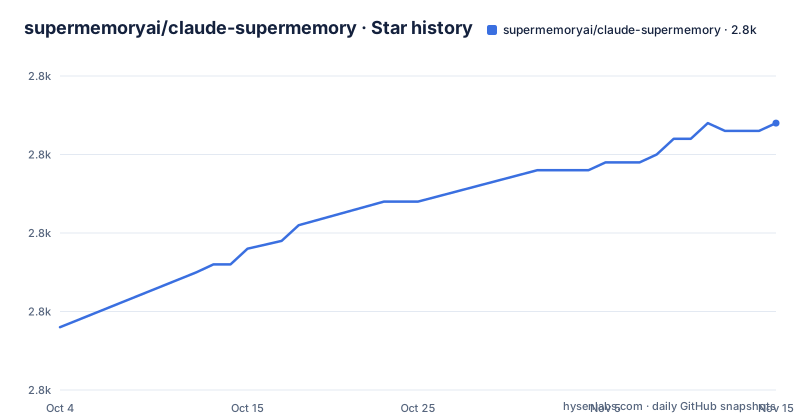
Star history
- supermemoryai/claude-supermemory2,804 ★ · +26
| Repository | 2026-10-04 | 2026-11-15 |
|---|---|---|
| supermemoryai/claude-supermemory | 2.8k | 2.8k |
26 Stars in the last 42 days, measured from the daily GitHub snapshot. Compare with other projects
Editorial analysis
Search runs automatically, with no permission prompt
The reasoned recall feature is the part with the widest blast radius, and the file is direct about it. Before each turn, Claude decides whether recalling memory would actually help the message being sent, and only searches when it is worth it, which the file describes as anywhere from every turn to once in a while to not at all. The search then runs automatically with no permission prompt, in the same way as auto-capture, and the stated reason for the restraint is partly economic: searching only when needed keeps more usage on your plan.
Auto-capture is the other half. Conversations are saved when a session ends, with no prompt either.
Two explicit commands sit alongside those automatic paths. `supermemory-search` asks about past work or previous sessions, and `supermemory-save` stores something important for the team. The practical consequence is that data leaves the machine at two moments you may not see, one during the turn and one at the end of it, while the file routes retention questions to the Supermemory privacy policy rather than describing retention here.
The plugin was renamed, so the old install cannot update in place
The install is two slash commands:
/plugin marketplace add supermemoryai/claude-supermemory
/plugin install supermemory
The plugin they install is named supermemory, and the file explains what happens to anyone who already had the previous one. The old `claude-supermemory` plugin was renamed to `supermemory`, so it will not update in place. Migration is three commands, and the order matters:
/plugin marketplace update supermemory-plugins
/plugin install supermemory@supermemory-plugins
then, and only if the old plugin is still present, `/plugin uninstall claude-supermemory@supermemory-plugins`.
The conditional on that last step is doing real work. Someone who runs the uninstall without the rename having taken effect removes a working install and is left with neither, and the file does not describe what happens if the uninstall is skipped, which leaves two plugins capturing the same sessions into two containers.
The recall strip needs a newer build than the one verified
One feature depends on a Claude Code version, and the file pairs the requirement with a verification result that does not match it. The recall strip is described as available on Claude Code 2.1.287 and later in the terminal, where pressing the changing memory headline above the prompt browses the returned facts one at a time.
Then the version note: on Claude Code 2.1.250, local marketplace install and update and the `SessionStart` and `UserPromptSubmit` command hooks were verified, but `claude plugin validate` rejects the recall mod's `classic.SessionStart` event. The strip is not available on that version, and other older versions and other install sources have not been verified at all.
So the hooks are confirmed on one build, the strip is confirmed on a later one, and the validation failure sits on the build that was actually checked. Anything else in that range is untested territory, and the file marks it as such rather than implying coverage.
The API key can sit in a file inside the repository
Two configuration locations are documented and they differ in what they can hold. Global settings live at `~/.supermemory-claude/settings.json` and cover behaviour rather than credentials:
{
  "maxProfileItems": 5,
  "signalExtraction": true,
  "signalKeywords": ["remember", "architecture", "decision", "bug", "fix"],
  "signalTurnsBefore": 3,
  "includeTools": ["Edit", "Write"]
}
Project configuration lives at `.claude/.supermemory-claude/config.json`, inside the repository, and this is the copy that accepts an `apiKey` alongside `baseUrl`, `repoContainerTag` and `signalExtraction`. The key also has an environment variable form, `export SUPERMEMORY_CC_API_KEY="sm_..."`, described as required.
So a Supermemory key can be held per repository rather than per person, and the file does not say that the per repo file should be excluded from version control. With signalExtraction defaulting to false, the default behaviour also captures whole turns rather than the keyword-selected ones in the example.
Memory is keyed to the git remote, and worktrees share it by default
Claude Code, Codex and OpenCode are said to use one container per repository, named `repo_<project-name>__<remote-hash>`, with `sm_scope` metadata keeping personal and project memories filterable inside that single container. The hash comes from the normalised git remote, so clones of a repository share their memory while two unrelated repositories with the same name do not collide. A repository with no remote falls back to a local path identity.
Existing memories are found without a migration, because the plugins also read a set of older containers: `user_project_*`, `repo_<project-name>`, `claudecode_project_*`, `codex_user_*`, `codex_project_*`, `opencode_user_*` and `opencode_project_*`. Note that the legacy entry is the bare `repo_<project-name>`, without the hash suffix the current scheme adds, which is what makes the read set a read set rather than a write destination.
Worktrees are the exception, and the fix is a variable rather than a default. `SUPERMEMORY_ISOLATE_WORKTREES=true` switches the identity to the worktree path instead of the remote identity, so out of the box two checkouts of the same repository write into the same container.
The release tag and the package version do not match
The release list holds one entry, v0.0.2 named Claude Supermemory V2, dated 2026-02-09. The package file in the repository declares version 0.1.9, so the newest tag is behind the package version by a wide margin, and the last push to main is dated 2026-09-17.
The package file also names the project `claude-supermemory-dev` and marks it private, which lines up with a plugin distributed through the marketplace rather than through a registry. It declares Node 18 or newer in its engines field, matching the Node.js 18 on PATH requirement in the install section, since the hooks run as Node scripts.
Development tooling is small and explicit. Tests run with `node --test test/unit.mjs`, and lint, lint fix and format all run through biome, declared as a single dev dependency. The repository's primary language is recorded as HTML while the tree holds plugin-inspector.ts, and there is no LICENSE file at the root even though the file's closing section states the license as MIT.
Five slash commands, one of them prints a session URL
The command surface is five entries. `/supermemory:index` indexes codebase architecture and patterns, `/supermemory:project-config` configures project level settings, `/supermemory:logout` clears saved credentials, `/supermemory:status` shows authentication status, and `/supermemory:session` shows a clickable URL for the current session document in Supermemory.
That last one is the only command that exposes where the conversation went. Combined with auto-capture at session end and recall with no prompt during the turn, it gives a way to inspect a specific session after the fact, and it is the only pointer in the file to the stored artifact itself.
The privacy section is one sentence and a link to the Supermemory privacy policy. What the repository does not do is restate what is retained, for how long, or who on a team can read a project container, so those answers live outside this file by design.
Editorial conclusion
This plugin suits someone who wants an assistant to carry project context between sessions without rebuilding it each time, and it is unusually specific about the settings that control what gets stored. Three things to check before you turn it on. Recall and auto-capture both run without a permission prompt, so decide what belongs in a team container before the first session ends. Read the settings file, because signalExtraction defaults to false, which means whole turns are stored rather than selected ones, and includeTools names Edit and Write in the example. And decide on the container layout early, because the default keys memory to the git remote, which means clones share it and worktrees share it unless you set SUPERMEMORY_ISOLATE_WORKTREES.
Frequently asked questions
Can Supermemory AI be self-hosted?
The repository does not say. The project config accepts a baseUrl, whose example value is https://api.supermemory.ai, which is the one place a different endpoint could be entered, and no deployment or hosting instructions appear anywhere in the file.
Which memory plugin is best for Claude Code?
This file does not compare memory plugins. It covers one plugin, its five commands, its two configuration files and its container naming scheme, and it names other agent hosts, Claude Code, Codex and OpenCode, only as clients of the same shared containers.
How does supermemory AI work?
The repository describes the plugin's side of it rather than the service. Conversations are saved when a session ends, memory is searched before a turn when the agent judges it worthwhile, and everything for a repository lands in one container keyed by a hash of the git remote.
Does claude-supermemory ask before searching my memories?
No. The file states the search runs automatically with no permission prompt, in the same way as auto-capture, and that Claude decides per turn whether searching would actually help. Auto-capture also runs without a prompt when a session ends.
How do I migrate from the old claude-supermemory plugin?
The old plugin was renamed to supermemory and will not update in place. Run `/plugin marketplace update supermemory-plugins` and then `/plugin install supermemory@supermemory-plugins`, and only if the old plugin is still there run `/plugin uninstall claude-supermemory@supermemory-plugins`.
Official sources
Add this badge to your README
If you maintain this project, the badge below links readers to this analysis and shows its maintenance status from the daily GitHub snapshot. Paste the markdown into your README; add ?metric=license or ?metric=stars to the image URL for a different field.

[](https://hysenlabs.com/projects/supermemoryai-claude-supermemory)Star history chart for your README
[](https://hysenlabs.com/projects/supermemoryai-claude-supermemory)Was this useful?