SuperTuxKart stk-code: the C++ tree, four platform ports, and no build command
The code base of SuperTuxKart
At a glance
- What is it?
- The C++ source behind the SuperTuxKart kart racer: one shared src/ tree with android/, switch/ and windows/ siblings, a documented Blender axis mismatch, and a README that hands every build step to INSTALL.md.
- Who is it for?
- Take stk-code if you intend to build the game yourself or contribute track and model work, and read INSTALL.md before anything else, because the README contains no build command of its own. Skip it if you need a documented library API, a configuration reference or realistic vehicle dynamics, since the repository documents none of those.
- Can I use it commercially?
- Check first. The repository uses a licence we do not classify automatically, so read its LICENSE file before any commercial use.
- Is it still maintained?
- Yes. The repository last received commits 12 days ago.
- What is it written in?
- Mainly C++, according to GitHub's language statistics.
Answers come from the project's GitHub data, last synced on November 15, 2026, and from our analysis. They are not legal advice.
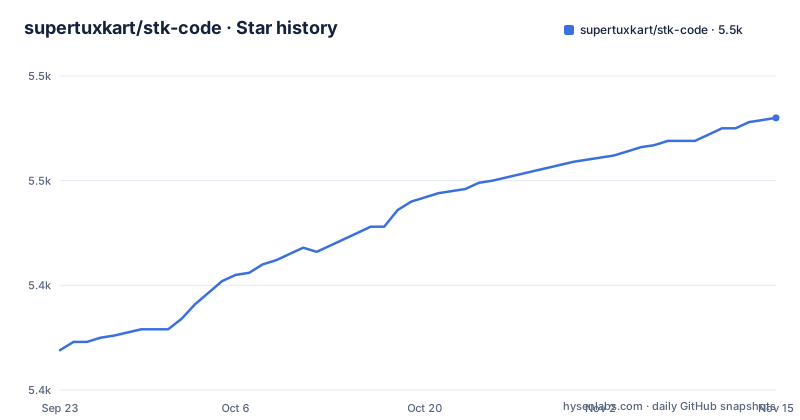
Star history
- supertuxkart/stk-code5,480 ★ · +111
| Repository | 2026-09-23 | 2026-11-15 |
|---|---|---|
| supertuxkart/stk-code | 5.4k | 5.5k |
111 Stars in the last 53 days, measured from the daily GitHub snapshot. Compare with other projects
Editorial analysis
OpenGL 3.3 and a 2010-era discrete GPU set the floor
SuperTuxKart puts its hardware floor in numbers rather than adjectives. Any GPU that supports OpenGL >= 3.3 or OpenGL ES >= 3.0 should run it, and Android needs 5.0 or greater. Those two lines date the project precisely: a dedicated Nvidia or AMD card released after 2010, an integrated GPU released after 2012, or an Android phone released after 2014 all clear the bar. The README then splits the budget in two. A better GPU lets you run higher quality graphics at a higher resolution, and a better CPU is what keeps online multiplayer smooth. Nothing in the README names a CPU model, a RAM figure or a disk requirement, so if you are provisioning a dedicated server or a lab of low end machines, the detailed answer sits in the "What are the hardware requirements?" entry of the FAQ page on supertuxkart.net rather than anywhere in the tree.
The README hands the build to INSTALL.md and shows no command
This is the first thing that stops a new contributor. The building from source part of the README is a single sentence pointing at INSTALL.md in the repository root. There is no configure line, no CMake invocation, no dependency list in the README itself. What you can read instead is the shape of the tree, which already tells you how the build is put together: CMakeLists.txt and sources.cmake at the root, a cmake/ directory, and separate lib/, src/, data/, tools/ and doc/ directories. A Brewfile sits at the top level too, the file name Homebrew uses for a dependency bundle, so macOS developers have a dependency manifest in the tree even though no library is ever named in prose.
CMakeLists.txt
sources.cmake
Brewfile
INSTALL.md
NETWORKING.md
OPUS.md
COPYING
CHANGELOG.md
Three Markdown files sit beside the build files, NETWORKING.md, OPUS.md and CHANGELOG.md, and not one of them is summarized or linked with a subject anywhere in the README. Open INSTALL.md first, then those three, before you plan anything.
Blender's ground plane is XY, the code's is XZ
Track and model work runs into a coordinate mismatch that the README handles in one short section.
SuperTuxKart: X right, Y up, Z forwards
Blender: X right, Y forwards, Z up
Two of the three axes are swapped between the tool you author in and the game you render in. The export utilities perform the transformation, so a track laid out on Blender's XY ground plane arrives standing up in the game, where the code treats XZ as the ground. The trap for a newcomer is skipping that export path and pushing raw coordinates, which leaves the model on its side. This note is also the whole of the coordinate documentation: nothing in the README describes conventions for kart models, item meshes or UI quads, so anyone extending the pipeline is working past the end of what is written down.
Tag 1.5 shipped 2025-10-20 and master kept moving
Release tags and the default branch have drifted apart. The published tags run 1.5-rc1 on 2025-05-27, 1.5-rc2 on 2025-09-06 and 1.5 on 2025-10-20, while the last push to master landed on 2026-11-01 and the repository is not archived. That is close to a year of commits on master with no newer tag among the releases the project publishes. Binaries come from two channels:
https://github.com/supertuxkart/stk-code/releases/latest
https://github.com/supertuxkart/stk-code/releases/preview
The preview channel holds the binaries of preview releases. For a packager this distinction is concrete. A build from master is not 1.5, CHANGELOG.md is the place to look for what changed since the tag, and the README offers no compatibility table or upgrade notes to check that record against.
android/, switch/ and windows/ sit beside src/
The tree keeps a separate directory for every non desktop platform: android/, switch/ and windows/ alongside the shared src/ and data/. The README reinforces that by linking four workflow files by name, linux.yml, apple.yml, windows.yml and switch.yml, plus a Libera.Chat channel called #supertuxkart for questions. The cost of that layout lands on contributors rather than players. A change to shared rendering, input or asset loading has to survive four build targets, and a console tree means platform specific code lives in the same repository rather than in a downstream fork. This is the shape of the work for anyone deciding whether to fork: upstream is one codebase with ports in-tree, so there is no separate port to wait on and no upstream port fixes to backport, but there is also no smaller engine to depend on.
COPYING says GPL while the license field says NOASSERTION
The licensing picture needs two sources, and they do not agree in usefulness. The README states that the software is released under the GNU General Public License, with the text in the COPYING file sitting in the same directory as the README, which is where a human reader will look. The repository's own license metadata field reads NOASSERTION, so anything that reads that field instead of the file, a package index, a license scanner or a software bill of materials generator, gets no answer at all. The README also names no version number for the GPL, and that is the detail that decides whether your own code can link against it. If you plan to ship SuperTuxKart inside a product or an appliance, read COPYING yourself and confirm the version there before trusting either signal.
Gameplay rules live in the binary, contribution rules live on a website
The repository is not self contained for onboarding, and the README is candid about where each piece sits. How to play is documented on the in-game help page, so it exists only once you have a build. Hardware detail sits in the "What are the hardware requirements?" entry on the FAQ page. Contribution policy is hosted at https://supertuxkart.net/How_to_contribute_code, a guide the README calls important guidelines intended to smooth the process and raise the chance a contribution is accepted, and that guide is not in the repository at all. Read it before your first pull request. Work from a mirror, an air gapped checkout or a fork you browse offline, and you end up with the source and none of the rules that govern it, which is exactly how a well meant track patch gets rejected on process instead of on content.
Arcade handling by design, and no documented interface
Two things this codebase is not, by its own account. It is not a physics reference: the game focuses on fun and not on realistic kart physics, which reads as a tuning decision rather than an unfinished feature, so nobody should treat the kart handling code as a vehicle dynamics model. And it is not a library. The primary language is C++, yet the README documents no command line flags, no configuration keys, no environment variables and no API, which leaves a script with nothing to call and an embedding project with nothing to link against. The tree carries tools/ and cmake/, so some surface probably exists in the source, but nothing in the documentation commits to it or guarantees it. If scripting, headless rendering or embedding is the actual requirement, pick a different project and come back to this one for the game itself.
Editorial conclusion
Take stk-code if you intend to build the game yourself or contribute track and model work, and read INSTALL.md before anything else, because the README contains no build command of its own. Skip it if you need a documented library API, a configuration reference or realistic vehicle dynamics, since the repository documents none of those. If you need binaries that match a tag, use 1.5 from 2025-10-20 rather than master, whose last push was 2026-11-01, and confirm the GPL version in COPYING before you link anything against it.
Frequently asked questions
What hardware does SuperTuxKart need to run?
Any GPU supporting OpenGL >= 3.3 or OpenGL ES >= 3.0, and Android 5.0 or greater. The README puts the bar at a dedicated Nvidia or AMD card released after 2010, an integrated GPU released after 2012, or an Android phone released after 2014, and sends further detail to the FAQ page on supertuxkart.net.
How do I build SuperTuxKart from source?
The README contains no build command of its own. Its building from source line points to INSTALL.md in the repository root, which sits next to CMakeLists.txt, sources.cmake and the cmake/ directory that drive the build.
Where do I download SuperTuxKart binaries?
Stable builds sit at https://github.com/supertuxkart/stk-code/releases/latest and preview builds at https://github.com/supertuxkart/stk-code/releases/preview. The published tags include 1.5 from 2025-10-20 plus the earlier 1.5-rc1 and 1.5-rc2 candidates.
Which axes does SuperTuxKart use and how does Blender differ?
The game uses X right, Y up and Z forwards, while Blender uses X right, Y forwards and Z up. The export utilities apply the transformation, so you author on Blender's XY ground plane and the code treats XZ as the ground.
What license is SuperTuxKart released under?
The README states the GNU General Public License, with the text in the COPYING file beside it, and names no version number. The repository's license metadata field reads NOASSERTION, so automated license checks find nothing there.
Official sources
Add this badge to your README
If you maintain this project, the badge below links readers to this analysis and shows its maintenance status from the daily GitHub snapshot. Paste the markdown into your README; add ?metric=license or ?metric=stars to the image URL for a different field.

[](https://hysenlabs.com/projects/supertuxkart-stk-code)Star history chart for your README
[](https://hysenlabs.com/projects/supertuxkart-stk-code)Was this useful?