faster-whisper runs Whisper on CTranslate2, and its generator and CUDA pins catch new users
Faster Whisper transcription with CTranslate2
At a glance
- What is it?
- faster-whisper is a Python reimplementation of OpenAI's Whisper on CTranslate2. It claims up to 4 times the speed of openai/whisper, needs no system FFmpeg, and ties GPU use to CUDA 12 and cuDNN 9.
- Who is it for?
- Use faster-whisper if you transcribe audio from Python on an NVIDIA GPU or a CPU and want int8 and batched modes without installing FFmpeg. Check your CUDA and cuDNN versions before the first run, because the current ctranslate2 supports only CUDA 12 with cuDNN 9, and remember that the latest tagged release is v1.2.1 from 31 October 2025.
- Can I use it commercially?
- Yes. MIT is a permissive licence: you can use, modify and sell software built on it, as long as you keep its copyright and licence notices.
- Is it still maintained?
- Yes. The repository received new commits within the last day.
- What is it written in?
- Mainly Python, according to GitHub's language statistics.
Answers come from the project's GitHub data, last synced on November 25, 2026, and from our analysis. They are not legal advice.
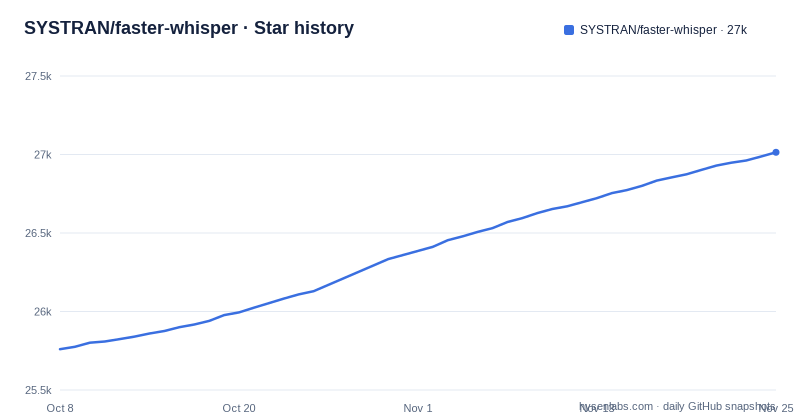
Star history
- SYSTRAN/faster-whisper27,014 ★ · +1,254
| Repository | 2026-10-08 | 2026-11-25 |
|---|---|---|
| SYSTRAN/faster-whisper | 25.8k | 27k |
1,254 Stars in the last 48 days, measured from the daily GitHub snapshot. Compare with other projects
Editorial analysis
CTranslate2 does the inference, so the speed claim is about the engine
faster-whisper reimplements OpenAI's Whisper model on top of CTranslate2, a fast inference engine for Transformer models. The project says it is up to 4 times faster than openai/whisper for the same accuracy while using less memory, and that 8-bit quantization improves efficiency further on both CPU and GPU.
The package depends on ctranslate2 at version 4.0 or newer but below 5, huggingface_hub 0.23 or newer, tokenizers from 0.13 up to below 1, onnxruntime from 1.14 up to below 2, av 11 or newer, and tqdm. That list is the whole runtime.
The setup.py classifiers mark the project as Development Status 4, Beta, and list Python 3.9, 3.10 and 3.11. The README requirement is Python 3.9 or greater. A newer interpreter is covered by the README's wording, but the classifiers stop at 3.11, so check your Python version against the dependency pins when you install.
The benchmark covers a 13 minute clip on one RTX 3070 Ti and one i7-12700K
The README's Whisper benchmark transcribes a 13-minute clip; its separate distil-whisper benchmark uses a different evaluation workload. They compare openai/whisper v20240930, whisper.cpp v1.7.2, transformers v4.46.3 and faster-whisper v1.1.0. GPU runs used CUDA 12.4 on an NVIDIA RTX 3070 Ti 8GB.
On the large-v2 model with beam size 5, openai/whisper at fp16 takes 2m23s and 4708MB of VRAM. whisper.cpp with Flash Attention takes 1m05s and 4127MB. transformers with SDPA takes 1m52s and 4960MB, and the footnote says it runs out of memory for any batch size above 1. faster-whisper at fp16 takes 1m03s and 4525MB. With batch_size=8 it falls to 17s and 6090MB. At int8 it takes 59s and 2926MB, and int8 with batch_size=8 takes 16s and 4500MB.
So against whisper.cpp with Flash Attention, plain faster-whisper is within two seconds on this clip, and the large gain comes from batching. On distil-whisper-large-v3, faster-whisper at batch_size=16 takes 25m50s with a YT Commons WER of 13.527, against 46m12s and 14.801 for transformers.
On CPU with the small model, run with 8 threads on an Intel Core i7-12700K, whisper.cpp at fp32 takes 2m05s and 1049MB, and the OpenVINO build takes 1m45s. faster-whisper at fp32 takes 2m37s and 2257MB, so whisper.cpp is faster and lighter there. faster-whisper int8 takes 1m42s and 1477MB, and int8 with batch_size=8 takes 51s and 3608MB. Batching raises RAM use in every row. One GPU and one CPU is the whole sample, so your hardware may order these differently.
GPU use needs cuBLAS and cuDNN 9 for CUDA 12, and older stacks must downgrade
GPU execution needs two NVIDIA libraries installed: cuBLAS for CUDA 12 and cuDNN 9 for CUDA 12. The project's README describes recent CTranslate2 versions as requiring that pair; verify the support matrix for the specific version you install. The README suggests CTranslate2 3.24.0 for CUDA 11 with cuDNN 8, but check the installed faster-whisper version's dependency constraints first: a release requiring CTranslate2 4 or newer cannot satisfy that recommendation without changing versions. For CUDA 12 with cuDNN 8, downgrade to 4.4.0, either with `pip install --force-reinstall ctranslate2==4.4.0` or by pinning the version in a requirements.txt.
The consequence is that an older driver stack forces an older ctranslate2, and faster-whisper's own requirements.txt only demands ctranslate2 4.0 or newer below 5. That range lets pip pick a version that may not match your CUDA install, so pin it yourself.
The README gives three ways to get the libraries. The recommended one is the official NVIDIA documentation. A Docker image, nvidia/cuda:12.3.2-cudnn9-runtime-ubuntu22.04, already contains cuBLAS and cuDNN. On Linux only, pip can install them:
pip install nvidia-cublas-cu12 'nvidia-cudnn-cu12==9.*'After that, LD_LIBRARY_PATH must be set before launching Python, using the export line from the README. On Windows and Linux there is a third source: Purfview's whisper-standalone-win repository publishes the libraries in a single archive, which you decompress into a directory on PATH.
Audio decoding goes through PyAV, so no system FFmpeg is needed
Unlike openai-whisper, faster-whisper does not need FFmpeg installed on the system. Audio is decoded with the Python library PyAV, which bundles the FFmpeg libraries inside its package. The requirement in requirements.txt is av 11 or newer.
For a deployment this removes one apt or brew step and one version mismatch. It also means decoding behavior follows whatever FFmpeg build PyAV ships, not the one on your machine, so a codec your system FFmpeg handles may still fail if the bundled build lacks it. Test your real input files.
Installation itself is one command from PyPI:
pip install faster-whisperTwo alternatives are given. The master branch installs with `pip install --force-reinstall "faster-whisper @ https://github.com/SYSTRAN/faster-whisper/archive/refs/heads/master.tar.gz"`, and a specific commit installs the same way with the commit hash in the archive URL. Installing the master branch or a specific commit is the way to get changes made after v1.2.1.
Iterate the segments generator and time both stages
The usage example creates a WhisperModel with model_size set to large-v3 and device set to cuda with compute_type float16. Commented alternatives show GPU int8 as compute_type int8_float16, and CPU int8 as device cpu with compute_type int8. Then `model.transcribe("audio.mp3", beam_size=5)` returns a pair, segments and info. The info object carries the detected language and its probability.
The README warns that segments is a generator, so transcription only starts when you iterate over it. A script that calls transcribe and never loops will finish instantly without producing text. Gathering the segments forces the run to completion:
segments, _ = model.transcribe("audio.mp3")
segments = list(segments)  # The transcription will actually run here.
Segment generation is lazy, but the current implementation can decode audio and detect language during the transcribe call before returning the generator. Errors and time can therefore occur both at the call and during iteration. Wrap and time both stages when measuring end-to-end transcription.
Batched transcription uses BatchedInferencePipeline and costs more memory
BatchedInferencePipeline.transcribe is described as a drop-in replacement for WhisperModel.transcribe. The import is `from faster_whisper import WhisperModel, BatchedInferencePipeline`, and the README example builds the model from "turbo" with device cuda before wrapping it. The batch_size argument appears in the benchmark rows as batch_size=8 for large-v2 and small, and batch_size=16 for distil-whisper-large-v3, so those are the values with published timings. Anything else you choose is untested by the project's own tables, and larger values will push memory up further, as the VRAM column already shows between batch sizes 1 and 8. Start from 8 and watch memory before raising it.
The benchmark tables show the trade. Batching with batch_size=8 on large-v2 cut GPU time from 1m03s to 17s at fp16 but raised VRAM from 4525MB to 6090MB. On an 8GB card like the RTX 3070 Ti used in the benchmark, int8 with batching at 4500MB leaves more headroom than fp16 with batching. On CPU the small model went from 2m37s to 1m06s at fp32 while RAM went from 2257MB to 4230MB.
If you transcribe one file at a time and memory is tight, the plain WhisperModel with int8 uses the least memory in every table: 2926MB of VRAM on large-v2 and 1477MB of RAM for the small model on CPU. Use the batched pipeline when throughput matters more than footprint.
The repository's last push is recent but the last release is a year old
The repository is not archived, and the last push was on 2 November 2026. The most recent tagged releases are v1.2.1 on 31 October 2025, v1.2.0 on 6 August 2025 and v1.1.1 on 1 January 2025. The benchmark in the README was run on v1.1.0, so the numbers predate both v1.2.0 and v1.2.1 and no later run is published.
For users this splits into two cases. If you install from PyPI you get the last release, which does not include changes pushed since 31 October 2025. If you need those changes, install the master branch or a pinned commit with the pip lines above, and accept that master is not a tagged release.
The project is MIT licensed, so the answer to whether faster-whisper is free is yes. The repository also ships a docker directory, a benchmark directory and a requirements.conversion.txt, used by the setup.py conversion extra for converting models.
Editorial conclusion
Use faster-whisper if you transcribe audio from Python on an NVIDIA GPU or a CPU and want int8 and batched modes without installing FFmpeg. Check your CUDA and cuDNN versions before the first run, because the current ctranslate2 supports only CUDA 12 with cuDNN 9, and remember that the latest tagged release is v1.2.1 from 31 October 2025.
Frequently asked questions
Is Faster Whisper free?
Yes. faster-whisper is released under the MIT license and installs from PyPI with pip install faster-whisper.
What is the difference between OpenAI Whisper and Faster Whisper?
faster-whisper reimplements Whisper on CTranslate2 and is described as up to 4 times faster than openai/whisper for the same accuracy, with lower memory use. It also does not need FFmpeg on the system, since PyAV bundles it.
How to install faster-whisper?
Install with pip install faster-whisper. The project's documented NVIDIA GPU setup requires compatible CUDA and cuDNN libraries; its Linux example installs cuBLAS and cuDNN 9 for CUDA 12. Quote the wildcard in shells such as zsh: pip install nvidia-cublas-cu12 'nvidia-cudnn-cu12==9.*'. Check the versions required by your installed CTranslate2 release.
How to use faster-whisper?
Create a WhisperModel, call transcribe, then iterate over its segments generator. Segment generation is lazy, but the call can also do work such as audio decoding or language detection before iteration, so handle errors and measure time around both stages.
Official sources
Add this badge to your README
If you maintain this project, the badge below links readers to this analysis and shows its maintenance status from the daily GitHub snapshot. Paste the markdown into your README; add ?metric=license or ?metric=stars to the image URL for a different field.

[](https://hysenlabs.com/projects/systran-faster-whisper)Star history chart for your README
[](https://hysenlabs.com/projects/systran-faster-whisper)Was this useful?