Taho's manifest is named for another organisation, and its Docker build allows the install to fail
Taho, the community owned and operated Web3 wallet.
At a glance
- What is it?
- tahowallet/extension is a GPL browser extension wallet written in TypeScript and webpack, built as two packages with separate threat models and generated validators so its content security policy can omit a dangerous directive. Its repository carries three organisation names, four licence files, and a committed build output directory.
- Who is it for?
- Taho is worth reading as an example of a wallet extension that treats its own attack surface as a design problem, because the split between a trusted background package and an untrusted interface package, and the code generation that keeps a dangerous content security policy directive out of the build, are both explained rather than asserted. Two things to know before building on it.
- Can I use it commercially?
- Yes, with conditions. GPL-3.0 is a copyleft licence: if you distribute software that includes it, you must release that software's source code under the same licence. Running it internally without distributing it does not trigger that obligation.
- Is it still maintained?
- Yes. The repository last received commits 3 days ago.
- What is it written in?
- Mainly TypeScript, according to GitHub's language statistics.
Answers come from the project's GitHub data, last synced on November 15, 2026, and from our analysis. They are not legal advice.
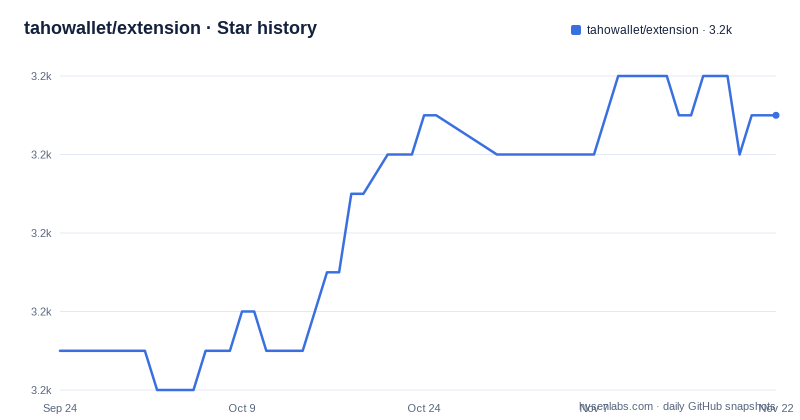
Star history
- tahowallet/extension3,211 ★ · +6
| Repository | 2026-09-24 | 2026-11-15 |
|---|---|---|
| tahowallet/extension | 3.2k | 3.2k |
6 Stars in the last 52 days, measured from the daily GitHub snapshot. Compare with other projects
Editorial analysis
Three organisation names and two repository names for one wallet
The rename left traces in five different files, and they do not agree.
The repository is under one organisation. The manifest's package name is scoped to a second, an older name with a different scope and a different artefact name from the repository. The manifest's repository field points at a third organisation, with the SSH form of the address and the old artefact name.
The Dockerfile agrees with the manifest rather than with the repository. Its build directory is named after the old project, and the dist stage copies from that path.
So the name a consumer sees on a package registry, the name in the repository field, the name in the directory the build runs in, and the name of the repository itself are four different strings.
None of this breaks the build. It does mean that anything automated which reads the repository field to find the source, or matches the package name to a repository, will not find what it expects. For a project whose stated reason for existing is community ownership, the metadata is the part a prospective contributor looks at first.
The prose has caught up. The heading uses the current name, and the description inside the manifest matches the current one-line summary.
The author field names an individual while the project describes itself as community owned
One line of the manifest sits oddly against the rest of the project.
The author field carries a named individual at a corporate domain, and that domain is the same one behind the third organisation name in the repository field. The licence field says GPL-3.0, and the description says the wallet is community owned and operated.
The README makes the same claim in stronger terms. It says the wallet will be fairly launched, sustainably aligned with users, and wholly owned by the community, and it grounds that claim in a specific argument: that today's landscape is dominated by a single wallet and a single infrastructure provider, both owned by a single conglomerate, and that those facts undermine the censorship resistance of the system.
That argument is about governance and about the distribution of infrastructure. It is not about the authorship of a file.
So there are two different claims in play. One is that the project's outputs are community-owned, which is a statement about the token and the treasury. The other is that a manifest field attributes authorship to one person at one company, which is a statement about who wrote the code. Neither contradicts the other on its own terms, and plenty of community-governed projects name an author in their package metadata.
It is worth reading both, because the README's framing invites a reader to assume the second follows from the first.
Two packages, two threat models, and one rule about key material
One section of the README describes the architecture in security terms rather than in build terms, and it is the clearest writing in the file.
The extension is built as two packages. One contains the bulk of the extension's background script; the other contains the code that powers the extension's popups.
Then the reason, stated plainly: they are separate packages in order to emphasise the difference in attack surface and clearly separate the threat models of each. The interface package is treated as untrusted code and the background package as trusted code. Only the background package should interact with key material regularly, while the interface package should only reach key material through a carefully maintained API.
That is a real architectural constraint rather than a naming convention, and it changes how the tree should be read. A wallet extension's most valuable target is the code that can reach a key, and this project has drawn that boundary in the build system rather than in a review checklist.
The background package also carries a supply-chain constraint: it is intended to minimise external dependencies where possible, reducing the surface exposed to a supply-chain attack. Dependencies are generally version-pinned, and the package manager used for installs is chosen to ensure build integrity.
Validators are generated so the content security policy can omit unsafe-eval
There is a short procedure in the README for adding a validation function, and the reason it exists is the last line.
The steps are: write the schema in the TypeScript file so it types correctly; add the new schema, named after the validator function, to the generator file; update one of two typing definition files with the definition; run the generation script; then import it where you need it.
The reason is that this setup is necessary so the project does not need to include `unsafe-eval` in its content security policy.
That is a specific and interesting trade. A browser extension's content security policy is one of its main defences, and `unsafe-eval` is one of the directives that weakens it, because it permits dynamic code evaluation anywhere the policy applies. Rather than argue for the exception, the project generates the validators ahead of time so no evaluated string is needed at run time.
The generation script is defined in the manifest and it runs a file inside the background package, so the code generation happens on the trusted side of the boundary described in the previous section.
The cost is a four-step process for what would otherwise be a single schema declaration, and a typing definition file that has to be updated in step with the schema.
The container build allows its dependency install to fail
The Dockerfile is thirty lines long and one of them is the finding.
It starts from a Node 16 Alpine base image. It moves the production environment file into place as the build environment. It adds Python, pip, git, make, and bash, and symlinks the Python executable. Then it installs dependencies.
That install line has a comment above it about a SQLite compile step throwing an error during installation, and the file says that error does not cause a problem so it is being ignored. The line itself ends with a shell construct that makes any failure succeed:
RUN yarn install --frozen-lockfile || trueThe comment names one specific failure and the construct accepts all of them. A network timeout, a checksum mismatch, a registry outage, and an incompatible engine would all be reported the same way: the build continues, the next step runs, and the image is produced.
The rest of the file is disciplined by comparison. The build sets an environment variable that selects Firefox as the browser target, runs the production build, and then copies the output directory into a scratch-based image containing nothing but those files. There is no shell and no package manager in the final image.
So the output image is minimal and the build that produces it tolerates failure. Those two facts point in opposite directions.
Releases run on their own branch and main is supposed to carry only version bumps
The release procedure is automated with the package manager's own version command, and the mechanics are documented in detail.
Running the patch or minor version command does three things. It ensures the commit is running on the correct branch for review, named after the new version, and if you are on a different branch the script attempts to switch to a new branch based on the latest main. It synchronises the extension manifest version to the updated package version. And it commits, tags, and pushes the new version and the branch.
Two sentences after the commands carry the policy. Major releases generally require more discussion than the automation allows, but can be managed the same way. Releases should generally only add version bumps to the main branch.
That last sentence inverts the usual arrangement. Rather than cutting releases from the trunk, the trunk is supposed to receive nothing but version bumps, and the actual change lives on a branch named after the version. The pull request opened afterwards is where further processing happens, including potentially managing automated submission of the new version to extension directories.
So the submission to browser extension stores is described as something that happens as a consequence of opening a pull request, rather than as a release step with its own checks.
The same section of the README that describes the release also states that commits are all required to be signed, and that no pull request will be merged if it has unsigned commits.
Four licence files, a committed output directory, and a third source directory
The repository root has forty-nine entries, and several groups of them overlap.
There are four licence files: one named plainly, one named for the GPL version, one named for additional terms, and one with a generic extension. So the licence position is expressed four times, and one of the four is a set of terms additional to the licence rather than the licence itself.
The build output directory is committed. It sits at the root alongside the source directories and the webpack configuration, which means a production bundle is version-controlled in the same tree as the code that produces it.
There is also a third top-level source directory. The README describes the extension as two packages, the background package and the interface package, and both of those exist as directories. A third directory named simply as source sits beside them, and the threat model section does not account for it.
The testing arrangements are three. There is a mocks directory and two setup files for one runner, plus a setup file inside the interface package, and separately an end-to-end test directory with a Playwright configuration. The runner's configuration in the manifest rewrites how five specific packages resolve, three of them so that they compile despite being excluded from transformation by default.
There is also a shell script named for a browser build at the root, matching the browser that the container build selects, and an image asset with an at-sign in its filename.
Bitcoin is in the keyword list and the environment example has no Bitcoin entry
The manifest carries a keyword list of six terms, and one of them is not represented anywhere in the configuration example.
The keywords are Ethereum, Bitcoin, cryptocurrency, wallet, web3, and dapp.
The environment example sets six remote procedure call URLs, and every one of them is an Ethereum-family network. There is one for the main chain, three for layer two networks, one for a test network, and one for a network whose name is not explained anywhere in the visible material. All six share a prefix that is likewise unexplained.
So the project advertises Bitcoin in its metadata and its example configuration covers no Bitcoin network. Either the keyword is aspirational, or the support lives behind configuration that the example does not show, or the two were written at different times.
The third possibility is worth taking seriously for this project specifically, given the naming situation elsewhere in the repository. The metadata and the documentation drifted apart in at least one place already, and this is another.
The five build targets are a reminder of how wide the surface is: one webpack configuration produces a bundle per browser, and the developer narrows which ones rebuild on save by naming targets:
$ yarn start --config-name firefox --config-name braveThe install instructions also carry a Python location workaround for a Linux distribution from 2020.
Editorial conclusion
Taho is worth reading as an example of a wallet extension that treats its own attack surface as a design problem, because the split between a trusted background package and an untrusted interface package, and the code generation that keeps a dangerous content security policy directive out of the build, are both explained rather than asserted. Two things to know before building on it. The identity in the manifest has not caught up with the rename, so tooling that reads the package or repository fields will be working from older names. And the container build explicitly tolerates a failed dependency install, so a green image is not evidence that the dependency tree resolved.
Frequently asked questions
What is the Taho extension and how is it built?
It is a community owned and operated Web3 wallet built as a browser extension in TypeScript, bundled with webpack. One build produces a bundle per browser under a dist directory named for the browser, and the development command rebuilds all of them on save or narrows the set by naming targets.
How does the Taho extension split its attack surface?
It is built as two packages. The background package holds the extension's background script and is treated as trusted code; the interface package holds the popup code and is treated as untrusted. Only the background package should interact with key material regularly, and the interface package should reach it only through a maintained API. The background package also minimises external dependencies.
Why does Taho generate its validators?
So the extension does not need to include unsafe-eval in its content security policy. Adding a validator means writing the schema with correct typing, adding it to the generator file with the validator's name, updating one of two typing definition files, running the generation script, and importing the result.
How are Taho releases cut?
With the package manager's version command, which ensures the commit is on a branch named after the new version, synchronises the extension manifest version to the package version, then commits, tags, and pushes. A pull request is opened afterwards, which handles further processing including potentially submitting the version to extension directories. Main is supposed to receive only version bumps.
What does the Taho Dockerfile do with a failing dependency install?
It ignores it. The install line carries a comment about a SQLite compile step throwing an error that does not matter, and ends with a shell construct that makes any failure succeed. The rest of the build is strict, and the final image is built from a scratch base containing only the output directory.
Official sources
Add this badge to your README
If you maintain this project, the badge below links readers to this analysis and shows its maintenance status from the daily GitHub snapshot. Paste the markdown into your README; add ?metric=license or ?metric=stars to the image URL for a different field.

[](https://hysenlabs.com/projects/tahowallet-extension)Star history chart for your README
[](https://hysenlabs.com/projects/tahowallet-extension)Was this useful?