tediousjs/tedious for Node.js SQL Server Connections
Node TDS module for connecting to SQL Server databases.
At a glance
- What is it?
- Tedious is a pure JavaScript implementation of the TDS protocol for connecting Node.js applications to Microsoft SQL Server. It supports several SQL Server generations and requires Node.js 22 or later, while leaving application-level database design to the caller.
- Who is it for?
- Adopt tedious when the application is a Node.js service that needs direct TDS access to SQL Server and can manage its own connection, parameter, transaction, and bulk-load logic. Do not choose it as a complete ORM or migration layer, and do not assume that a successful connection proves production compatibility.
- Can I use it commercially?
- Yes. MIT is a permissive licence: you can use, modify and sell software built on it, as long as you keep its copyright and licence notices.
- Is it still maintained?
- Yes. The repository last received commits 3 days ago.
- What is it written in?
- Mainly TypeScript, according to GitHub's language statistics.
Answers come from the project's GitHub data, last synced on November 6, 2026, and from our analysis. They are not legal advice.
Star history
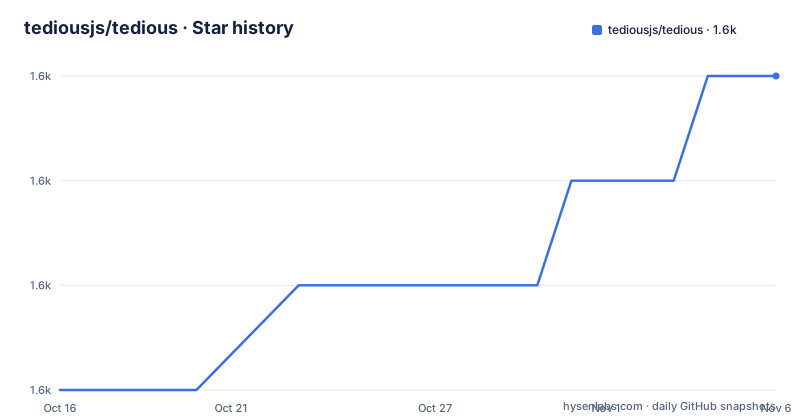
- tediousjs/tedious1,620 ★ · +3
| Repository | 2026-10-16 | 2026-11-06 |
|---|---|---|
| tediousjs/tedious | 1.6k | 1.6k |
3 Stars in the last 21 days, measured from the daily GitHub snapshot. Compare with other projects
Editorial analysis
What Tedious Solves for Node.js Applications
Tedious addresses the network and protocol layer between a Node.js application and Microsoft SQL Server. SQL Server speaks TDS, and the project provides a pure JavaScript implementation of that protocol rather than relying on a native extension or a separate operating-system database client. That makes it relevant to services written in JavaScript or TypeScript that need to issue SQL statements, pass parameters, execute stored procedures, load bulk data, or manage transactions.
The project is aimed at developers who want a relatively small protocol implementation. The README describes Tedious as "a fairly slim implementation of the protocol, with not too much additional functionality." That boundary matters. Tedious is a database driver, not an ORM, query builder, schema migration system, broad connection-pool manager, or SQL Server administration console. The repository examples include prepared statements, parameters, stored procedures, transactions, table-valued parameters, bulk loading, and a simple client, which shows the intended application-level surface more clearly than a general-purpose abstraction would.
It is also useful for projects that need to control connection options and protocol behavior from Node.js. The README lists support from SQL Server 2000 through SQL Server 2025 according to TDS version, with TDS 8.0 available through `options.encrypt` set to `'strict'`. Older protocol support is not permanent: TDS 7.1 for SQL Server 2000 is marked deprecated and is scheduled for removal in a future version. A new deployment should therefore confirm the server generation and encryption requirement before choosing a package version.
How Tedious Uses the TDS Protocol
The architecture described by the repository is centered on implementing TDS in JavaScript. A Node.js client can establish a connection to SQL Server, authenticate, send SQL requests, receive results, and expose database-specific operations through the driver API. The README does not document each internal module, so the repository layout is the clearest guide: source code is under `src/`, published entry points are declared in `package.json`, and examples exercise the public JavaScript API.
The package metadata identifies `./lib/tedious.js` as the main entry point and `./lib/tedious.d.ts` as the type declaration entry point. This indicates that consumers load the compiled JavaScript package at runtime and receive TypeScript declarations for editor and type-checking support. The package is written primarily in TypeScript, while the examples are JavaScript files under `examples/`.
TDS support is versioned according to the SQL Server protocol generation. The README lists TDS 7.1, 7.2, 7.3.A, 7.3.B, and 7.4, with corresponding SQL Server versions. TDS 8.0 is different because it is selected through `options.encrypt` with the value `'strict'`. This is a protocol and connection setting, not a promise that every SQL Server feature is available. The driver still exposes separate examples for prepared execution, parameters, transactions, table-valued parameters, and bulk loading, so application code must choose the appropriate API and prepare values correctly.
The repository includes tests and benchmarks, but the README does not document a public benchmark result, throughput guarantee, or connection limit. A performance claim would therefore go beyond what the README establishes. The project should be assessed against the workload and SQL Server configuration that will actually be used.
Installing Tedious and Running a First Connection
Tedious documents Node.js as the prerequisite and specifies Node.js `>=22` in `package.json`. Install the package into a Node.js project with the command shown in the README:
npm install tediousAfter installation, the README directs developers to the Node.js SQL Server guide and to platform-specific setup guides for macOS, Red Hat Enterprise Linux, SUSE Linux Enterprise Server, Ubuntu, and Windows. Those links matter because installing the package does not configure SQL Server itself. You still need a reachable SQL Server instance, valid credentials, network access, and an authentication mode accepted by that server.
The repository includes `examples/minimal.js`, but its contents are not reproduced in the README, so a complete first-use snippet cannot be copied without adding unsupported code. The documentation site is the repository's stated source for more examples. Before writing application code, check that example for the connection configuration appropriate to the selected SQL Server version. For a server requiring TDS 8.0, the documented setting is `options.encrypt` with `'strict'`.
A practical first use should verify the connection boundary first, then add parameterized SQL, transactions, or bulk operations. The repository's separate examples indicate that these are different capabilities rather than one all-purpose call. Keep connection settings separate from business logic so that encryption, server name, credentials, and database selection can be reviewed independently.
Connection Scope and Operational Limits
Tedious's slim scope is both its main attraction and its main constraint. The README does not promise ORM features, schema migrations, automatic retries, a web administration interface, or a high-level query abstraction. Applications will need to manage their own SQL organization and may need separate libraries for migrations, modeling, job scheduling, or observability.
The protocol support list also creates a server-lifecycle issue. TDS 7.1 support for SQL Server 2000 is explicitly deprecated and will be removed in a future version. Teams using that server generation must treat an upgrade as a compatibility decision, not merely a routine package bump. The README does not identify the release in which removal will occur, so it does not provide a safe upgrade deadline. Testing the package against the oldest server in the environment is more defensible than assuming later releases preserve every old protocol path.
Encryption is another boundary. TDS 8.0 support requires `options.encrypt` set to `'strict'`. The README identifies the option but does not explain certificate validation, trust-store configuration, or deployment-specific certificate handling. Those details must be checked in the project documentation and against the SQL Server network policy. A connection string copied from another driver may not be directly applicable because Tedious has its own configuration model.
The repository also has a benchmark directory, but no benchmark result is documented in the README. There is no published performance target in that description. Consequently, Tedious should not be accepted for a throughput-sensitive service merely because it is JavaScript or because the repository contains benchmarks.
Tedious Compared with Higher-Level Database Tools
Tedious is a lower-level choice than tools that provide an ORM or a managed database platform. An ORM typically maps application objects to tables, manages query construction, and supplies migration or relationship tooling. Tedious instead implements the TDS connection and exposes SQL operations that the application controls. That difference favors codebases that already have a data-access design, require explicit SQL, or need to use SQL Server capabilities outside a conventional ORM.
A higher-level driver or platform may be more appropriate when the application wants managed pooling, simplified deployment, an integrated migration path, or an abstraction that hides SQL Server protocol details. The README does not document those features as part of Tedious, so adopting Tedious means accepting responsibility for them outside the driver. The repository examples, including `examples/parameters.js`, `examples/prepared.js`, and `examples/transaction.js`, show that the intended work is organized around explicit database operations.
This is not a claim that one approach is always better. Tedious can be the narrower dependency when protocol control matters. A higher-level tool can reduce application code when model management is more valuable than direct SQL access. The decision should follow from required SQL Server features, existing team conventions, connection lifecycle requirements, and the server versions in production.
Maintenance, Licensing, and Upgrade Cost
The repository is not archived, and the last push was on 2026-10-15. Recent releases listed in the project history include v20.3.8, v20.3.7, and v20.3.6 on 2026-10-11. The package metadata also defines release branches for stable and prerelease channels, although the visible `publishConfig` uses the `next` tag. Teams should inspect the published package and release notes when selecting a version because the repository's internal version is `0.0.0-dev` in `package.json`, which is not the version consumers normally install from npm.
The package requires Node.js `>=22`, so upgrading Node.js may be part of adopting or upgrading Tedious. The project also depends on packages for Azure identity and Key Vault keys, among other components. That dependency list indicates that identity-related functionality is part of the package surface, but the README does not provide a complete Azure authentication tutorial. Validate the exact credential flow against the project documentation before relying on it.
Tedious is distributed under the MIT License. The license permits use, copying, modification, merging, publication, distribution, sublicensing, and sale, subject to retaining the copyright and permission notice. That is a licensing summary, not legal advice. The repository includes a `SECURITY.md`, and the README directs security vulnerability reports there. For upgrades, review the changelog, test against each SQL Server version in use, and check whether deprecated TDS 7.1 support is relevant to your environment.
Editorial conclusion
Adopt tedious when the application is a Node.js service that needs direct TDS access to SQL Server and can manage its own connection, parameter, transaction, and bulk-load logic. Do not choose it as a complete ORM or migration layer, and do not assume that a successful connection proves production compatibility. Verify first that the target SQL Server version, encryption mode, Node.js 22 requirement, authentication configuration, and required project examples match your deployment.
Frequently asked questions
How do I install tedious for Node.js?
Install Node.js first, then run `npm install tedious` in the project. The package metadata requires Node.js version 22 or later.
Which SQL Server versions does tedious support?
The README lists TDS 7.4 support for SQL Server 2012 through 2025, TDS 7.3.B for SQL Server 2008 R2, TDS 7.3.A for SQL Server 2008, and TDS 7.2 for SQL Server 2005. TDS 7.1 for SQL Server 2000 is deprecated.
How does tedious support TDS 8.0?
Set `options.encrypt` to `'strict'`. The README identifies this setting as the way to enable TDS 8.0 support for SQL Server 2022 and later.
Official sources
Add this badge to your README
If you maintain this project, the badge below links readers to this analysis and shows its maintenance status from the daily GitHub snapshot. Paste the markdown into your README; add ?metric=license or ?metric=stars to the image URL for a different field.

[](https://hysenlabs.com/projects/tediousjs-tedious)Star history chart for your README
[](https://hysenlabs.com/projects/tediousjs-tedious)Was this useful?