8bitcn/ui hands you retro component source instead of a dependency
A set of retro-designed, accessible components and a code distribution platform. Open Source. Open Code.
At a glance
- What is it?
- TheOrcDev/8bitcn-ui repaints shadcn/ui primitives in 8-bit styling and installs them through the shadcn CLI, so what lands in your project is component source rather than a versioned package. The repository behind it turns out to be a Next.js site with a payment and database stack, and the README documents exactly one component.
- Who is it for?
- Adopt 8bitcn/ui when you already run the shadcn/ui workflow and want 8-bit styling you own outright, which fits a hero section or a settings panel faster than hand-written CSS. Pass on it when components must be patched centrally, audited as dependencies, or upgraded on a schedule, because copy and paste gives you a file with no version channel.
- Can I use it commercially?
- Yes. MIT is a permissive licence: you can use, modify and sell software built on it, as long as you keep its copyright and licence notices.
- Is it still maintained?
- Yes. The repository last received commits 15 days ago.
- What is it written in?
- Mainly TypeScript, according to GitHub's language statistics.
Answers come from the project's GitHub data, last synced on October 23, 2026, and from our analysis. They are not legal advice.
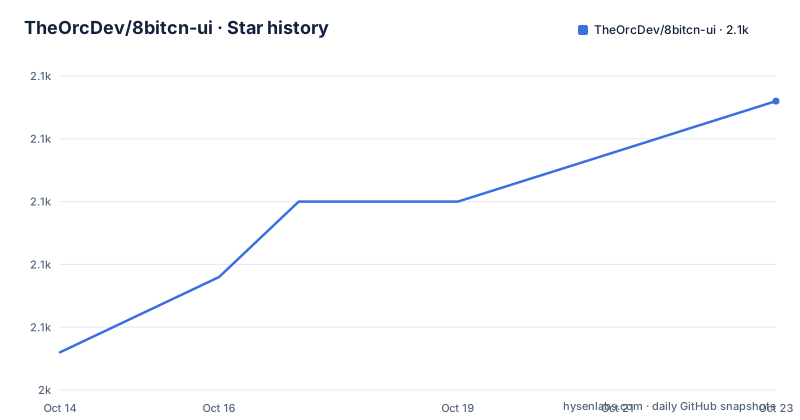
Star history
- TheOrcDev/8bitcn-ui2,059 ★ · +10
| Repository | 2026-10-14 | 2026-10-23 |
|---|---|---|
| TheOrcDev/8bitcn-ui | 2k | 2.1k |
10 Stars in the last 9 days, measured from the daily GitHub snapshot. Compare with other projects
Editorial analysis
Why copying the code changes who owns the component
8bitcn/ui presents itself as accessible retro components that you copy and paste into your apps: free, open source, built on shadcn/ui. Documentation sits on the project's own site at `8bitcn.com/docs`, split across pages for components, blocks and themes, with a Discord invite for support. The audience is narrow and easy to name, a React developer already inside the shadcn/ui workflow who wants pixel art without hand-writing the CSS.
The delivery model matters more than the theme. Nothing arrives as a runtime dependency. The component file lands in your repository, by convention under `components/ui/8bit`, and from that moment it is ordinary source compiled by your own bundler and editable by your own team. Retro styling here is a border and text treatment laid over accessibility primitives, not a separate rendering engine, and that framing decides most of what follows.
The repository is not archived, the last push was on 2026-09-30, and the code is offered under an MIT license, so dropping a component into a closed application raises no disclosure obligation.
The install command and the path alias it assumes
One command installs a component. `pnpm dlx shadcn@latest add @8bitcn/button` runs the shadcn CLI, resolves the namespaced name against the registry, and writes the files into your tree. The documented runner is `pnpm`, so npm, yarn and bun users reach for their own equivalent first.
pnpm dlx shadcn@latest add @8bitcn/buttonYou then import from your own directory rather than from a package:
import { Button } from "@/components/ui/8bit";

export default function App() {
  return <Button>Click me</Button>;
}
The one trap in this flow is the path itself. The README flags that `@/components/ui/8bit` assumes a configured alias, which the note calls common in Next.js and similar frameworks, and it tells you to adjust the import when your project structure differs. The command reports success on file copy, so a wrong alias surfaces later, when your build resolves an import that points nowhere. A `tsconfig.json` with the right paths entry is a precondition, not an afterthought.
The repository root is a Next.js site, not a package
Here is the detail a skim misses. The repository does not look like a component library at all. Its root `package.json` declares `"private": true` at version 0.1.0, which means the project publishes no npm package under its own name. The dependency list mixes twenty-six `@radix-ui/react-` primitives with `@neondatabase/serverless` at 1.1.0, `@creem_io/nextjs` at 0.6.0, four `@dnd-kit` packages and `@origin-space/image-cropper` at 0.1.9. Read together, that is a web application stack: a serverless database client, a payments integration, and an uploader for whatever the 8-bit site needs to accept.
The root listing agrees. There is `app/`, `db/`, `server/`, `drizzle.config.ts`, `content/`, `mdx-components.tsx`, `source.config.ts`, `next.config.ts`, `postcss.config.mjs`, `public/`, `pnpm-lock.yaml` and `tsconfig.json`. What the CLI installs is a byproduct of building a documentation and commerce site, not the output of a separate library build step, and the project description does call itself a code distribution platform.
That distinction changes what you are adopting. You are taking files from a storefront application, not from a published library with its own build, its own versioning scheme and its own compatibility matrix.
Agent config directories sit beside the component sources
The same root is wired for coding agents rather than for library consumers. Directories `.claude/`, `.cursor/` and `.opencode/` sit next to an `AGENTS.md` and an `opencode.jsonc`, with `plans/` and `artifacts/` for staging work in front of a model. `.husky/` and `.vscode/` confirm a working setup rather than a published artifact.
None of it travels. When the add command finishes, what reaches your project is the component plus whatever it imports, nothing more. Reading the tree tells you how the components are made, which is genuinely useful context, but the file you get is a snapshot taken at one moment, with no channel that announces when the snapshot has gone stale.
Husky, Ultracite and Biome guard a codebase you never install
The site does carry real quality gates, and they point inwards:
  "scripts": {
    "dev": "next dev",
    "build": "next build",
    "start": "next start",
    "test": "vitest run",
    "test:watch": "vitest",
    "perf:cold-home": "node scripts/benchmark-cold-home.mjs",
    "check": "ultracite check",
    "fix": "ultracite fix",
    "prepare": "husky"
  },
Two entries deserve a second look. `perf:cold-home` calls `scripts/benchmark-cold-home.mjs`, a benchmark for the site's cold home page rather than for a component. And the check and fix scripts delegate to `ultracite`, with a `biome.jsonc` file in the root as the configuration; that lint setup governs this repository and nothing in your app.
A `test/` directory and `vitest.config.ts` exist on the same terms. If you care how a retro button behaves after three rounds of your own edits, you inherit neither the harness nor the rules that would have caught the regression.
The accessibility claim rests on Radix, not on tests
Accessibility here is a dependency floor rather than a documented guarantee. Twenty-six `@radix-ui/react-` packages cover the interactive primitives a retro set needs, from dialog and dropdown-menu through select, tabs, tooltip and switch. `@radix-ui/react-slot` at 1.3.0 is among them, which is what lets a styled wrapper forward props onto whatever child you pass. Icons come from `@tabler/icons-react` at 3.44.0.
What is not on record is any conformance target, screen reader pass or keyboard pass for the 8-bit skins themselves. The claim on the page is the word accessible sitting in front of retro components, and the machinery underneath is Radix, so the distance between a pixel border and a visible focus ring is exactly where your own review has to happen. The documented install flow hands you no evidence either way, and the README does not document one.
For a team shipping a control to assistive technology users, that gap is the part to close before you paint anything retro.
One documented component hides the size of the registry
The distribution surface is wider than the README admits. Those documentation links cover `8bitcn.com/docs/components`, `8bitcn.com/docs/blocks` and `8bitcn.com/themes`, so block level compositions and themes exist as products alongside single components. Only one component name appears in the README, `@8bitcn/button`, paired with one import path.
The catalogue itself is not spelled out. A `registry.json` file at the root is the usual place for a shadcn namespace to declare what it serves, and the README does not document its contents, so you cannot audit what exists without reading that file or opening the site. A second, smaller inconsistency sits at the top of the repository: the homepage is recorded as `https://www.8bitcn.com/` while every link inside the README points at `https://8bitcn.com`. Harmless in a browser, worth knowing before you script a check against either address.
Copy-paste ownership removes the upgrade path npm gives
The difference from a package dependency is ownership. Install a component from npm and a lockfile pins a version, someone else applies the patches, and an update command moves you forward. Copy one out of a registry and the code belongs to you at that instant; the original can change tomorrow and your tree will not hear about it. The `pnpm-lock.yaml` in this repository pins the site, not the components it hands out.
That trade suits a hero button and fails a form with twenty fields. Outside the commit history there is no record of what changed in a dialog component, there is no deprecation path, and there is no version to pin. Projects that need coordinated upgrades across many components, or that treat a UI library as a dependency worth scanning during a supply chain review, get a worse deal from copy and paste. Projects that want 8-bit styling and accept owning the resulting file are exactly who this was built for.
Editorial conclusion
Adopt 8bitcn/ui when you already run the shadcn/ui workflow and want 8-bit styling you own outright, which fits a hero section or a settings panel faster than hand-written CSS. Pass on it when components must be patched centrally, audited as dependencies, or upgraded on a schedule, because copy and paste gives you a file with no version channel. Verify first that `shadcn@latest add @8bitcn/button` resolves in your project and that your `tsconfig.json` alias matches the documented `@/components/ui/8bit` import.
Frequently asked questions
How do I install the 8bitcn/ui button component?
Run `pnpm dlx shadcn@latest add @8bitcn/button`, then import it from `@/components/ui/8bit`. The README notes that this import path assumes your project already has a path alias configured, so adjust it if your structure differs.
Can I use 8bitcn/ui components in a commercial application?
The repository carries an MIT license at `license.md`, and the project describes the components as free and open source. The components are copied into your own code rather than linked as a dependency.
Does 8bitcn/ui publish an npm package I can add to package.json?
No. The repository's own `package.json` is marked private at version 0.1.0, so components reach you through the shadcn CLI and its registry instead of a published package.
How many components does 8bitcn/ui have?
Only one component name, `@8bitcn/button`, is named in the README, and the docs site splits its catalogue into components, blocks and themes pages. The full set of `@8bitcn` names is not enumerated in the README.
Does 8bitcn/ui replace shadcn/ui?
It is built on shadcn/ui rather than replacing it. The install command runs `shadcn@latest add @8bitcn/button`, so the same CLI serves both the upstream components and the retro ones.
What linting and testing tools does the 8bitcn/ui repository use?
Its `package.json` maps `test` to `vitest run` and `check` to `ultracite check`, with a `vitest.config.ts` and a `biome.jsonc` file in the repository root. These guard the project's own site code, not the files you copy out.
Official sources
Add this badge to your README
If you maintain this project, the badge below links readers to this analysis and shows its maintenance status from the daily GitHub snapshot. Paste the markdown into your README; add ?metric=license or ?metric=stars to the image URL for a different field.

[](https://hysenlabs.com/projects/theorcdev-8bitcn-ui)Star history chart for your README
[](https://hysenlabs.com/projects/theorcdev-8bitcn-ui)Was this useful?