AgentsMeetRL: an awesome list that admits it was written by coding agents
Awesome List for Agentic RL
At a glance
- What is it?
- thinkwee/AgentsMeetRL catalogs open source repositories for training LLM agents with reinforcement learning, across sixteen categories and a separate axis for reward types. Selection was done by LLM coding agents reading code, plus manual review, and the list says so, including the possibility of unfaithful cases.
- Who is it for?
- AgentsMeetRL is useful as a map of where agentic reinforcement learning code actually exists, and its update log is the part with real information in it: how many repositories were added each month, which categories stayed empty, and which papers were held back because the code was not out. It is not a paper index and not a leaderboard, and the maintainer says the corpus may contain unfaithful entries.
- Can I use it commercially?
- Not without permission. GitHub finds no licence file in the repository, and without a licence all rights are reserved by default: you may read the code but not reuse it. Check the README, or ask the authors, before using it.
- Is it still maintained?
- Yes. The repository last received commits 9 days ago.
- What is it written in?
- Mainly HTML, according to GitHub's language statistics.
Answers come from the project's GitHub data, last synced on November 15, 2026, and from our analysis. They are not legal advice.
Star history
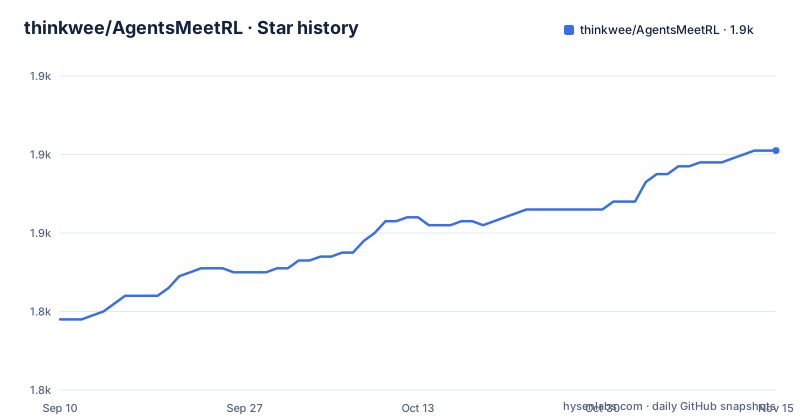
- thinkwee/AgentsMeetRL1,881 ★ · +43
| Repository | 2026-09-10 | 2026-11-15 |
|---|---|---|
| thinkwee/AgentsMeetRL | 1.8k | 1.9k |
43 Stars in the last 66 days, measured from the daily GitHub snapshot. Compare with other projects
Editorial analysis
Entry criterion: multi-turn interaction or tool use
The filter is stated in one sentence and it is a specific one. A repository qualifies if it has at least one of two things: multi turn interaction, or tool use. Projects built around Tool-Integrated Reasoning are therefore in scope, since tool calls are what the second half of the criterion covers. That criterion is what separates this list from a generic reinforcement learning survey, and it is also what makes the omissions legible: a project that only does supervised fine tuning on single turn data does not belong here. The stated emphasis is on the infrastructure underneath those projects, meaning the reinforcement learning frameworks, the algorithms, the reward designs and the environments they depend on, with a technical details view available under each table so an entry is meant to be read rather than skimmed.
The corpus was built by reading code with coding agents
This is the part of the project a reader should know before trusting any entry, and it is stated plainly rather than buried. The list is based on code analysis of open source repositories performed with LLM coding agents, and the text warns that this may contain unfaithful cases. Manual review follows that automated pass, and the remaining risk called out is omissions rather than false positives. Contributions are invited in the same breath, through issues or pull requests, so the intended correction loop is external to the project. Two consequences follow. A repository can appear because an agent read its code and inferred a training loop, which is evidence rather than proof. And the maintainer is effectively asking readers to audit, which is a reasonable arrangement for a list of this size but means an entry's presence is weaker evidence than its absence would suggest.
Sixteen categories, one of which is still being defined
The taxonomy is the main structure and it was reorganised rather than grown. The March update moved it from twelve categories to sixteen: Multi-Agent RL, Reward & Training, Safety, VLM Agent, Self-Evolution and Domain-Specific were added, GUI was merged into Web & GUI, and TextGame and Biomedical were retired. The current set runs from Base Framework, described as general purpose reinforcement learning training frameworks, through Search & RAG, Web & GUI, Tool-Use, Code & SWE, Reasoning, Multi-Agent RL, Memory, Embodied, Domain-Specific, Reward & Training, Safety and VLM Agent, to Self-Evolution and Environment, the last covering benchmarks, gyms and sandboxes. Self-Evolution carries a marker saying its definition is still evolving in the community, which is an admission that the category boundary is unsettled rather than merely young.
Reward type is a second axis, not a category
Alongside the categories there is a separate enumeration of reward types, and it is the part most directly reusable by someone designing an experiment. An external verifier is one where something outside the model decides, a compiler or a math solver being the examples given. A rule-based reward is scored by parsing, with a LaTeX parser scored by exact match offered as the case. A model-based reward comes from a trained verifier or reward model. Custom is the fourth slot, left open. Keeping this out of the category tree is a deliberate choice with a practical effect: two repositories in the same category can have nothing in common about how they tell the model it was wrong, and the reward axis is what exposes that. It is also the axis a reader is most likely to use when choosing what to build on.
The monthly update log is where the information is
Six update entries are spelled out, with counts. April 2026 added 67 repositories covering the year to date, May added 17, June added 43 across eleven categories, July added 13, and August added 23 across nine categories. March was the structural month: the taxonomy was rebuilt and roughly 70 repositories were added, taking the total from about 134 to 205. The August entry also records a negative result worth as much as the positive one: no qualifying new Safety, Embodied or Multi-Agent RL repositories appeared in that window, because that crop of work was uniformly supervised fine tuning only, inference only, or code withheld. A list that can say which of its categories had nothing new is doing something different from padding a count, and that is the signal to weigh when reading any single month.
Papers without code are held in an under review pile
There is a second list for work that does not yet qualify, and the named exclusions are specific enough to be useful. In August the held items were Qwen-UI-Agent, Qwen-CUA, UI-Mate, SearchMaster, RoMeRL, Agon, SINKFLEX-RL, GRASP, MAVEN, EviBack and ChemWorld, all excluded because their code was still unreleased. July held EvoCUA-1.5, DeepSearch-World, CompactionRL, GUICrafter, VideoSearcher and Xiaomi-GUI-0 for the same reason, and May moved CoEvolve into that state. The August entry also records a promotion in the other direction: MUA-RL moved out of under review after its code turned out to have been public since 2025.8. So the under review pile is a live queue rather than a graveyard, and a project missing from the main tables today may appear in a later window with no paper attached.
The corpus is also a Claude Code skill, and no licence is recorded
Two things sit outside the tables. First, the list is packaged as a Claude Code skill called agents-meet-rl, under a skills directory with a plugin manifest directory beside it, which turns the corpus into something an assistant can consult on demand. The failure modes it advertises are the practical ones from training runs: a reward that will not move, KL divergence, entropy or length blow-ups, GRPO, PPO and DAPO knobs, retokenization drift, tool call parse failures, long horizon credit assignment, inconsistent LLM judges and benchmark contamination. Second, and less comfortably, the repository records no licence at all and there is no LICENSE file in its tree, while a CITATION.cff exists and a sidebar button asks readers to cite it. So the material is citable but its reuse terms are unstated. The dates tell the same story twice: the list says last updated 2026-08-26, the branch was pushed 2026-09-15, and there are no releases.
Editorial conclusion
AgentsMeetRL is useful as a map of where agentic reinforcement learning code actually exists, and its update log is the part with real information in it: how many repositories were added each month, which categories stayed empty, and which papers were held back because the code was not out. It is not a paper index and not a leaderboard, and the maintainer says the corpus may contain unfaithful entries. Before you use it, check three things. Whether an entry is under review or confirmed, since papers without released code are tracked separately. Whether the category means what you think, since one of them is marked as still having an unsettled definition. And what you can reuse, because the repository records no licence and has no LICENSE file in its tree, so treat the list as a pointer to other projects rather than as text you can copy.
Frequently asked questions
What is AgentsMeetRL?
It is an awesome list summarizing open source repositories for training LLM agents with reinforcement learning, published as a README and as a site at thinkwee.top/amr. Entries are grouped into sixteen categories, and each table has a technical details view for the frameworks, algorithms, rewards and environments a project depends on.
What gets included in the AgentsMeetRL list?
A repository qualifies if it has at least one of multi-turn interaction or tool use, which is why Tool-Integrated Reasoning projects are in scope. The corpus was assembled by code analysis with LLM coding agents and then manually reviewed, and the project warns it may still contain unfaithful cases and omissions.
Can I submit a project to AgentsMeetRL?
Yes, through an issue or a pull request, and contributions of projects are welcomed at any time. Papers whose code is not yet released are deliberately held outside the main tables and tracked separately as under review, so a project can move in once the code appears.
What can I do with the AgentsMeetRL repository itself?
It records no licence and carries no LICENSE file, although it does include a CITATION.cff and a button asking readers to cite it. Treat the list as a pointer to other projects and check the licence of anything you reuse from it directly.
Official sources
Add this badge to your README
If you maintain this project, the badge below links readers to this analysis and shows its maintenance status from the daily GitHub snapshot. Paste the markdown into your README; add ?metric=license or ?metric=stars to the image URL for a different field.

[](https://hysenlabs.com/projects/thinkwee-agentsmeetrl)Star history chart for your README
[](https://hysenlabs.com/projects/thinkwee-agentsmeetrl)Was this useful?